
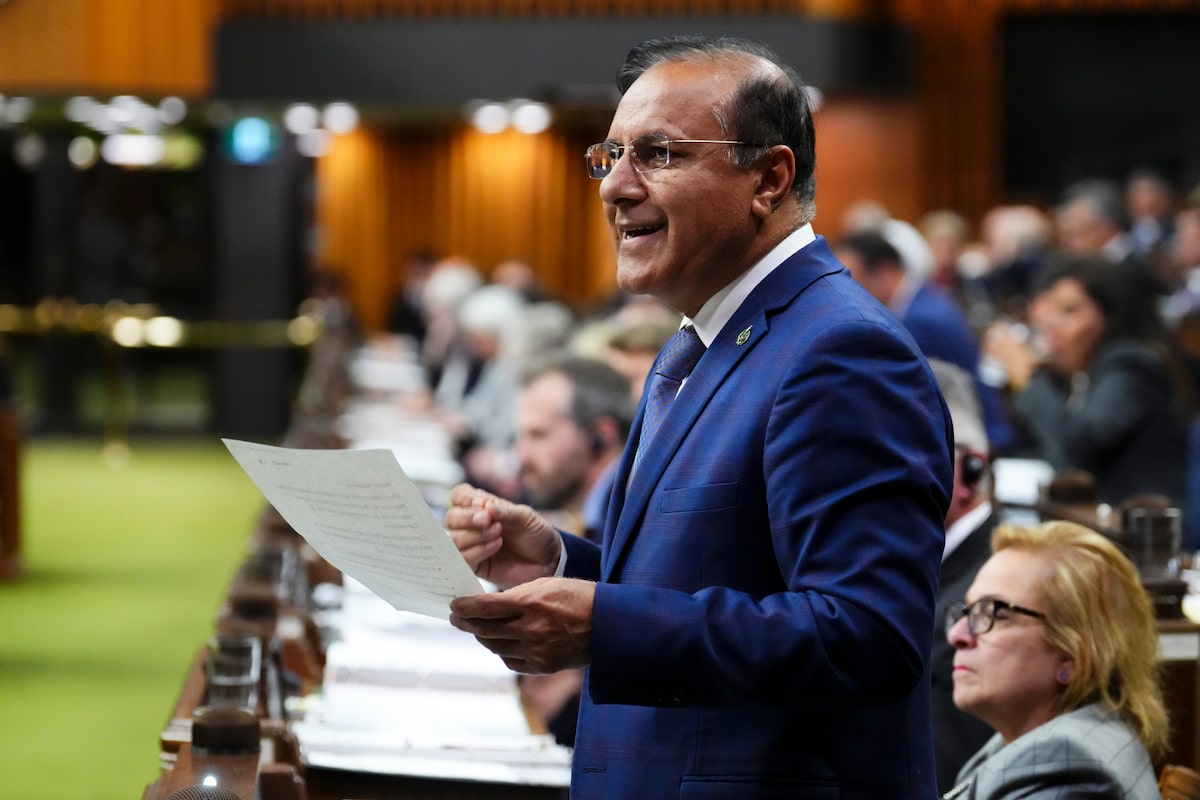
Treasury Board President Shafqat Ali announced on Thursday plans to shift nearly $1-billion from public-service pension fund to the government’s general revenues.Sean Kilpatrick/The Canadian Press
The federal government is shifting nearly $1-billion in surplus funds from the public-service pension fund into general revenues, a move that is legally allowed but sharply criticized by unions.
It is the latest step in a plan first announced in the Nov. 4 federal budget to use surplus pension funds to offset the cost of a $1.5-billion early retirement incentive as a way of shrinking the size of the public service.
Treasury Board of Canada President Shafqat Ali announced the decision Thursday afternoon. He said in a statement that independent actuarial reports show the public-service pension fund remains well managed and sustainable.
The Public Service Superannuation Act states that the size of the pension’s funded ratio cannot exceed 125 per cent. The minister said the fund is at 125.5 per cent, meaning there is an excess surplus of “approximately $0.9-billion” as of March 31, 2025.
The government intends to transfer the non-permitted surplus to the consolidated revenue fund, a central government bank account, where it will be held along with last year’s non-permitted surplus. He said discussions with stakeholders about how those funds will be used “will be held as appropriate.”
“Once the transfer is made, there will no longer be a non-permitted surplus in the fund,” the minister said.
However, the government announced an early retirement benefit in the budget that it said would be funded from the Public Service Pension Fund. The budget said the incentive would cost $1.5-billion and generate continuing savings of $82-million a year.
On Thursday, the government also released a report from the Office of the Chief Actuary showing the effect of the budget announcements on the public service pension fund. The report, dated Nov. 6, estimates the early retirement incentive will have an actuarial impact on the pension fund of $1.8-billion.
It says there is “significant uncertainty” as to how many public servants will accept the early retirement incentive but assumes 25 per cent of eligible members will do so and retire. If that number were to climb to one-third, the liability cost would rise to $2.8-billion. The report said such a cost would result “in a funded ratio of 124.8 per cent and no non-permitted surplus.”
The size of the core public service reached a peak of 367,772 employees in 2024 before falling to 357,965 this year. The budget announced a plan to reduce it by about 30,000 people over five years, in addition to a recent cut of about 10,000 jobs. Letters were recently sent to approximately 68,000 public servants to inform them that they may be eligible for the early retirement incentives.
Typically, an employee who retires before meeting age requirements faces a permanently reduced pension of 5 per cent for each year of early retirement. The incentive would waive the penalty.
In a news release, the Treasury Board said the public pension plan is fully guaranteed by the Government of Canada. It notes that the government is required to top up the fund in the event that it falls into a deficit. This situation occurred between 2013 and 2018, when $2.8-billion in deficit payments were made to the fund.
Last year, Ottawa collected a $1.9-billion non-permitted surplus from the fund.
Sean O’Reilly, president of the Professional Institute of the Public Service of Canada, said in a statement that it is alarming to see the government treat the pension surplus “as a piggy bank it can access at will.”
The union said surpluses should be used to strengthen the plan, either through a joint contribution holiday or by improving benefits.
“Using workers’ own pension surpluses to finance their departure sets an extraordinary and dangerous precedent,” he said. “It risks hollowing out the public service at precisely the wrong moment. No employer should ever be permitted to unilaterally appropriate workers’ deferred compensation and repurpose it for its own purposes.”
The Public Service Alliance of Canada has also long criticized the practice of shifting surpluses into general revenue, and promotes a “stop pension theft” campaign.
“Workers and employers contribute together to the pension fund. So why should only the government get a break?” the union says on its website. “Pensions are sacred, and poaching pension funds from federal government workers and retirees sets a dangerous precedent for other employers in Canada who may be encouraged to do the same.”
PSAC has previously estimated that Ottawa is planning to collect $9.3-billion from the pension surplus between 2024 and 2027.
“PSAC will oppose any attempts to unilaterally allocate these funds,” the union said.