
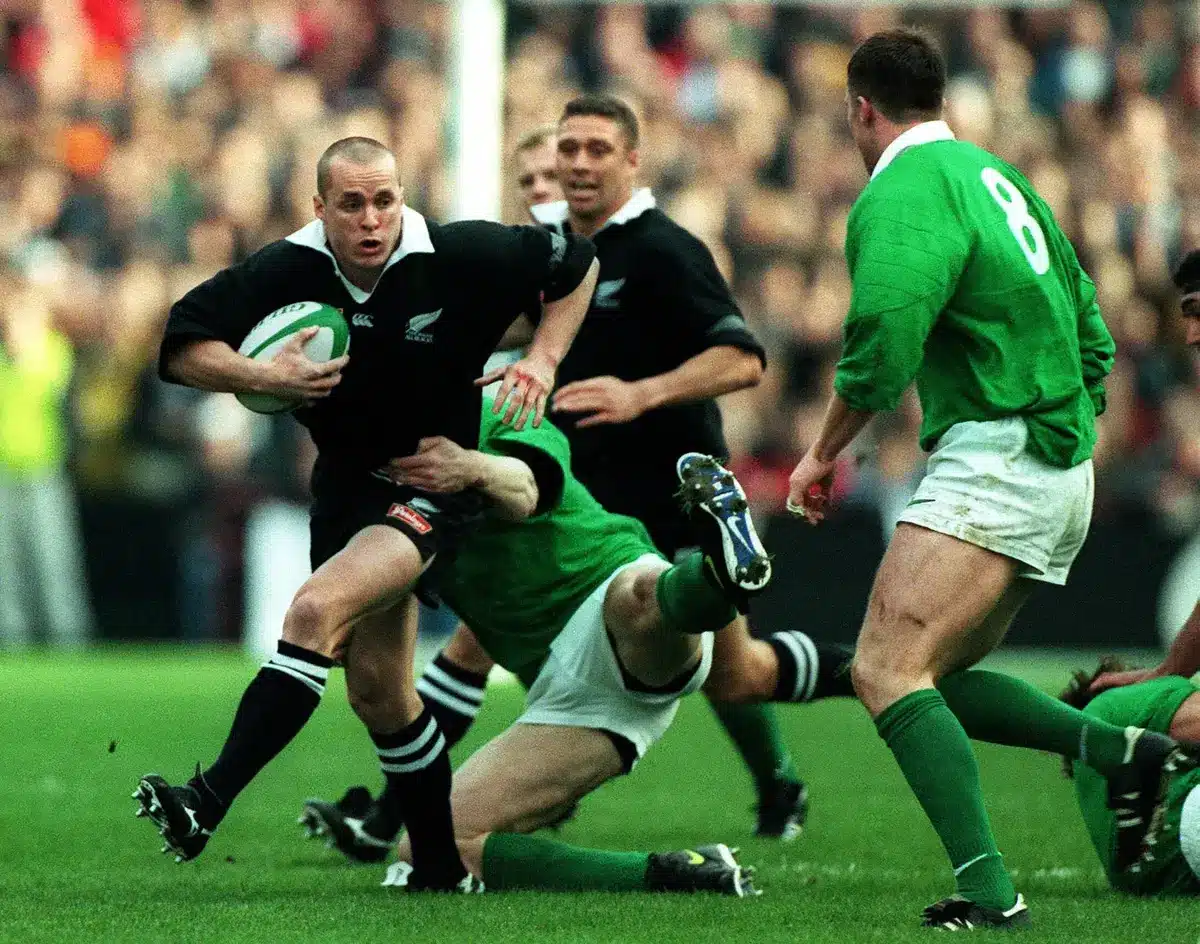
From last lines of defence to first sparks of attack, the fullback has long been one of rugby’s most influential positions. The greatest to wear 15 combined courage under the high ball with vision, pace and the ability to change games in a heartbeat.
Join the RUCK’s WhatsApp community here and get the latest news sent straight to your messages.
This list looks back at the finest fullbacks rugby has ever produced and the legacies they left behind.
10 Percy Montgomery (South Africa)
For more than a decade, South Africa’s backfield was anchored by a figure of calm authority and unwavering reliability. Retiring in 2008 as the Springboks’ most-capped player and highest points scorer, Percy Montgomery’s legacy was built on consistency rather than flash. His left boot was famously accurate, but his true value lay in his composure under pressure, positional intelligence and defensive assurance.
Montgomery’s defining chapter came at the 2007 Rugby World Cup, where he finished as the tournament’s leading points scorer and played a central role in South Africa’s march to the title. Rarely spectacular but relentlessly effective, he embodied control and discipline, proving that greatness at fullback can come from precision, patience and unshakeable nerve.
9 Andy Irvine (Scotland)
Few players did more to redefine Scotland’s attacking ambition from the back than Andy Irvine. Operating at fullback throughout the 1970s and early 1980s, he combined blistering pace with incisive running lines that constantly unsettled defences. Winning 51 caps and captaining his country 15 times, Irvine was as influential as he was exciting.
His three British & Irish Lions tours further showcased his quality, particularly in 1974, where his points tally bordered on the extraordinary. Even when not in possession, his presence alone drew defenders and created space elsewhere. Regularly cited among Scotland’s greatest ever players, Irvine remains a benchmark for attacking fullbacks who play with freedom and confidence.
8 André Joubert (South Africa)
Grace, power and control defined one of the smoothest fullbacks rugby has ever seen. André Joubert earned the nickname “The Rolls-Royce of Fullbacks” thanks to his effortless running style and impeccable positional sense. Though capped only 34 times, his influence peaked at the 1995 Rugby World Cup, where he was outstanding throughout the tournament. His performance in the final against New Zealand, played despite a broken hand, has become legendary.
Joubert chose his moments carefully, punishing opponents with devastating efficiency rather than constant involvement. His ability to blend elegance with toughness made him the ideal big-match player, and his reputation far outweighs the modest length of his international career.
7 J.P.R. Williams (Wales)
No fullback played with more visible ferocity during the 1970s than Wales’ iconic J.P.R. Williams. Instantly recognisable with his sideburns and socks around his ankles, he attacked the game with the mindset of a forward and the skill of a back. Fearless in contact and relentless in pursuit, Williams thrived in counter-attack and defence alike.
A three-time Grand Slam winner, he was a central figure in Wales’ golden era, setting standards for commitment and intensity. Despite playing his entire international career at fullback, his heart often leaned toward the back row. Intelligent, uncompromising and fiercely competitive, JPR became a symbol of Welsh rugby’s swagger and resolve.
6 Chris Latham (Australia)
Versatility and intelligence marked the career of one of Australia’s most complete backline players. Across 78 Tests, Chris Latham proved equally effective as a runner, organiser and tactical kicker. His 40 international tries place him among the Wallabies’ most prolific finishers, while his ability to step in as a secondary playmaker added another dimension to Australia’s attack.
Latham featured at three Rugby World Cups, with his five-try performance in 2003 standing out as a personal highlight. In 2006, his all-round influence was recognised with the John Eales Medal. Whether wearing 15, 14 or 13, Latham delivered composure, skill and consistency at the highest level.
CONTINUES ON PAGE TWO
Like this:
Like Loading…