
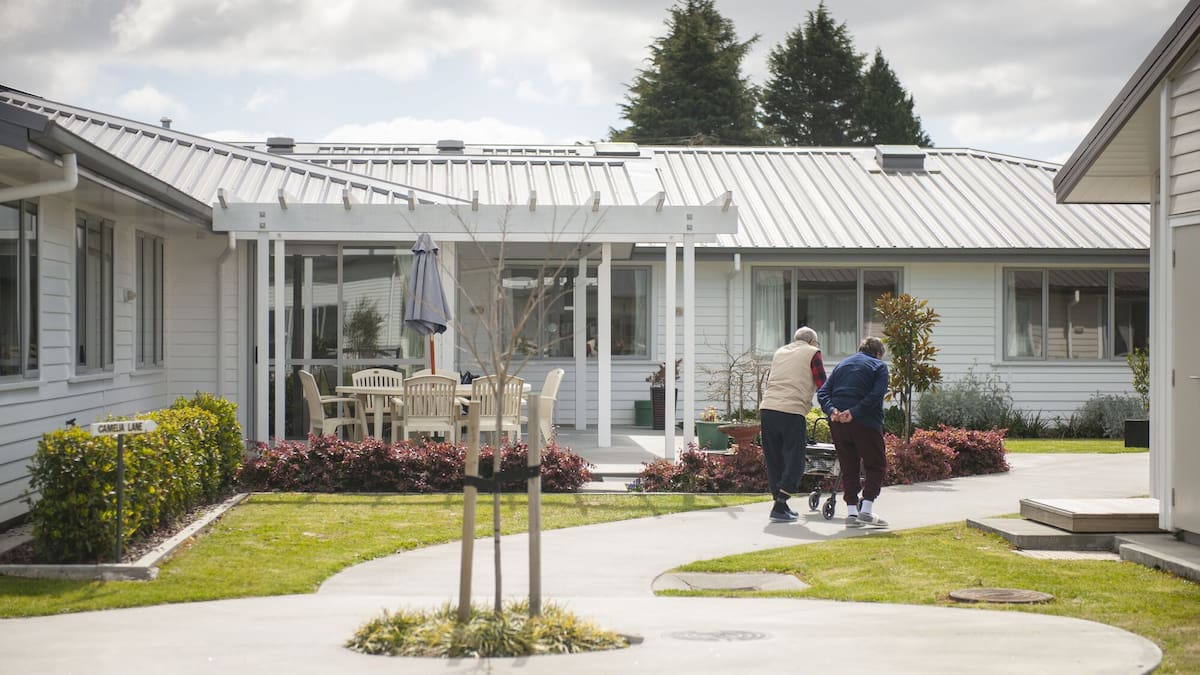
What’s special about the CARE Village is that residents live in households of six people grouped by lifestyle similarities, rather than the level of care they need.
One advantage of this is if they move in at rest-home level and deteriorate to secure-level dementia, they do not need to move.
Care staff work in the homes all-hours. Cooking and laundry are done in each home, allowing residents to participate if they wish.
Parliament’s health select committee last month recommended the Government consider enabling “alternative aged care models” similar to the CARE Village.
The committee’s report on its inquiry into the aged care sector’s capacity to support people with neurological cognitive disorders said the “non-institutional setting” could improve residents’ and families’ experiences.
It said the CARE Village was the second facility worldwide after De Hogeweyk Dementia Village in the Netherlands “to pioneer a new approach” to aged care that challenged the traditional models of rest home, hospital and secure care levels.
The report said 17% of New Zealand’s population was aged 65 or older. This was expected to reach 25% by 2040.
CARE Village chief executive Thérèse Jeffs told the Rotorua Daily Post it was formerly Whare Aroha Care and on land owned by Pukeroa Oruawhata Trust.
When their lease ended, the board wanted to find another site to build on, she said.
Jeffs, who was doing consulting work, believed it should be built differently from the institutional model.
She learned of the De Hogeweyk model and visited the village in the Netherlands about 11 or 12 years ago.
“We became convinced that this was the right way forward.”
Jeffs said the village had 13 houses for 81 residents. They lived with those of a “similar lifestyle” – with groups for formal, cultural, simple or “middle New Zealand” living.
CARE Village had been operated since 2017 by the not-for-profit Rotorua Continuing Care Trust.
The CARE Village in Ngongotahā overlooks Lake Rotorua. Photo / Megan Wilson
Aged Care Association chief executive Tracey Martin said she took the select committee to CARE Village “to show how far care for those with dementia has come”.
Martin said the model could be replicated in many different ways, for example, as apartment-style living in multi-storey buildings.
“The key is an accurate understanding of the person needing the care, their past and present. How they interact with others and so on.”
Martin said it was not suitable for anyone with violence as part of their condition response as it put other residents at risk.
“Everything about this model is grounded in an appropriate funding model and a more honest holistic assessment process to ensure the service fits the person.”
Committee chairman and Tauranga MP Sam Uffindell said the village was an “outstanding setting, based on the concept of giving people in need of care the opportunity to go about their normal life”.
“Residents appeared to have a greater sense of dignity and freedom.”
Uffindell said the model could be rolled out further nationally.
“I would strongly encourage suitable providers to work closely with the CARE Village to identify and provide future opportunities.”
The CARE Village in Rotorua. Parliament’s health select committee recommended the Government consider enabling “alternative aged care models” similar to how the village works.
He would like to see the model used in Tauranga, where the proportion of population aged 65 and older was 20% at the last Census – greater than the national average of 17%.
“Everyone wants to see our elderly folks live with care, dignity and respect and this model offers families a unique choice where their loved ones can thrive in their later years.”
Health NZ ageing well acting director Mark Powell said the Government was considering the committee’s findings.
While New Zealanders generally had access to services that provided a good standard of care, reviews of aged care had highlighted challenges, he said.
They included an “outdated” funding model that did not support aged care providers to sustain service levels or to invest and build new services, and there being “no cohesive and integrated” system that provided the care people needed at the right time and place, Powell said.
Access to services could be inconsistent and inequitable, differing across groups of people and nationally.
Powell said Health NZ welcomed innovation in aged care and had contracts with several other aged residential care providers delivering “unique models of care”.
Providers interested in developing similar services could contact Health NZ’s regional ageing well teams.
Powell said the Government was establishing a Ministerial Advisory Group to provide independent advice to ministers on the aged care system.
Work was expected to begin by the end of January and the group would report back with recommendations by the middle of next year.
Megan Wilson is a health and general news reporter for the Bay of Plenty Times and the Rotorua Daily Post. She has been a journalist since 2021.