
It was obvious to everyone and everything apart from his immune system.
The antibodies tasked with defending his body were blind to the cancer, flailing in the dark, unable to recognise the threat.
The cancer travelled freely, unseen by the one system designed to stop it.
Then, in China, Oxenham’s immune system was made to see – and it went to work.
Three months on from his CAR T-cell therapy, Oxenham is in remission – as close to cancer-free as he can be.
Instead of scans lighting up like a dreaded festive show, they now reveal only innocuous black-and-white body parts.
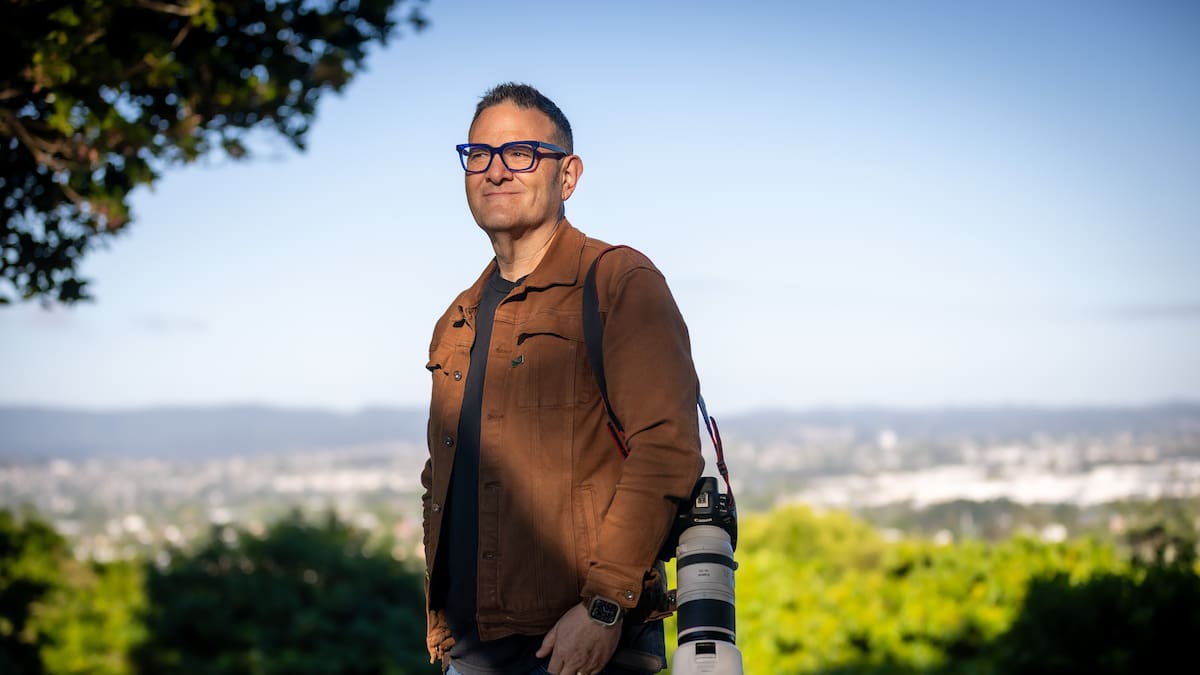
Former New Zealand Herald photographer Jason Oxenham. Photo / Michael Craig
Oxenham keeps his feet on the ground, playing it cool – he knows the myeloma can come back. He lets others express the emotion.
“Some people on the phone were in tears. Just so much joy given for the journey we’ve been on, especially over the trials we had in Shanghai.
“So yeah, that was important to me, letting people know, because they’ve been so supportive while we’ve been going through this challenge.”
The Herald visited Oxenham in August on his return from China, as tests showed his re-engineered immune cells were tearing into the cancer he had lived with for the past five years.
“Last time we spoke, you know, I wasn’t quite sure if I was prepared to say I’d been an advocate for CAR T[-cell therapy].
“My results are still rolling in, and even weeks and weeks after returning from Shanghai, the numbers are still dropping. The markers in my blood are at zero – undetectable – so that’s mind-boggling.
“So when people ask me now, I’m prepared to say it’s worth trying if you can afford it.
“But we’re in a difficult situation where there’s no funding for this here.”
For many New Zealand patients with cancers such as multiple myeloma, access to groundbreaking treatments like CAR T-cell therapy remains extremely limited.
Outside a small number of trials, the only realistic option is to seek treatment overseas – in countries such as the United States where costs can approach $1 million, or in more affordable countries like Israel, India and China, though the financial outlay still runs well into the hundreds of thousands of dollars.
Earlier this year, when Oxenham was weighing up his options, he openly questioned whether the monetary risk was worth it, knowing that CAR T-cell therapy does not work for everyone.
He was aware of other people with myeloma who had travelled overseas seeking the treatment, absorbed the financial burden, but without a successful outcome.
It was at the insistence of his wife and daughters that they stretch their finite funds and he flew to China.
“It’s a shame that patients have to go to such extents – cashing up KiwiSaver, fundraising, flogging stuff off – just to stay alive.”
A nurse holds Jason Oxenham’s infusion bag of re-engineered T-cells.
Photo / Jason Oxenham
Chimeric Antigen Receptor T-cell therapy – it sounds like science fiction.
First, doctors harvest T-cells – the soldiers of the immune system – from a patient’s blood.
Those cells are genetically re-engineered to recognise a specific marker on cancer cells they had previously been blind to, then infused back into the patient’s body.
It is not like chemotherapy, which is essentially poisoning the body in the hope of killing the disease faster than the patient.
Instead, it is a targeted response because the immune system now sees the cancer and attacks it directly.
The development of these types of treatments is a game changer, says Dr Rodger Tiedemann, an associate professor at the University of Auckland.
“The immune system is an incredible thing, and once you unleash it in a way that it can recognise the cancer, it can be very, very effective.”
Dr Rodger Tiedemann, associate professor of medicine at the University of Auckland and consultant haematologist. Photo / Jason Oxenham
Advances in immunotherapy treatments are rapid.
A new step in CAR T-cell re-engineering involves doing it in the body, eliminating the need to harvest or infuse cells.
Tiedemann works on bispecific antibodies — proteins that “glue” a T-cell to a cancer cell, guiding the immune system’s soldiers directly to their targets.
“It used to be that new companies were bringing out new drugs or small molecules for cancer treatment. But in myeloma nearly all new treatments are now immunotherapies, and for many patients they have fewer side effects,” explains Tiedemann.
“The progress is accelerating, and I don’t see that changing any time soon.”
CAR T-cell therapies target blood cancers, including lymphoma, myeloma and leukaemia.
More than 20,000 New Zealanders are living with one of these diseases, including around 3000 people with multiple myeloma.
Myeloma is incurable and relapsing – something Oxenham knows all too well.
Over the past five years, he has undergone repeated rounds of treatment as the disease diminished and then inevitably returned.
His treatment has included multiple drug regimens, brutal rounds of chemotherapy, and a stem cell transplant.
“I’ve been on this journey for a while. I’ve been cancer-free before,” remarks Oxenham.
In New Zealand, there are far fewer publicly funded treatment options than in countries such as Australia and the UK, and patients and clinicians continue to call for improved access.
The strongest push has been for the drug daratumumab, which is funded in 49 countries but not publicly available here.
While daratumumab can be accessed privately, it costs around $240,000 in the first year alone – a price comparable to CAR T-cell treatment in China, which is a one-off cost and helps explain why some patients see overseas therapy as a valid option.
A spokesperson for Myeloma New Zealand said all blood cancer treatments needed to be well-researched and considered.
“We certainly as an organisation can’t recommend anything [CAR T-cell] because they’re all just too new, the data isn’t there and each person is different as well.
“With myeloma, people can respond quite differently. You can have quite a different disease, and so what works for one won’t work for another.”
There is no funded CAR T-cell therapy in New Zealand, but there are moves to change this.
The Malaghan Institute, which is currently running CAR T-cell clinical trials for lymphoma patients and hopes to expand the approach to diseases such as multiple myeloma, is now building the foundations to deliver the therapy in New Zealand, said general manager Mike Zablocki.
Malaghan Institute general manager Mike Zablocki. Photo / Sophie Trigger
In partnership with Bridgewest Ventures, the institute has established a start-up company, BioOra, which will manufacture and distribute CAR T-cell treatments.
They were building the infrastructure to make homegrown CAR T-cell therapies possible as well as allowing overseas providers to come in and offer options, he said.
“We just want to be able to lower the barriers for CAR T-cell therapies to come here.”
Introducing CAR T-cell into the health system would mean no direct cost to patients. There would be an upfront cost to the system but it would be offset by downstream savings, he said.
“Because the beauty of CAR T-cell therapy, when it works, is that you’re treated and that’s it. You don’t have ongoing hospitalisation costs.”
In a best-case scenario, Zablocki said CAR T-cell therapy could be available in New Zealand by late 2027, though he acknowledged the timeline depended on factors outside Malaghan’s control.
In May, photographer Jason Oxenham examines the space for his upcoming fundraising exhibition Light+Shade. Photo / Michael Craig
Earlier this year, when the Herald published Oxenham’s story about his treatment in Shanghai and the fundraising photography exhibition he organised called Light+Shade, numerous people got in touch to ask about his treatment or share their own experiences.
He was happy to share his knowledge. Word of mouth and shared stories was one way patients learned about treatments like CAR T-cell therapy.
“I was really lucky that another friend of mine who battled myeloma – unfortunately, he’s passed – but I’ve kept in touch with his wife, sister and family, and they gave me the contact for professor Ho in Shanghai.
“I’m not sure where I’d be today if I didn’t have that introduction.”
Compared with when he arrived home after nine weeks in China, Oxenham’s colour is vibrant and his fitness continues to improve.
He is back on the tools – taking photos, producing video and doing the creative work that has always been his passion. Before China, Oxenham did not think he would ever have the energy to work professionally again.
His main focus is to be the best friend, husband and dad, and some mornings he wakes blissfully unaware of the cancer that for years filled his horizon.
“I feel I’m starting to move away from that intensity, that being hyper-focused on treatment.
“You know, I feel like we’ve won the battle.
“We might not have won the war, but we’re winning the battle.
“And that’s a pretty good place to be, to be honest.”
Mike Scott is an award-winning visual journalist with more than two decades’ experience telling stories across multiple media platforms.
Sign up to The Daily H, a free newsletter curated by our editors and delivered straight to your inbox every weekday.