
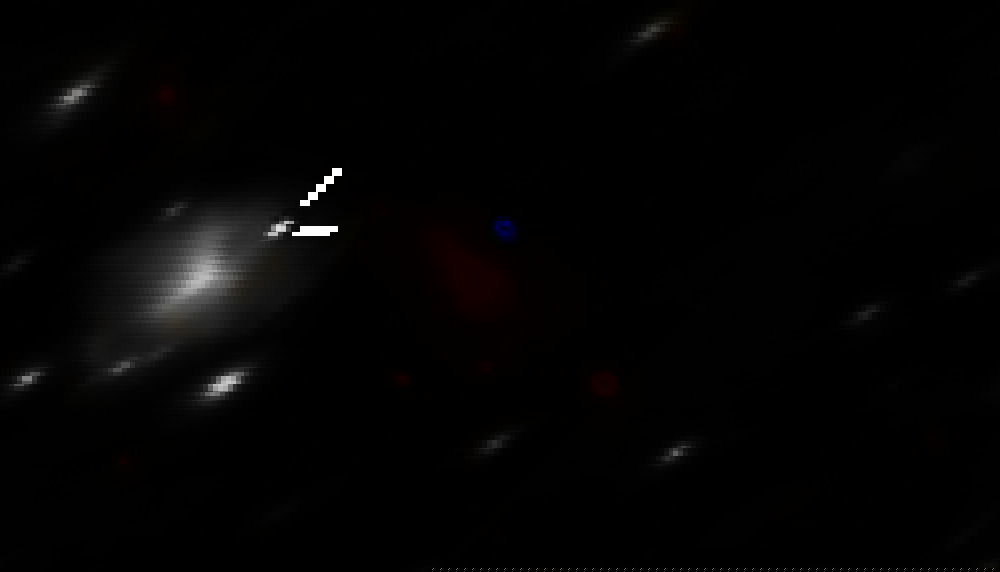
Unusual blue and ultraviolet bursts called luminous fast blue optical transients (LFBOTs) have been studied by astronomers for a decade, but recent analysis reveals that the leading theories of their origin were incorrect.
As the mysterious flashes known as LFBOTs fade, they leave faint X-ray and radio emissions behind that astronomers can study. Until now, however, researchers have suspected that they resulted from gas inflating into a black hole or from an unusual variety of supernova.
Powerful Black Holes
Now, astronomers at the University of California, Berkeley, have revealed the cause: a black hole, perhaps 100 times the mass of the Sun, consuming its companion star within a span of just a few days. Their research illuminates how much astronomers can learn from the light signatures of cosmic events, providing new context for their observations of black holes and stellar evolution.
The work was revealed in two new papers forthcoming in The Astrophysical Journal Letters, based on an event designated AT 2024wpp.
Black holes of such tremendous mass remain a mystery to scientists, with the mechanism of their enormous growth still unknown. They have never been directly observed, but the Laser Interferometer Gravitational-Wave Observatory (LIGO) and other gravitational-wave experiments have detected their mergers.
Now, the UC Berkley team says that their new research may offer insight into the lingering questions about these massive black holes.
“Theorists have come up with many ways to explain how we get these large black holes, to explain what LIGO sees,” said Raffaella Margutti, UC Berkeley associate professor of astronomy and physics. “LFBOTs allow you to get at this question from a completely different angle.
“They also allow us to characterize the precise location where these things are inside their host galaxy,” Margutti said, “which adds more context in trying to understand how we end up with this setup—a very large black hole and a companion.”
Luminous Fast Blue Optical Transients
The aptly named LFBOTs are so luminous that their light carries for up to several billion light-years, despite their short duration. Astronomers observed an LFBOT in 2014, but it wasn’t until 2018 that sufficient observational data for practical analysis were obtained with the event dubbed AT 2018cow.
From that 2018 event, scientists not only obtained their first high-quality data on these cosmic phenomena but also began referring to these events by animal names. The first became known as the Cow. Subsequent events received other animal names: ZTF 18abvkwla was the Koala, AT 2022tsd was the Tasmanian Devil, and AT 2023fhn was the Finch (presently, AT 2024wpp has not yet received an animal moniker).
Analyzing AT 2024wpp revealed something that quickly invalidated one of the prime suspects for the force behind LFBOTs. The amount of energy released during the event was far too great for a supernova by a factor of 100.
“The sheer amount of radiated energy from these bursts is so large that you can’t power them with the collapse and explosion of a massive star—or any other type of normal stellar explosion,” LeBaron said. “The main message from AT 2024wpp is that the model that we started off with is wrong. It’s definitely not caused by an exploding star.”
Explaining LFBOTs
Based on this knowledge, the researchers have developed a new hypothesis that, at the end of a long period during which a black hole siphoned matter from a star with which it formed a binary system, an extreme tidal disruption was triggered, producing the LFBOT.

Based on the team’s reconstruction of the event, they believe the black hole eventually became surrounded by material that was too far away to be pulled in. Eventually, the companion star itself was torn apart by the black hole. The accretion that coalesced from the star’s debris then smashed into the other material surrounding the black hole, producing the LFBOT.
The UC Berkeley team estimates that the companion star had 10 times the mass of the Sun and was a highly evolved Wolf-Rayet star. Such stars are typically extremely hot and have already exhausted their hydrogen, consistent with the low hydrogen emission observed in AT 2024wpp. In the team’s model, gas from the star congregated toward the black hole’s poles, then emitted as a jet at 40% of the speed of light. When that jet collided with surrounding gases, it produced additional radio waves.
To capture the full spectrum of light emitted during the event, the team employed a range of instruments, including X-ray, radio, and optical telescopes. The team points to two future ultraviolet telescopes on the horizon: ULTRASAT and UVEX, which they say should both enable advanced observations that allow further characterization of LFBOTs.
“Right now, we find only about one LFBOT per year,” concluded co-author A. J. Nayana. “But once we have UV telescopes in place in space, then finding LFBOTs will become routine, like detecting gamma ray bursts today.”
The papers, “The Most Luminous Known Fast Blue Optical Transient AT 2024wpp: Unprecedented Evolution and Properties in the Ultraviolet to the Near-Infrared” and “The Most Luminous Known Fast Blue Optical Transient AT 2024wpp: Unprecedented Evolution and Properties in the X-rays and Radio,” are currently available on the preprint server arXiv.org.
Ryan Whalen covers science and technology for The Debrief. He holds an MA in History and a Master of Library and Information Science with a certificate in Data Science. He can be contacted at ryan@thedebrief.org, and follow him on Twitter @mdntwvlf.