
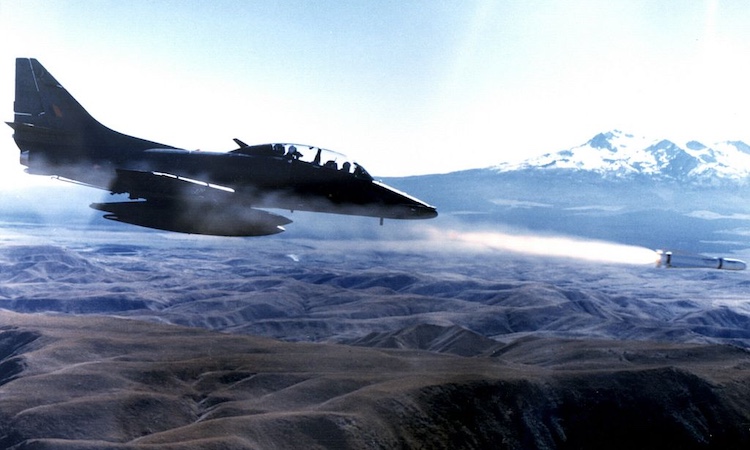
A New Zealand A-4 Skyhawk in 1989. Image: US Navy.
For small states, the upgrade of New Zealand’s A-4 Skyhawks provides a valuable lesson from history, writes Josh Wineera. Maintaining airpower relevance doesn’t necessarily mean paying for the latest platforms.
When New Zealand upgraded its A-4 Skyhawks under Project Kahu, it quietly proved a point that matters even more today. New Zealand did not buy a new fleet; it took a 1960s airframe and gave it a modern radar, avionics, weapons and cockpit.
The result was an A-4K that, in combat systems terms, lived in the same conversation as contemporary F-16s – without ever being one.
Kahu was a small-state answer to a big-state problem: how to stay credible in the air without matching the major powers platform-for-platform. New Zealand used integration and brains rather than brute force and budget.
Fast-forward to the present, and the question has returned in a sharper form. Many nations – including New Zealand’s regional neighbours and global partners will be flying fourth generation (and 4.5 generation) fighters over the coming decades. Threats are more complex, drones are everywhere, and talk has quickly shifted to sixth generation concepts and loyal wingmen.
The issue rings similarly to the one Kahu answered in its time: How do small air forces keep older fighters militarily relevant in a new, more challenging environment?
Today’s airpower forces also face similar ‘small’ nation challenges of insufficient ‘mass’: too few fighters and a dwindling percentage of younger pilots to fly them. Simply buying more aircraft (even if they could afford to) would not solve this mathematical problem.
An emerging solution is manned-unmanned teaming (MUM-T). And my argument is that this, in many ways, represents the new Kahu.
MUM-T will not magically turn a fourth generation fighter into a stealth aircraft but it will surround current fighters with a multitude of loyal wingmen (machines) where the human pilot represents the manned, sovereign centre of a much larger combat system.
The small-state fighter problem
Small air forces live with hard arithmetic:
Limited numbers of aircraft and experienced crews, and large areas of ocean, polar caps, and land to cover.
Partners and potential adversaries are modernising and multiplying fast.
Fourth-generation jets, whether they are F-16s, Gripens, F-18 Hornets, or other types, are still highly capable, albeit they cannot leverage stealth. As stand-alone platforms, they risk becoming strategically marginal as sensor ranges, missile envelopes and unmanned systems expand. These aircraft are not obsolete – but they are incomplete.
Project Kahu showed that part of the modernisation gap can be closed with more advanced sensors, avionics and weapons. Today, with budgets tight and technology moving quickly, we need to think in systems again – this time not just inside the airframe, but around it.
What MUM-T offers a fourth generation fleet
MUM-T is often presented as high-end future warfare: stealthy loyal wingmen, AI copilots and swarms. For small states, the value is more grounded. It comes down to three things: reach, resilience and cognition:
Reach. Uncrewed systems, from modest ISR drones to more capable unmanned aircraft, allow a manned fighter to influence parts of the battlespace it cannot safely enter itself. Forward sensors can map threats and find targets at range. Stand-in jammers or decoys can operate inside hostile envelopes, forcing adversary systems to reveal themselves while the crewed aircraft stays safely back.
Resilience. Small fleets cannot afford to trade away aircraft or experienced pilots. Attritable unmanned systems can absorb much of the early risk. If a reconnaissance drone or decoy is lost, the national cost is acceptable. If an aircraft and crew are lost doing the same job, it may take years to recover.
Cognition. Done well, MUM-T lets one crew command a more complex pattern of activity than would otherwise be possible. A fighter directing a small team of uncrewed assets multiplies the quantity of sensors and weapons available to the system – able to see further, shape more of the battlespace and create dilemmas for an adversary that outstrip the unitary fighter.
The important shift is this: The fighter is no longer just a single weapons platform (or in New Zealand parlance a ‘Toyota Hilux’); it becomes a human judgement node in a dispersed, manned-unmanned web.
That logic should feel familiar. Kahu’s upgrades turned the A-4 cockpit into a more effective decision space by improving what the pilot could see and do. MUM-T is the same principle, but projected outwards into the wider battlespace.
The cognitive trap
But there is a risk attached to this, and small states cannot ignore it. Every additional sensor, datalink, and unmanned wingman is another potential demand on the crew’s attention.
If we simply bolt drones onto the mission set without redesigning roles and interfaces, the pilot becomes a bandwidth bottleneck – overloaded with information and tasks at the exact moment judgement matters most. Technology moves quickly. The human brain does not.
If MUM-T is to be the ‘next Kahu’, we must treat it first as a human–machine teaming problem, and only second as a procurement problem. This means asking: which decisions truly require human involvement, and which can be delegated to automation under clear rules? And where the human ‘needs to know’, how do we present that information so it better supports decision making, rather than drowning it?
For small states, advantage will lie with those who design MUM-T architectures that respect human cognitive limits and then train deliberately against them. If we get the human side wrong, more drones just mean more noise.
Practical steps for small air forces – the triple helix
Triple helix thinking is the discipline of designing defence programmes so that policy, industry and academia move in lockstep. The good news is that the first moves do not require a clean-sheet fleet or a blank cheque.
Start with realistic use cases. Look at actual geography and missions – maritime surveillance, EEZ protection, air defence of key points, and support to partners. Identify where simple manned-unmanned pairings could add reach or resilience. A fighter working with a small ISR drone, or directing a decoy platform, for example.
Experiment in simulators first. Use existing simulators and synthetic environments to rehearse MUM-T scenarios. Stress-test crews’ cognitive load by adding or removing unmanned assets, changing who controls what, and debriefing how decisions were made. This costs little but generates real insight.
Write short, clear playbooks. Document a small set of MUM-T ‘plays’: who has authority over which systems, how control is handed over, what unmanned assets do if links are lost. The goal is shared mental models, not a thick “concept of operations” binder.
Pull academia and industry into the tent early. Uncrewed platforms and payloads are precisely where intellectual thought and local industry can contribute.
Partnering too with primes who are comfortable with open architectures and sovereign tailoring matters. The aim is to move from pure buyer to sovereign integrator, just as New Zealand did when it wrapped Project Kahu around its own Skyhawks.
Several European and Nordic nations, and countries such as Canada now exploring new fighters and AEW&C platforms, are already framing their modernisation in these terms: not just ‘which aircraft’?, but ‘how does this aircraft sit at the centre of a wider manned–unmanned and surveillance system?’.
Relevance through integration
New Zealand’s A-4K Skyhawks never became F-16s. They did not need to. Kahu turned them into something more important: our aircraft, integrated on our terms, good enough to be taken seriously in the company they would have kept.
Fourth-generation fighters today are in a similar position. They will not become stealth platforms. But with thoughtful MUM-T, they can become the human heart of a much larger, more survivable, more adaptable combat system.
For small states, that is the real choice. It is not between fourth and sixth generation. It is between treating fighters as single aircraft – or as the manned centre of a network we design, own and understand. That, in the end, is the spirit of Kahu – and astute observers will know that the same logic applies in the maritime, land, and space domains.