
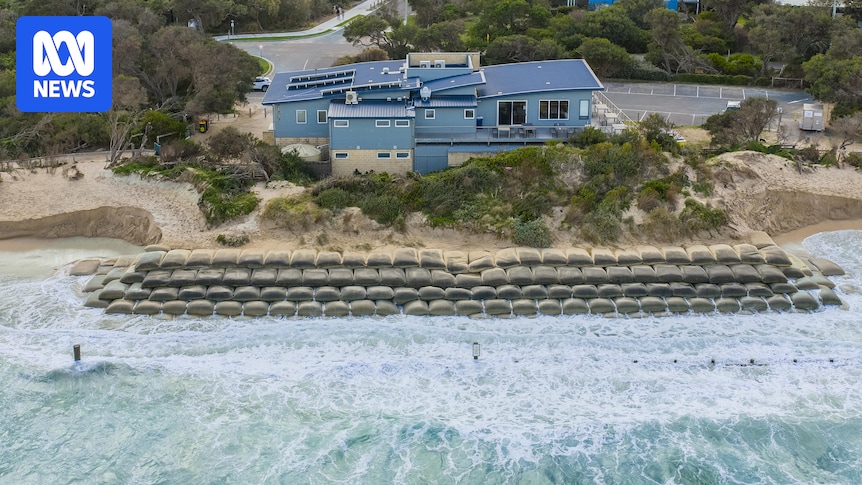
Most Australians live by the beach.
But the coastline we have built our lives around is disappearing before our eyes.
About an hour north of Perth, Gingin Shire President Linda Balcombe has watched her community’s precious coastline be taken over by the sea.
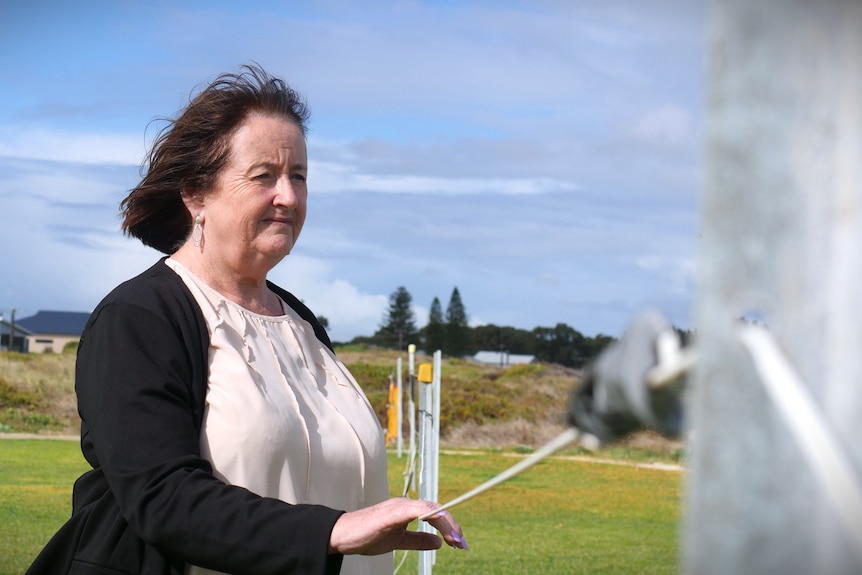
Linda Balcombe knows coastal erosion is an emotive issue for her community. (ABC Midwest & Wheatbelt: Piper Duffy)
Earlier this year, a popular lookout in Lancelin had to be demolished to stop it from crumbling into the ocean.
“Lancelin has two problems: it has coastal erosion, and it’s below sea level,” Ms Balcombe said.
“So if the ocean breaks through the sand dunes, then we have inundation.”
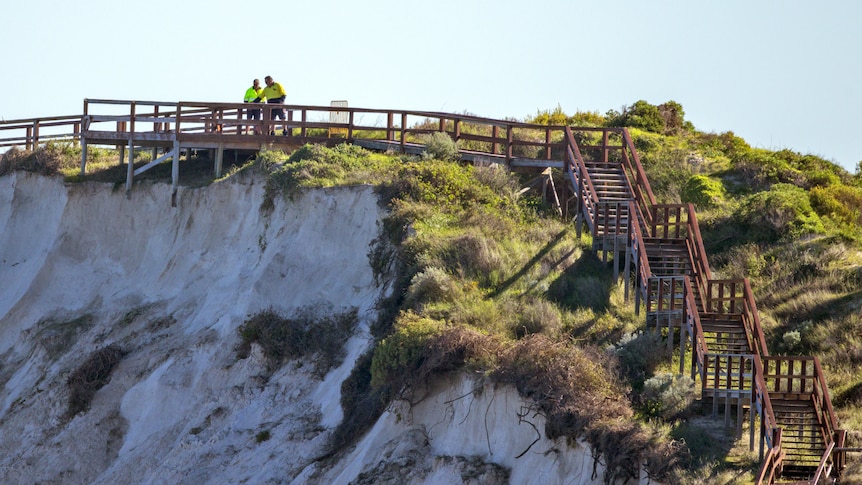
By 2025 the beach had eroded so much the Lancelin lookout had to be demolished. (ABC Midwest & Wheatbelt: Chris Lewis)
A decade ago, in nearby Seabird, a group of homes was nearly lost to the waves, saved by a $2 million seawall.
“That was over 10 years ago. [The wall’s] probably only got another five years of life left,” Ms Balcombe said.
Erosion like this is evident across the country, with houses falling into the ocean and shifting sands leaving jetties marooned.
At Inverloch surf beach in Victoria, more than 70 metres of foreshore has eroded since 2012.
For local surf lifesaving club president Glenn Arnold, it has been an arduous battle to keep his clubhouse standing.
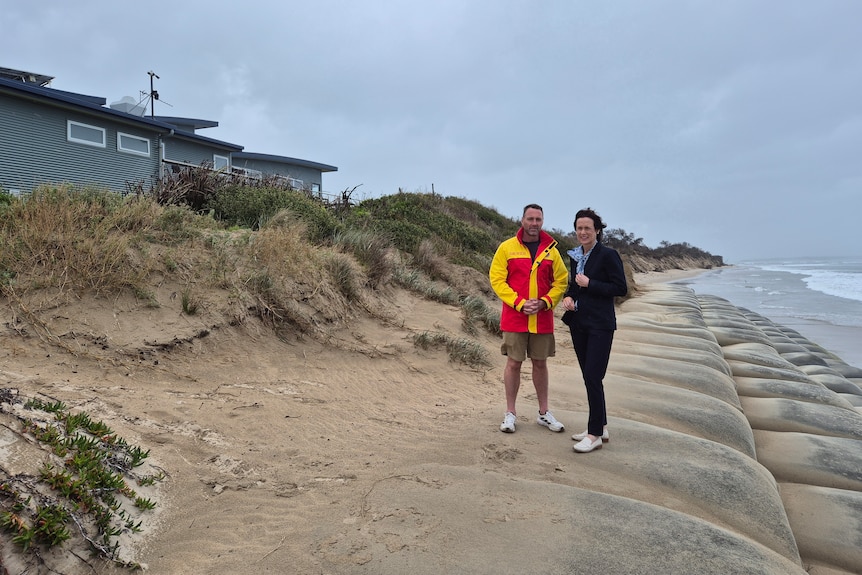
Glenn Arnold and Nationals MP Melina Bath stand on the sandbag wall at the lifesaving club’s clubhouse. (ABC Gippsland: Danielle Kutchel)
“The damage was continuing, it wasn’t abating at all,” Mr Arnold said.
After a long wait for funding, new sandbags are being added to Mr Arnold’s beloved beach in a bid to save it.
“I find it a bit sad that we’re at this point,” he said.
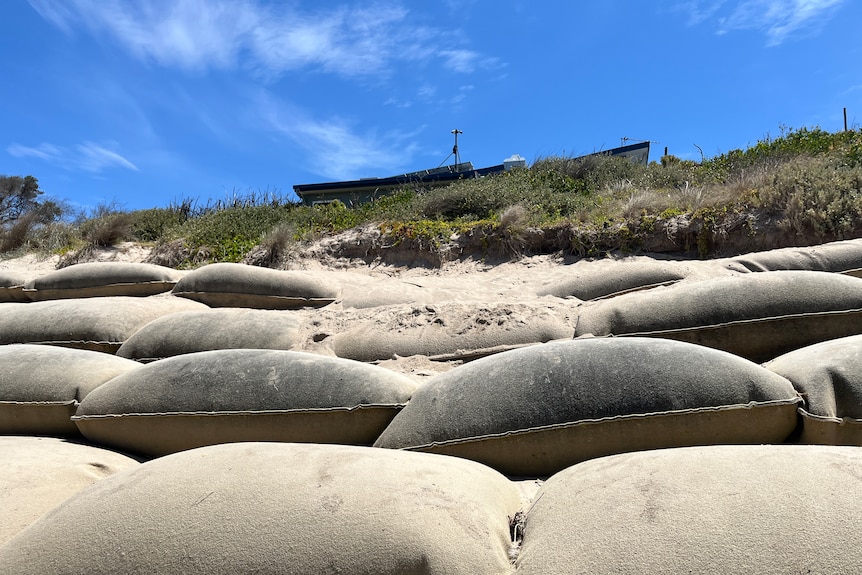
Sandbags at Inverloch. (ABC Gippsland: Danielle Kutchel)
For communities that revolve around the beach, coastal erosion is an emotive issue.
“They’re scared,” Ms Balcombe said.
“And then when they get scared, they get angry.”
What’s behind erosion?
Coastal erosion is not a new issue, but climate change means there have been drastic changes to the coastline in recent decades.
Angus Gordon OAM is a coastal engineer.
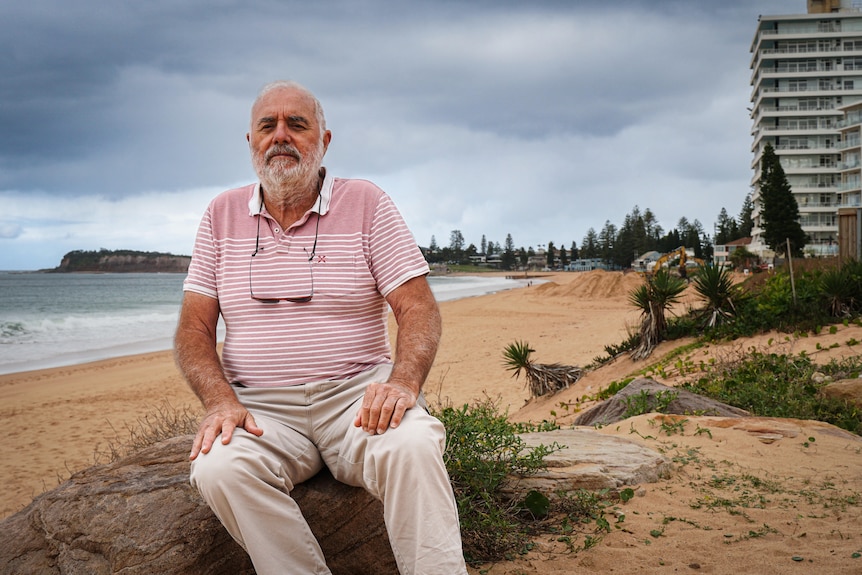
Angus Gordon has studied coastal erosion for decades. (ABC Central Coast: Keira Proust)
He said people often assumed sea level rise was behind coastal erosion, but that was not the key factor.
“It’s actually a shift in latitude of the weather systems.”
In other words, storms and pressure systems now occur in different parts of the world than they used to.
The ocean has responded to that with something called “wave energy flux”, the changing direction of waves.
“The weather systems generate the winds, the winds generate the waves, and so when they change, the coastline just tries to respond to it,” Mr Gordon said.
For Mr Gordon, building permanent structures in an inherently changing environment is at the crux of the issue.
“We have been allowing what I would say is an incompatible form of development by making it a fixed development in a flexible environment.”
Whose responsibility is coastal erosion?
The question of who is in charge of fixing coastal erosion is tied to a more existential coastal dilemma: who owns the beach?
To answer that, we can look to Ancient Rome.
Loading…
Mr Gordon said our modern right to wander on the beach harked back to Roman emperor Justinian’s public trust doctrine from the sixth century.
It determined that things like air and rainfall were free.
“Strangely enough … he also, in that doctrine, included free access to foreshores,” Mr Gordon said.
That 1,500-year-old rule came to underpin modern laws, and is part of why Australia boasts so many spectacular public beaches.
But according to Mr Gordon, modern developments complicated matters.
“In reality, there’s a lot of beach that is in fact in private ownership,” he said.
Who pays?
Techniques to stop erosion include building seawalls and pylons to protect the shoreline.
Another method is to protect the natural barrier of sand dunes by sandbagging and maintaining native vegetation.
There is also sand nourishment, where extra sand is added to the beach.
But all this costs money, and funding can be slow-moving and hard to come by.
In Inverloch, a federal grant of $3.3 million has been put towards the problem, with other money from the state government and local council.
The Bass Coast Council has been vocal about the fact that it cannot afford to keep forking out for sand nourishment.
“It always comes back to money,” Glenn Arnold said.
It is a similar story in Linda Balcombe’s shire.
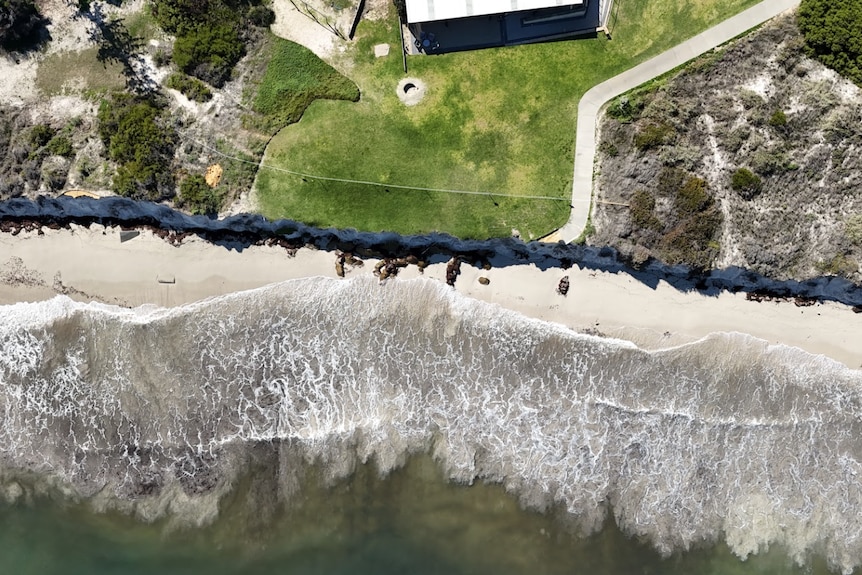
In Lancelin, the ocean is rapidly encroaching on the town. (Supplied: Kaeto Hoffman/DroneSphereAU)
She said the council was looking into the possibility of sharing the cost with private landowners.
“We would like to be able to protect everyone, but we can not, financially.”
Looking to the long term
Even if there were infinite money for sandbags and sea walls, Angus Gordon said the current solutions would not stop erosion forever.
“When we start to put non-adaptive structures … in the natural environment of the coastline, you’ll only win for a short time — eventually you’ll lose.”
The Gingin Shire is implementing new rules, so any development flagged as vulnerable to erosion or inundation in the next 100 years is subject to certain conditions.
“It would have to … be able to be moved if water reaches a certain point,” Ms Balcombe said.
At-risk properties must also have the danger noted on their titles.
“So going forward, we’re making the right decisions.”
Mr Gordon said a better public understanding of coastal erosion could help people grapple with the issue.
“When they get that understanding … people realise they need to be adaptive and that the beaches will change and they will lose some beaches.”