
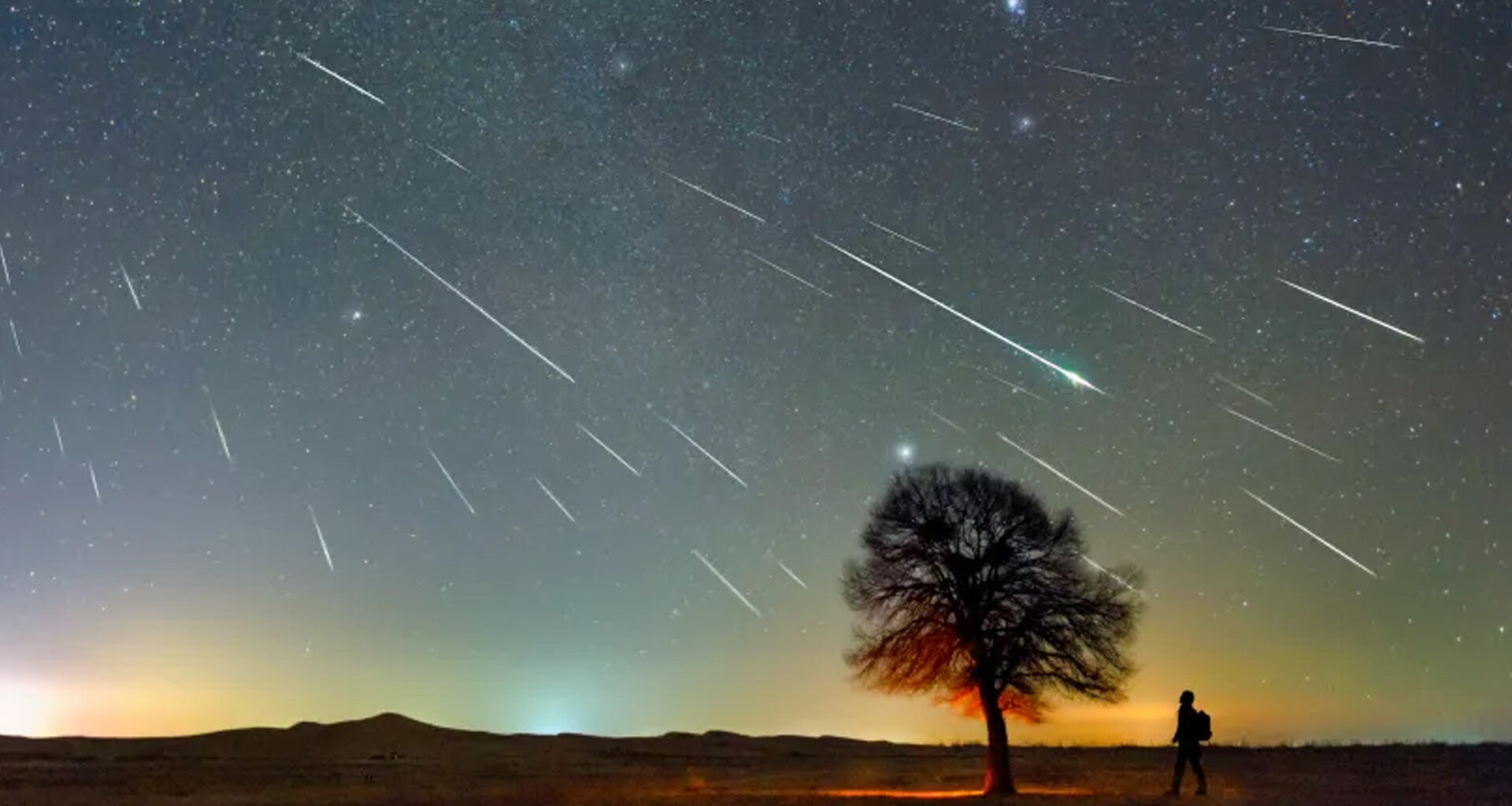
TONIGHT is your last real chance to spy a blazing fireball from the 2025 Geminid meteor shower.
It’s the final major meteor shower of the year, and it ends tonight.
Sign up for The US Sun newsletter
Thank you!
The Geminids meteor shower produces bright meteors that streak across the night skyCredit: AFP
A Geminid can be seen here streaking across the sky over the Valley of Fire State Park in Nevada in 2018Credit: Getty
Meteor showers happen when chunks of debris strike Earth’s atmosphere.
They burn up at high speeds, creating flashes of light across the sky.
Normally meteor showers occur when we pass through the debris field of a comet.
But the Geminids is especially unique because it’s caused by the debris from 3200 Phaethon, which is rocky like an asteroid – and not an icy comet.
LUNAR LIVING
Nasa reveals plan for VILLAGE on Moon as timeline for lunar colony revealed
STARRY EYED
Nasa observatory could finally find ALIENS as it hunts for habitable worlds
“The meteors of the Geminid meteor shower are very bright, moderately fast,” said the Royal Greenwich Observatory.
“And are unusual in being multi-coloured – mainly white, some yellow and a few green, red and blue.
“These colours are partly caused by the presence of traces of metals like sodium and calcium, the same effect that is used to make fireworks colourful.”
Geminids meteor showers typically produce up as many as 120 and 160 meteors per hour at the peak.
WHEN IS THE GEMINIDS METEOR SHOWER 2025? HOW TO SEE IT
The Geminids meteor shower is expected to run from December 4 right through to December 20.
That means tonight is the last night that you’ll be able to see the Geminids.
The peak was on December 14, which is when the shower was most active.
However, tonight is also the New Moon for December 2025, which means the sky won’t be illuminated by our lunar neighbour.
So that gives you a much better chance of seeing a meteor compared to if there was a full Moon.
In fact, it gives you a better chance of seeing anything in the sky, because your view of the heavens is much darker.
This image shows the Geminid meteor shower in the Kubuqi Desert of Inner Mongolia, China in 2020Credit: Getty
So even if you don’t catch a meteor, you should get a great view of the stars, and maybe some planets or satellites too.
There’s no perfect place to look at the sky, as meteors can appear anywhere overhead.
But if you trace them back to their origin, they should all appear to radiate from the constellation of Gemini.
The bad news is that your evening of stargazing depends on the weather and general visibility.
This is an image of 3200 Phaethon, which is responsible for the Geminids meteor showerCredit: Wikipedia
What’s the difference between an asteroid, meteor and comet?
Asteroid: An asteroid is a small rocky body that orbits the Sun. Most are found in the asteroid belt (between Mars and Jupiter) but they can be found anywhere (including in a path that can impact Earth)
Meteoroid: When two asteroids hit each other, the small chunks that break off are called meteoroids
Meteor: If a meteoroid enters the Earth’s atmosphere, it begins to vapourise and then becomes a meteor. On Earth, it’ll look like a streak of light in the sky, because the rock is burning up
Meteorite: If a meteoroid doesn’t vapourise completely and survives the trip through Earth’s atmosphere, it can land on the Earth. At that point, it becomes a meteorite
Comet: Like asteroids, a comet orbits the Sun. However rather than being made mostly of rock, a comet contains lots of ice and gas, which can result in amazing tails forming behind them (thanks to the ice and dust vapourising)
If it’s a cloudy night where you are, or you’re staring up from a city with lots of light pollution, then you’ll struggle to see much.
For the best chance, get out into the countryside, and give your eyes a bit of time to adjust to the dark. That means you shouldn’t stare at your smartphone!
BONUS METEOR SHOWER
Although the Geminid shower is the final major meteor shower of the year, it’s not the last shower of 2025.
There’s a smaller – although very reliable – bonus meteor shower called the Ursids.
This image of a Geminid is from the Kushimoto, Wakayama Prefecture in Japan as seen in December 2013 – with Jupiter visible in the far rightCredit: Alamy
It usually runs from December 13 to 26, with a peak at December 22.
And as the Moon was a New Moon only just a few days ago, you should get a good view of the Ursids.