
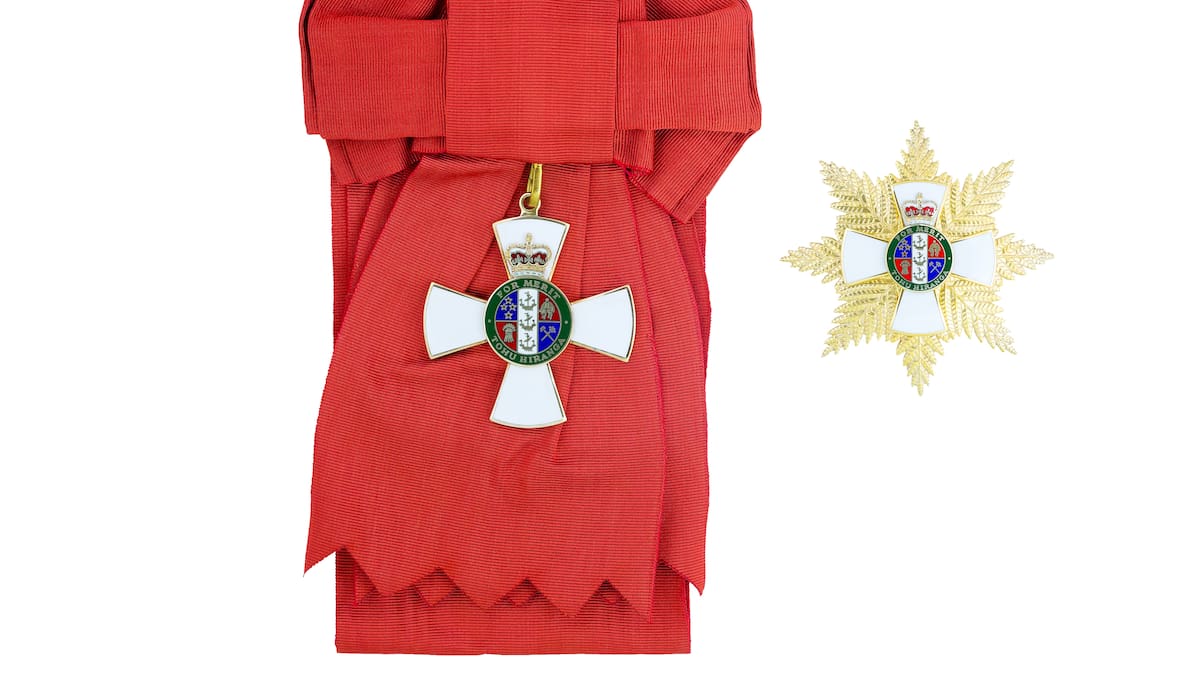
Bling: Just 30 living people get to wear the gold-edged badge awarded to a knight or dame Grand Companion of the NZ Order of Merit. They are also awarded (right) an eight-pointed gold star, each arm representing a fern frond.
As the annual round of backslapping – and backbiting – for new year knights and dames approaches, Paul Little looks at our honours system and whether it merits a polish up.
Separating an individual from the common herd with the royal honours “Sir” or “Dame” seems at first blush to
go against the egalitarian grain in New Zealand. Although Kiwis have paid only lip service to the myth for a long time, egalitarianism still lurks in the national subconscious.
The official government website for the honours system is upfront about the anomaly, quoting a 1995 review: “We believe that such recognition is consistent with the egalitarian character of New Zealand society and enlivens and enriches it.”
Sir John Key – who in 2009 restored the titular honours that his predecessor Helen Clark abolished in 2000 – thinks he knows why their reinstatement was popular. “What people were reflecting was that, as a general rule, the people who got them had done something very significant, and it was a way of explaining in shorthand that the person had done that,” says Key.
Nothing short about the titles though, because titular honours also come with post-nominal letters – so Dame Valerie Adams DNZM is officially a Dame Companion of the New Zealand Order of Merit.
There is also a non-egalitarian hierarchy within the titles. Some knights and dames are grand companions of the NZ Order of Merit. Some are just plain old companions.
There is another honour classified above that of any knight or dame: many people aren’t aware the non-titular Order of New Zealand (ONZ) is ranked higher still. It is held by only 20 people at one time.
“Believe it or not, about 10% of people say no to the offer of an honour,” Key recalls of his time in charge of the selection committee. “It’s for all sorts of reasons. It’s not because ‘I don’t like the government’ or ‘If another government gave it to me, I might say yes.’ They feel they don’t want recognition. They didn’t do what they did for that.”
Roman historian and statesman Cato the Elder is reputed to have said, when someone noted his lack of public honours, that he preferred to be asked why he didn’t have a statue rather than why he did have one.
Cato notwithstanding, the desire to acknowledge achievement and service is nearly universal. Countries without any sort of national honours system – titular or otherwise – are rare. They include Ireland, Switzerland, Libya, Nauru, Palau, the Seychelles and the Marshall Islands.
To make a gong story short, New Zealanders are by and large happy with their award arrangements. It is probably not in the top 50 list of things we need to worry about. No children are going to bed hungry because of the way knighthoods are distributed.
Critics may be rare, but there are plenty of reformers willing to offer free advice. There are several tweaks and titivations that could make our system something more relevant, indigenous and meaningful.
The mass investiture ceremony in St Paul’s Church, Wellington in 2009 for 72 knights and dames who took up the offer of redesignation after John Key reinstated the royal titles.
Political leanings
The process by which honourees are selected by the cabinet honours committee – all current members of the government – is reasonably transparent, says secretary of the cabinet Rachel Hayward, whose responsibilities include the honours unit. “Ministers and MPs in particular, are really close to their communities,” says Hayward. “It is actually really interesting who they know or know of.”
But they can’t do it all themselves. “We’re always looking for really good public nominations, good quality nominations.”
“It’s not nearly as political as you’d think,” says Key, who adds any bias would be evened out between changes of government. “Is the National government going to have a bit more sympathy as a general rule for commercial people? Yes, I think that’s true.” But a Labour government will do the equivalent on its side, and in his time, “there were lots of people who, if we knew they were really opposed to us and the government, we still said yes, because whatever they did was really worthy.”
Discretion is the better part of honours and the nominators themselves remain anonymous. None of the titled spoken to for this story knew who had put their names forward.
There’s no law against telling someone you nominated them but “we encourage people not to”, says Hayward. “You’ve put their name up, but it’s New Zealand that’s honouring them.” Another benefit of anonymity, she says, is that recipients don’t feel beholden to their nominators. “I’m sure there are sometimes people who know, but I think it’s really interesting how much nominators hold to that and don’t share.”
“I have no idea who nominated me,” says fashion designer Dame Denise L’Estrange-Corbet. “Everyone I thought it might be, it wasn’t.”
“A top-class Secret Santa is how I would describe it,” says acting coach and theatre luminary Dame Miranda Harcourt, honoured in 2023.
But getting a gong is not all champagne and skittles. Your republican mates are likely to give you a hard time. Accusations of cronyism must be borne. Friendships are sundered. “Two friends were jealous, being in the same industry, and not having received any accolades, but that was hardly my fault!” says L’Estrange-Corbet, who received her damehood for services to fashion and the community in 2018. “One of my closest friends in the industry, whom I had known for over 35 years, never really spoke to me after I received it and never, ever mentioned it. She blanked me after that.”
Some recipients have had doubts about accepting an award and many different motives can lie behind their decision. For L’Estrange-Corbet, “It represents the fact that someone who was brought up in a single-parent family in the early 60s and did not have the greatest of upbringings can overcome that through hard work and sheer determination to better oneself. None of my friends from school could get over it, and some of my family in the UK still think I made it up.”
Harcourt says her mother, fellow dame and theatre luminary Kate, “took it very seriously in terms of a sense of social responsibility. And I have done the same thing.” For them it is about looking forward, not a laurel on which to rest. “It is a spur to continue to work hard. They’re community awards, so you have to continue to identify what is your service to community.”
Anthropologist Dame Anne Salmond, who received her ONZ in 2021, had extremely mixed feelings when she was made a dame, aged 49, in 1995. “The letter came, and you’re not allowed to tell anybody, so you have to mull it over by yourself. I didn’t like the idea of having a title, because I thought it sounded really pompous, and I didn’t answer the letter. In the end, they rang me up and said they had to tell Buckingham Palace, and I thought, ‘Well, Mum will love it.’” So she accepted. Later, talking to her friend, educationalist Merimeri Penfold, she discovered Penfold had received the same offer and declined. “She said, ‘I got this letter, and I didn’t answer it, and then they rang me, and I thought, my ancestors will hate it.’ We laughed, and we said to each other, if we’d talked about it, we would probably have done the same thing.”
She sees benefits to her honours now: “I’ve been involved in Māori studies for a very long time, and that’s a field of contention. If you’re putting up arguments that some people might be a bit disinclined to listen to, sometimes they do listen a little more [because of the title].”
Feelings were less mixed when she got the ONZ. “That was lovely. You know that people have really looked at the thing you do, and tried to figure out whether you ought to be there or not. And there are some amazing people in that list.”
Not everyone has what it takes to earn a titular honour. And not everyone has what it takes to keep it. Businessmen James Wallace and Ron Brierley and politician Albert Henry all forfeited their knighthoods for various offences.
Hayward explains how this fortunately rarely used part of the system functions. “There’s no strict test, but the threshold is if the person continuing to hold an honour would bring the system into disrepute. It has tended to settle around criminal convictions. It doesn’t have to, but those have been the examples to date, and that’s a decision of the prime minister of the day.”
Top gong: The badge of the Order of New Zealand, which is limited to 20 living people.
Gongs for ‘doing your job’
Clearly, you can’t please everybody and there are plenty of quibbles about the working of the system. The arts community will always say there are too many sporting boofheads on the list; the sports community will always say there are too many arty wankers.
The royal connection rankles with some, but the republican movement’s calls for change go no further than wanting to change the date of the mid-year honours from the King’s birthday to Matariki.
One criticism could be addressed if there were a separate category called the Just Doing Your Job But We Realise It Was a Bit Hard Award for retired prime ministers and judges.
“Some people will say, yeah, it’s worthy because of the sacrifice that a prime minister has to make, whether you like them or not,” says Key. “And some people will go, no politician should get an honour that’s [for] doing their job. And both of those arguments have validity, I suppose.”
Dean Knight is associate dean of the Victoria University of Wellington law faculty, co-director of the New Zealand Centre for Public Law and a keen observer of the honours system. On the question of automatic honours for the likes of PMs and judges, he says, “As someone who believes in democracy, I do think the service from our governors is actually really important. But I think we need to take care about those things. It shouldn’t be just entitlement, and a reward from the government of the day.”
There have been some non-threatening evolutionary advances. Harcourt noted changes between her two honours – an ONZM (Officer of the New Zealand Order of Merit) in 2002 and the damehood in 2023. “I think they’ve done a really great job of repositioning these as New Zealand community honours, as opposed to something that is conferred upon you by a colonial system.
All Black great Richie McCaw turned down a knighthood but accepted the premier Order of New Zealand award from then governor-general Jerry Mateparae in 2016
“There’s a big difference between when I went to Government House to receive my ONZM, and when I went to Government House to receive my DNZM. The event is much more casual – no formal ranks of chairs. Now it is a morning or afternoon tea with whānau or supporter tables dotted around the room and the recipients are encouraged to move among the tables and chat with each other, to create relationships going forward. It’s a much more New Zealand-oriented ceremony.”
L’Estrange-Corbet’s request to be invested with a sword like the knights get was politely declined. Then governor-general Dame Patsy Reddy had a solution to that gender disparity in 2018, when she introduced the practice of putting a ceremonial korowai on anyone being made a dame.
“The accolade is an ancient chivalric thing, and she was looking for an equivalent that could be something special for women. That’s quite a nice thing that has developed over the last 10 to 15 years,” says Hayward.
There are numerous other aspects of the system that could be adjusted for a better local fit. Australia phased out imperial honours at federal and state level over a decade, finishing with the British system altogether in 1992. Instead of sirs and dames it has various levels of the Order of Australia, from the top-ranking Companion of the Order of Australia (AC, limited to 35 people a year), Officer of the Order of Australia (AO, 140 people) and Member (AM, up to 605).
Recipients, whose number includes Honorary AC John Key, get a gold lapel pin featuring different elements such as a coloured stone to indicate the level of the honour. “We have the same thing – a little badge,” says Key. “But we’ve never really done that as well as Australia.”
Kate and Miranda Harcourt are a rarity as two dames in one family.
Opportunity missed
Titular honours themselves are not up for discussion. Clark replaced them with the non-titular awards of Principal Companion and Distinguished Companion of the New Zealand Order of Merit. John Key put them back. People who missed out on being made a knight or dame were given the opportunity to take up the titles in 2009 and 72 of the 85 recipients chose to do so.
Dean Knight still thinks this could have been done better: “My idea was to reinstate the titular but also use the opportunity to make the honours more indigenous. Unfortunately, the Key government picked up on the titular, British part and didn’t run with the indigenisation and evolution. There was no work done on building more storytelling and labels and language of Aotearoa, New Zealand.”
Te reo Māori was first used in Warrants of Appointment certificates in 1987 with the establishment of the Order of New Zealand. Knight says the language we use is important and te reo Māori could have an even bigger part to play. His proposed changes would have officially allowed for the use of the titles “tā” for sir and “kahurangi” for dame, but this was not formally adopted and has been slow to catch on informally. Knight says the reinstatement of sir and dame, and failure to mandate te reo equivalents, has taken us back towards British royalism, not forward to blended indigenisation.
He cites overseas models that bring indigenous and local narratives to their awards. South Africa has different orders for different areas of service. Some of their honours are named after plants or people – the Order of the Baobab, the Order of Luthuli.
“Imagine if one of the premier titles was the order of the huia or the kākāpō, or something else that will ground them in our stories,” says Knight.
Sitting uncomfortably
Karen Fox did her MA thesis on the honours system at the University of Canterbury and is now senior academic research editor for the Australian Dictionary of Biography at Australian National University. “I think New Zealand, Australia and Canada all have a tendency to see themselves as egalitarian,” she says. “I wanted to look at how that played out in the honours system. I found a lot of quite similar debates in the three countries, even though they’ve ended up in different positions.”
She says arguments about how egalitarian honours are have waged since the 19th century, though early opposition was more to hereditary titles. More recently, a few people have suggested having gradations in the system is not egalitarian, either.
“It comes down, I think, to how you define egalitarianism. The historian John Hirst talks about egalitarianism of outcome versus of opportunity. Whether or not you see honours as compatible with egalitarianism really depends on what you mean by it.”
Gender distinctions are responsible for many of the anomalies surrounding honours, and not just about being inducted with a sword. People who will happily endorse the use of self-selected pronouns wax mightily over what they see as violations of title protocol, especially instances of wives of knights misappropriating the title “Lady”.The rules around that are complex and might require you to know, for instance, whether or not someone is the daughter of an earl. The honours committee is quite relaxed about who calls herself a lady and in what context. “That’s a New Zealand thing that we just do now,” says Hayward.
To date, the workings of the honours system and debates about it have been marked by civility and restraint. But something considerably more contentious is slouching towards the Beehive to be borne: what will happen when a person with the name Kevin on their birth certificate is offered an honour and says that things have changed and they want to be a dame, not a knight? And that they have the right to choose to be a dame rather than a knight, or vice versa.
Hayward, beneath her public service sangfroid, shows just the slightest sign of apprehension when presented with this quandary. Her words are carefully chosen: “That is under consideration and I can see that being an issue that we have to address quite soon.”
Honour again, off again
Our honours system may not be unique but it has thrown up some idiosyncratic examples.
All precedent was ignored by National’s Keith Holyoake in 1970 when he accepted a knighthood while prime minister – the usual protocol is to accept the honour post-office. His fellow National PM Rob Muldoon repeated what many saw as a transgression in 1984.
A conspicuous refusenik was the late prime minister Jim Bolger, who wanted to abolish titular honours. However, republican Bolger was not against honours per se, having been appointed to the empyrean heights of the Order of New Zealand in 1998.
Likewise, Helen Clark remains Ms Helen Clark, ONZ. Protocol is that if you’re offered a title and turn it down, you don’t comment. But given the PMs who came before and after her, including Key, Dame Jenny Shipley, Sir Bill English and Dame Jacinda Ardern, it may be inferred Clark was a thanks, but no.
Titular honours are awarded according to people’s birth names, rather than the names by which they are known, which isn’t normally a problem and is often ignored in the interest of common sense. Sir Nigel Neill is popularly known as Sir Sam Neill. Legendary singing teacher Sister Mary Leo had been known only by that name since she took her vows at age 28, and though there was murmuring, no one insisted she become known as Dame Kathleen Niccol when she accepted her honour aged 78.
Knights who say one of their reasons for accepting the honour is that the missus would like it include Sir Colin Meads (Verna, Lady Meads), Sir John Key, (Bronagh, Lady Key) and Sir Roger Hall (Dianne, Lady Hall).
Parent/child titular-honour pairs are extremely rare, but New Zealand has one exceptional pair living in the same house: Dames Kate and Miranda Harcourt.
Richie McCaw turned down a knighthood after the 2011 Rugby World Cup but, at age 35, became the youngest-ever member of the higher ranked, non-titular Order of New Zealand in 2016.
On Call
With a titular honour comes THE necessity to decide how to use that title. Generally, it seems we’re not too fussed.
Dame Kiri te Kanawa told the Listener via her representative she “is quite relaxed about the use of her title. Usually, people with whom she is working or meeting for the first time will be formally introduced using the title and then once work commences this will usually be dropped in favour of a more relaxed informal approach.”
Dame Kiri Te Kanawa
Sir Roger Hall has clear, easy-to-follow rules: “If I’m being introduced at a social occasion to people I haven’t met before, then I’m usually introduced as Sir Roger – which I think is right. Very quickly the Sir gets dropped. Either people sense that there is no need to keep using it or I make it clear that once is enough. On Morning Report, say, or breakfast TV, the interviewers use ‘Sir’ all the time … which feels right.”
Sometimes, a title can serve a practical purpose. “I’m on one board in the US, and there’s three Johns on the board, says Sir John Key. “So they do call me Sir John; it’s an easier way of doing things.”
John Key
Both Dames Kate and Miranda Harcourt recognised the title could give added weight to their advocacy work in the community, and film-maker Dame Gaylene Preston similarly sees it as recognition for the field in which she has distinguished herself. “When the letter arrived asking if I would accept the title, I thought long and hard. It changes your name. I miss ‘Ms’. But in the end it’s for the arts. I thought, ‘Well if it’s good enough for the Topp Twins it’s good enough for me!’”
Dame Denise L’Estrange Corbet uses “Dame, which can replace Miss, Ms, Mrs, to do just that. Though I have to say I have stayed in a few hotels, and the younger have greeted me as Ms Dame! I said ‘No, Dame is my title,’ but they were young and just did not understand what I was talking about!”
SaveShare this article
Reminder, this is a Premium article and requires a subscription to read.
Copy LinkEmailFacebookTwitter/XLinkedInReddit