
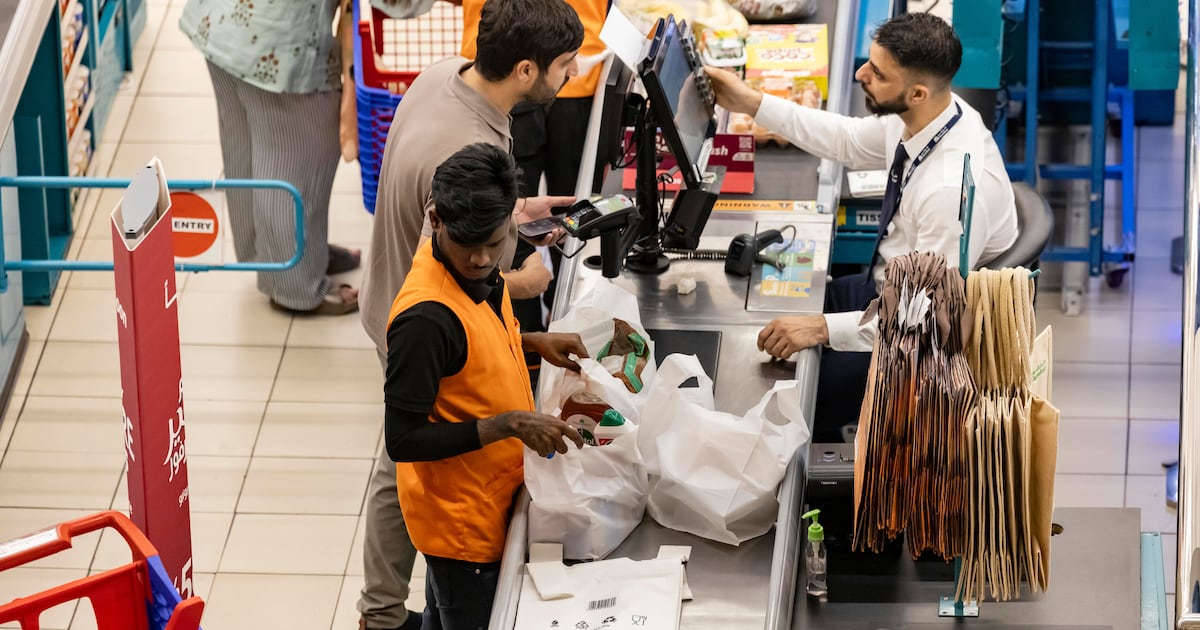
The UAE will begin 2026 with a major push to cut plastic waste and reduce pollution under a nationwide ban on various single-use plastic products.
From January 1, the country will prohibit the import, manufacture and trade of an expanded range of single-use plastics, including beverage cups and lids; cutlery, such as spoons, forks, knives and chopsticks; plates; straws; stirrers; and food containers and boxes made from Styrofoam.
The ban was announced previously and the Ministry of Climate Change and Environment on Tuesday sent a reminder urging all establishments, markets and suppliers to comply with the laws.
“Regulating the use of single-use products is not only intended to reduce waste but it is part of a comprehensive vision to advance the principles of the circular economy, in which resources are transformed into sustainable assets rather than environmental burdens,” said Alya Al Harmoodi, assistant undersecretary for the sustainable communities sector at the ministry.
“In the UAE, we adopt a balanced approach that prioritises the protection of marine and terrestrial environments from pollution risks, while simultaneously fostering business sustainability and growth.”
Ms Al Harmoodi said the authorities had confidence in “the robust environmental awareness of the Emirati community and in the constructive co-operation demonstrated by the private sector, manufacturers and retailers in adopting sustainable practices and embracing environment-friendly alternatives”.
“Protecting our environment is a shared responsibility, and every step taken to reduce the consumption of these products is an investment in the well-being of our society and the preservation of our natural landscapes,” she added.
The decision also establishes a comprehensive ban on single-use bags, regardless of their constituent material, if their thickness is less than 50 microns (a micron is one millionth of a metre). This will take effect on the same date.
Plastic waste: a growing problem in the UAE and worldwide
The impact of plastic pollution has been increasingly visible in the UAE. In July, the amount of discarded plastic found in dead seabirds was described as “very alarming”.
Dubai officials said in 2022 that nine out of 10 turtles and five out of 10 camels found dead had plastic in their stomachs.
A UAE study also showed that hundreds of camels have died since 2008 after consuming plastic waste.
Globally, the problem is even more stark. The Organisation for Economic Co-operation and Development believes plastic waste could triple to one billion tonnes a year by 2060.
According to the Earth Day charity, about five trillion plastic bags and 500 billion plastic cups are used worldwide every year. There has, therefore, been a broad welcome for the new rules.
“By building on earlier successes, such as the plastic bag ban that drastically reduced usage, the UAE is pioneering a model of sustained climate action,” Antonios Vouloudis, senior director of sustainability and stewardship at NYU Abu Dhabi, told The National.
“This new ban will encourage the use of reusable alternatives, foster innovation in sustainable materials, and demonstrate that economic development can go hand in hand with environmental stewardship.”
Tatiana Antonelli Abella, founder and managing director of Goumbook, a UAE-based social enterprise group dedicated to sustainability, said the switch marks a “crucial step” in the country’s journey towards a more sustainable future.
“This new measure will not only help safeguard our ecosystems but also inspire communities and businesses to embrace more responsible consumption, proving that every ban is a building block towards lasting environmental change,” she said.
Steps taken so far
The 2026 ban follows a series of measures introduced by individual emirates and at the federal level to limit single-use plastics.
Abu Dhabi banned single-use plastic bags on June 1, 2022, while a UAE-wide prohibition came into force at the start of 2024. Other emirates across the country have implemented similar measures.
Many of these initiatives were announced in the run-up to Cop28, which took place in the UAE in 2023. The UAE also pledged in 2021 to aim for net-zero emissions by 2050.
“I believe this bold move will inspire other countries in the region and beyond to implement similar strategies,” Mr Vouloudis said. “Initiatives like this keep up the momentum on climate action. They demonstrate that after major pledges and global summits, there is real follow-through.”
Are there any exemptions to the ban?
Products manufactured for export or those for re-export do not fall under the ban, the ministry said.
It furthermore does not apply to bags and products made from recycled materials within the UAE; and medicine bags, refuse bags, very thin plastic bags used to wrap fresh food items such as meat, vegetables and bread, as well as large shopping bags intended for clothing, electronics and toys.
Have the measures made a difference?
There is evidence these initiatives are having a positive impact.
After restrictions were introduced in Abu Dhabi, authorities said the use of plastic bags fell by 95 per cent at cash counters – equivalent to 2,400 tonnes of plastic.
Research has also shown that the number of camels found dead with plastic bags in their stomachs has fallen by up to 80 per cent since the government introduced restrictions.
Across the UAE, reusable bags have become common and many businesses now offer sustainable packaging options. Some cafes also encourage customers to bring their own cups by offering discounts.
Goumbook, for example, has long been involved in sustainability drives, such as its “Drop It” campaign launched in 2016 to tackle single-use plastic. It also teamed up with Dubai Can – a government-led drive to establish water refill stations across the UAE; and launched the Unisoap UAE initiative – a drive to recycle UAE hotel soaps
“Previous bans have already shown us the power of regulation in shifting behaviours and cutting unnecessary single-use plastics,” Ms Abella said. “Equally important is the need to push and foster new solutions and alternatives coming to market: innovative products and systems that can replace single-use plastics and accelerate the transition to a true circular economy.”
Who was Alfred Nobel?
The Nobel Prize was created by wealthy Swedish chemist and entrepreneur Alfred Nobel.
In his will he dictated that the bulk of his estate should be used to fund “prizes to those who, during the preceding year, have conferred the greatest benefit to humankind”.
Nobel is best known as the inventor of dynamite, but also wrote poetry and drama and could speak Russian, French, English and German by the age of 17. The five original prize categories reflect the interests closest to his heart.
Nobel died in 1896 but it took until 1901, following a legal battle over his will, before the first prizes were awarded.
The National in Davos
We are bringing you the inside story from the World Economic Forum’s Annual Meeting in Davos, a gathering of hundreds of world leaders, top executives and billionaires.
Barcelona 3
Messi (27’, 32’, 87’)
Leganes 1
El Zhar (68’)
MATCH INFO
Uefa Champions League, last 16, first leg
Ajax v Real Madrid, midnight (Thursday), BeIN Sports
The years Ramadan fell in May
Mercer, the investment consulting arm of US services company Marsh & McLennan, expects its wealth division to at least double its assets under management (AUM) in the Middle East as wealth in the region continues to grow despite economic headwinds, a company official said.
Mercer Wealth, which globally has $160 billion in AUM, plans to boost its AUM in the region to $2-$3bn in the next 2-3 years from the present $1bn, said Yasir AbuShaban, a Dubai-based principal with Mercer Wealth.
“Within the next two to three years, we are looking at reaching $2 to $3 billion as a conservative estimate and we do see an opportunity to do so,” said Mr AbuShaban.
Mercer does not directly make investments, but allocates clients’ money they have discretion to, to professional asset managers. They also provide advice to clients.
“We have buying power. We can negotiate on their (client’s) behalf with asset managers to provide them lower fees than they otherwise would have to get on their own,” he added.
Mercer Wealth’s clients include sovereign wealth funds, family offices, and insurance companies among others.
From its office in Dubai, Mercer also looks after Africa, India and Turkey, where they also see opportunity for growth.
Wealth creation in Middle East and Africa (MEA) grew 8.5 per cent to $8.1 trillion last year from $7.5tn in 2015, higher than last year’s global average of 6 per cent and the second-highest growth in a region after Asia-Pacific which grew 9.9 per cent, according to consultancy Boston Consulting Group (BCG). In the region, where wealth grew just 1.9 per cent in 2015 compared with 2014, a pickup in oil prices has helped in wealth generation.
BCG is forecasting MEA wealth will rise to $12tn by 2021, growing at an annual average of 8 per cent.
Drivers of wealth generation in the region will be split evenly between new wealth creation and growth of performance of existing assets, according to BCG.
Another general trend in the region is clients’ looking for a comprehensive approach to investing, according to Mr AbuShaban.
“Institutional investors or some of the families are seeing a slowdown in the available capital they have to invest and in that sense they are looking at optimizing the way they manage their portfolios and making sure they are not investing haphazardly and different parts of their investment are working together,” said Mr AbuShaban.
Some clients also have a higher appetite for risk, given the low interest-rate environment that does not provide enough yield for some institutional investors. These clients are keen to invest in illiquid assets, such as private equity and infrastructure.
“What we have seen is a desire for higher returns in what has been a low-return environment specifically in various fixed income or bonds,” he said.
“In this environment, we have seen a de facto increase in the risk that clients are taking in things like illiquid investments, private equity investments, infrastructure and private debt, those kind of investments were higher illiquidity results in incrementally higher returns.”
The Abu Dhabi Investment Authority, one of the largest sovereign wealth funds, said in its 2016 report that has gradually increased its exposure in direct private equity and private credit transactions, mainly in Asian markets and especially in China and India. The authority’s private equity department focused on structured equities owing to “their defensive characteristics.”
MATCH INFO
Inter Milan 2 (Vecino 65′, Barella 83′)
Verona 1 (Verre 19′ pen)
MATCH INFO
Uefa Champions League, semi-final result:
Liverpool 4-0 Barcelona
Liverpool win 4-3 on aggregate
Champions Legaue final: June 1, Madrid
Why it pays to compare
A comparison of sending Dh20,000 from the UAE using two different routes at the same time – the first direct from a UAE bank to a bank in Germany, and the second from the same UAE bank via an online platform to Germany – found key differences in cost and speed. The transfers were both initiated on January 30.
Route 1: bank transfer
The UAE bank charged Dh152.25 for the Dh20,000 transfer. On top of that, their exchange rate margin added a difference of around Dh415, compared with the mid-market rate.
Total cost: Dh567.25 – around 2.9 per cent of the total amount
Total received: €4,670.30
Route 2: online platform
The UAE bank’s charge for sending Dh20,000 to a UK dirham-denominated account was Dh2.10. The exchange rate margin cost was Dh60, plus a Dh12 fee.
Total cost: Dh74.10, around 0.4 per cent of the transaction
Total received: €4,756
The UAE bank transfer was far quicker – around two to three working days, while the online platform took around four to five days, but was considerably cheaper. In the online platform transfer, the funds were also exposed to currency risk during the period it took for them to arrive.
Avatar: Fire and Ash
Director: James Cameron
Starring: Sam Worthington, Sigourney Weaver, Zoe Saldana
Rating: 4.5/5
The specs
Engine: Direct injection 4-cylinder 1.4-litre
Power: 150hp
Torque: 250Nm
Price: From Dh139,000
On sale: Now
Pros%20and%20cons%20of%20BNPL
%3Cp%3E%3Cstrong%3EPros%3C%2Fstrong%3E%0D%3C%2Fp%3E%0A%3Cul%3E%0A%3Cli%3EEasy%20to%20use%20and%20require%20less%20rigorous%20credit%20checks%20than%20traditional%20credit%20options%0D%3C%2Fli%3E%0A%3Cli%3EOffers%20the%20ability%20to%20spread%20the%20cost%20of%20purchases%20over%20time%2C%20often%20interest-free%0D%3C%2Fli%3E%0A%3Cli%3EConvenient%20and%20can%20be%20integrated%20directly%20into%20the%20checkout%20process%2C%20useful%20for%20online%20shopping%0D%3C%2Fli%3E%0A%3Cli%3EHelps%20facilitate%20cash%20flow%20planning%20when%20used%20wisely%0D%3C%2Fli%3E%0A%3C%2Ful%3E%0A%3Cp%3E%3Cstrong%3ECons%3C%2Fstrong%3E%3C%2Fp%3E%0A%3Cul%3E%0A%3Cli%3EThe%20ease%20of%20making%20purchases%20can%20lead%20to%20overspending%20and%20accumulation%20of%20debt%0D%3C%2Fli%3E%0A%3Cli%3EMissing%20payments%20can%20result%20in%20hefty%20fees%20and%2C%20in%20some%20cases%2C%20high%20interest%20rates%20after%20an%20initial%20interest-free%20period%0D%3C%2Fli%3E%0A%3Cli%3EFailure%20to%20make%20payments%20can%20impact%20credit%20score%20negatively%0D%3C%2Fli%3E%0A%3Cli%3ERefunds%20can%20be%20complicated%20and%20delayed%0D%3C%2Fli%3E%0A%3C%2Ful%3E%0A%3Cp%3E%3Cem%3ECourtesy%3A%20Carol%20Glynn%3C%2Fem%3E%3C%2Fp%3E%0A
LIVERPOOL%20TOP%20SCORERS
%3Cp%3E(Premier%20League%20only)%3Cbr%3EMohamed%20Salah%20129%3Cbr%3ERobbie%20Fowler%20128%3Cbr%3ESteven%20Gerrard%20120%3Cbr%3EMichael%20Owen%20118%3Cbr%3ESadio%20Mane%2090%3Cbr%3E%3C%2Fp%3E%0A
The past winners
2009 – Sebastian Vettel (Red Bull)
2010 – Sebastian Vettel (Red Bull)
2011 – Lewis Hamilton (McLaren)
2012 – Kimi Raikkonen (Lotus)
2013 – Sebastian Vettel (Red Bull)
2014 – Lewis Hamilton (Mercedes)
2015 – Nico Rosberg (Mercedes)
2016 – Lewis Hamilton (Mercedes)
2017 – Valtteri Bottas (Mercedes)
HER%20FIRST%20PALESTINIAN
%3Cp%3EAuthor%3A%20Saeed%20Teebi%3C%2Fp%3E%0A%3Cp%3EPages%3A%20256%3C%2Fp%3E%0A%3Cp%3EPublisher%3A%C2%A0House%20of%20Anansi%20Press%3C%2Fp%3E%0A
What are the GCSE grade equivalents?
Grade 9 = above an A*
Grade 8 = between grades A* and A
Grade 7 = grade A
Grade 6 = just above a grade B
Grade 5 = between grades B and C
Grade 4 = grade C
Grade 3 = between grades D and E
Grade 2 = between grades E and F
Grade 1 = between grades F and G
In numbers
Number of Chinese tourists coming to UAE in 2017 was… 1.3m
Alibaba’s new ‘Tech Town’ in Dubai is worth… $600m
China’s investment in the MIddle East in 2016 was… $29.5bn
The world’s most valuable start-up in 2018, TikTok, is valued at… $75bn
Boost to the UAE economy of 5G connectivity will be… $269bn