
Attachments
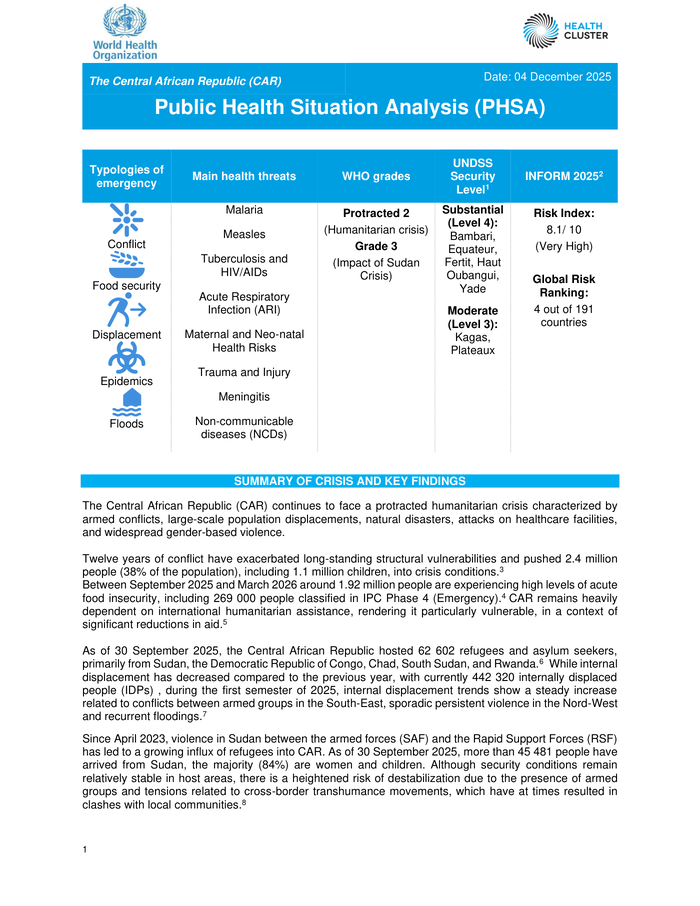
The Central African Republic (CAR) continues to face a protracted humanitarian crisis characterized by armed conflicts, large-scale population displacements, natural disasters, attacks on healthcare facilities, and widespread gender-based violence.
Twelve years of conflict have exacerbated long-standing structural vulnerabilities and pushed 2.4 million people (38% of the population), including 1.1 million children, into crisis conditions.
Between September 2025 and March 2026 around 1.92 million people are experiencing high levels of acute food insecurity, including 269 000 people classified in IPC Phase 4 (Emergency). CAR remains heavily dependent on international humanitarian assistance, rendering it particularly vulnerable, in a context of significant reductions in aid.
As of 30 September 2025, the Central African Republic hosted 62 602 refugees and asylum seekers, primarily from Sudan, the Democratic Republic of Congo, Chad, South Sudan, and Rwanda.6 While internal displacement has decreased compared to the previous year, with currently 442 320 internally displaced people (IDPs) , during the first semester of 2025, internal displacement trends show a steady increase related to conflicts between armed groups in the South-East, sporadic persistent violence in the Nord-West and recurrent floodings.
Since April 2023, violence in Sudan between the armed forces (SAF) and the Rapid Support Forces (RSF) has led to a growing influx of refugees into CAR. As of 30 September 2025, more than 45 481 people have arrived from Sudan, the majority (84%) are women and children. Although security conditions remain relatively stable in host areas, there is a heightened risk of destabilization due to the presence of armed groups and tensions related to cross-border transhumance movements, which have at times resulted in clashes with local communities.