
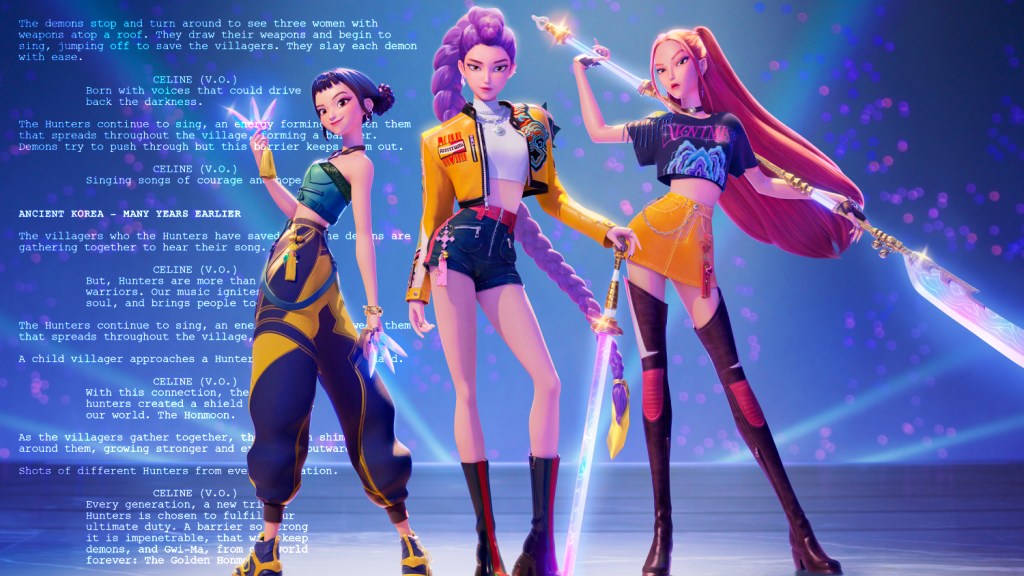
Deadline’s Read the Screenplay series spotlighting the scripts behind the awards season’s most talked-about movies continues with Netflix and Sony Pictures Animation‘s megahit KPop Demon Hunters.
Directed and written by Maggie Kang and Chris Appelhans and co-written by Danya Jimenez and Hannah McMechan, the film follows the global K-pop sensation HUNTR/X — comprising members Rumi, Mira and Zoey — who lead secret double lives as elite demon hunters dedicated to protecting their fans from supernatural threats.
The pic premiered on Netflix in late June and never looked back — first becoming the streamer’s most viewed animated film of all time, and then, it became Netflix’s most popular English-language film ever with more than 325.1 million views to date. It has made a couple of theatrical runs (including a sing-along version) that has grossed $24.6 million. On the awards front, the pic has Best Animated Film noms from the Critics Choice Awards and the Golden Globes, and it was voted the year’s best in that category from the New York Film Critics Circle. Its soundtrack snagged five Grammy nominations behind the smash hit “Golden,” which also made the Oscar Original Song shortlist.
A sequel is in the works eyeing a 2029 release.
KPop Demon Hunters’ narrative centers on their battle against the Saja Boys, a rival boy band whose members are secretly demons serving the villain Gwi-Ma, a flaming, all-consuming mouth inspired by Korean mythology.
The story, which originated from Kang, is anchored by the internal struggle of the group’s leader, Rumi, voiced by Arden Cho, who harbors the secret that she is half-demon. Trained to believe that all demons are inherently evil, Rumi lives in fear that her bandmates will destroy her if they discover the golden patterns hidden beneath her skin. This personal conflict serves as a central theme, illustrating the battle between one’s public persona and their inner demons — the negative, nagging voices of self-doubt that the filmmakers represent through literal supernatural forces.
Beyond the action, the film explores the nuances of cultural belonging through the character of Zoey, a Korean-American maknae who overcompensates for her fear of not being “Korean enough” as a Korean. Kang, who drew from her own heritage and childhood love of Korean mythology, emphasized that the film is rooted in the tradition of female shaman warriors who used music and dance to connect communities.
Ultimately, Kpop Demon Hunters explores how music and human empathy create a literal shield, known as the Golden Honmoon, against the darkness. The filmmakers aimed to show that while inner demons may never fully disappear, individuals can find power in their “true voices” and integrate the fractured parts of their identities rather than hiding them. Employing the blend of K-pop and ancient mythology, the film seeks to tell a universal story about the strength found in vulnerability and communal connection.
Read the screenplay below.