
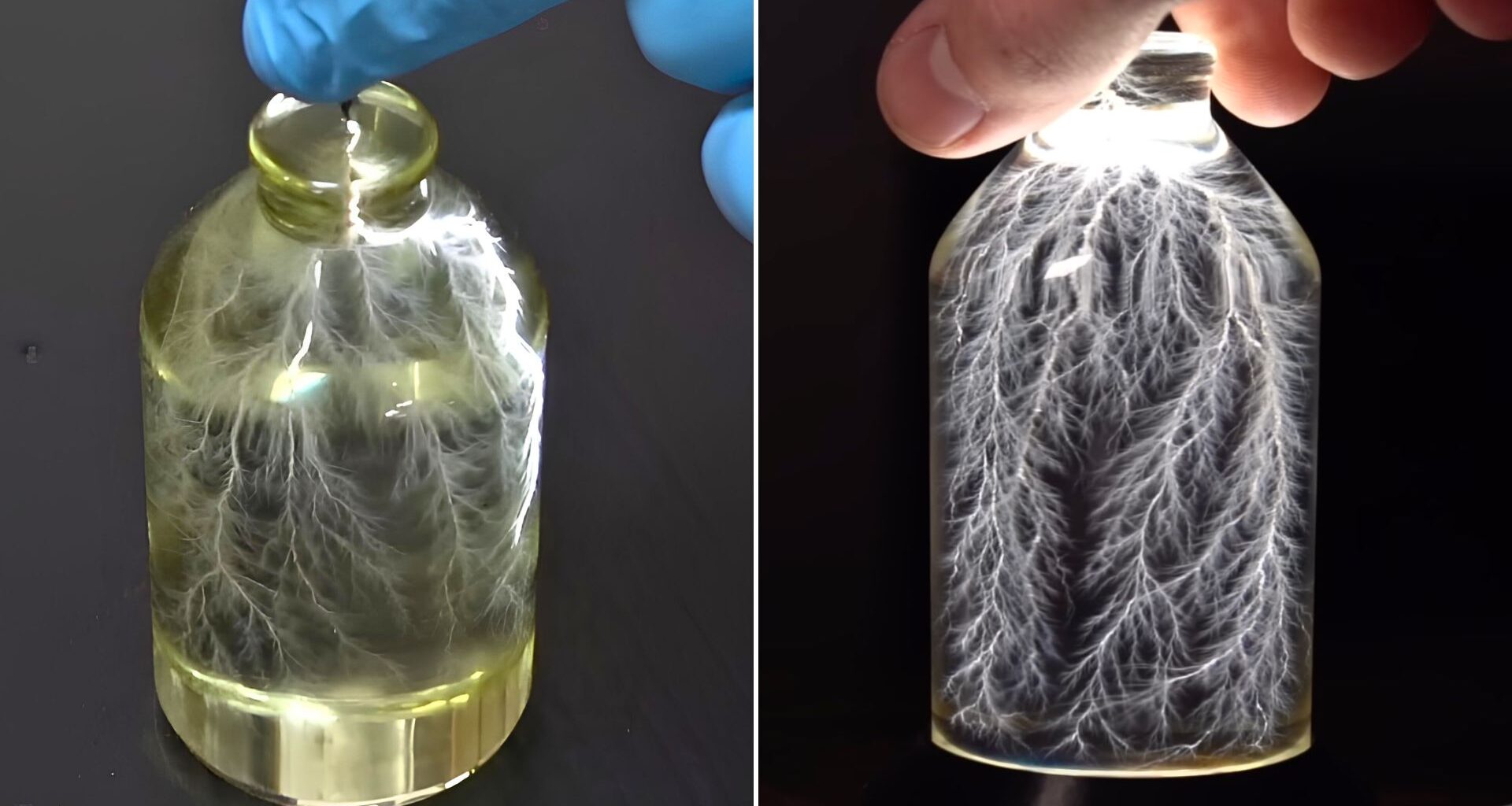
The phrase “lightning in a bottle” is usually used as a metaphor for something rare or impossible to reproduce. In a recent YouTube experiment, a creator known as Electron Impressions gave the phrase a literal interpretation, using a particle accelerator to generate permanent, lightning-like structures inside a clear acrylic cylinder.
The result is a three-dimensional Lichtenberg figure, branching electrical patterns frozen inside a tube that resembles captured lightning glowing within a bottle.
The creator specializes in producing Lichtenberg figures by firing high-energy electrons into insulating materials such as acrylic. These electrons penetrate the material and deposit electrical charge deep inside. When the charge is later released, it fractures the material internally, leaving behind tree-like patterns that trace the path of dielectric breakdown.
Until now, these designs were typically limited to flat blocks, sheets, or discs. The new experiment pushed the process into a fully cylindrical form.
Why a particle accelerator was essential
The key challenge in creating a cylindrical Lichtenberg figure lies in how electrons behave inside solid materials. When fired from a linear accelerator, electrons deposit their charge at a predictable depth determined by their energy.
For flat acrylic pieces, this makes it relatively easy to concentrate the charge near the center. In a cylinder, however, irradiating from only one direction would result in an uneven pattern confined to a single side.
Because the accelerator itself cannot be rotated, the acrylic cylinder had to rotate under the beam instead. This ensured that electrons entered from all angles around the central axis, creating a uniform radial distribution of charge.
The process required precise control. If the cylinder rotated too slowly, the charge would accumulate unevenly. Too quickly, and the exposure would be insufficient.
The cylinder was rotated at approximately 150 revolutions per minute, allowing it to pass under the electron beam multiple times during a brief exposure of 1 to 2 seconds. This speed was calculated to ensure that the entire surface received a uniform electron dose.
Engineering for extreme radiation
Designing a rotating mechanism for use inside a particle accelerator introduced another major challenge. The radiation environment is intense enough to destroy most modern electronics almost instantly. To address this, the rotating assembly was deliberately simple and built from radiation-tolerant components.
A brushed DC motor powered by a 12-volt lead-acid battery drove the system. Lead-acid batteries were chosen because they are more radiation-resistant than high-energy lithium-based alternatives.
A thin sheet of lead was also used to shield the battery, though the creator notes this may have been an extra precaution. Most of the structural components were 3D-printed from black PETG plastic, a material that had previously proven reliable under high radiation exposure.
The roller system itself resembled the rollers of a convenience-store hot-dog machine. Staggered printed wheels held the acrylic tube securely while allowing it to spin rapidly and smoothly during irradiation.
From charging to discharge
The acrylic cylinder, machined to a two-inch diameter from clear material, was designed using CAD software. Two identical cylinders were produced, just in case one did not survive the intended charging process. Once mounted in the accelerator chamber, a radiation-shielded GoPro recorded the exposure, capturing a blue Cherenkov glow as electrons struck the acrylic.
One cylinder accumulated charge successfully and was later discharged intentionally by tapping its side, triggering a sudden release of energy and forming evenly distributed, branching lightning patterns throughout the tube. The second cylinder overloaded and self-discharged under the beam, producing more chaotic and unpredictable internal structures.
Viewed through the curved surface of the cylinder, the internal patterns appear larger and more dramatic due to light refraction, even though the discharge forms a hollow, tube-like structure within. The final pieces highlight how geometry and material physics can combine to transform a familiar electrical phenomenon into a striking three-dimensional form, making “lightning in a bottle” more than just a figure of speech.