
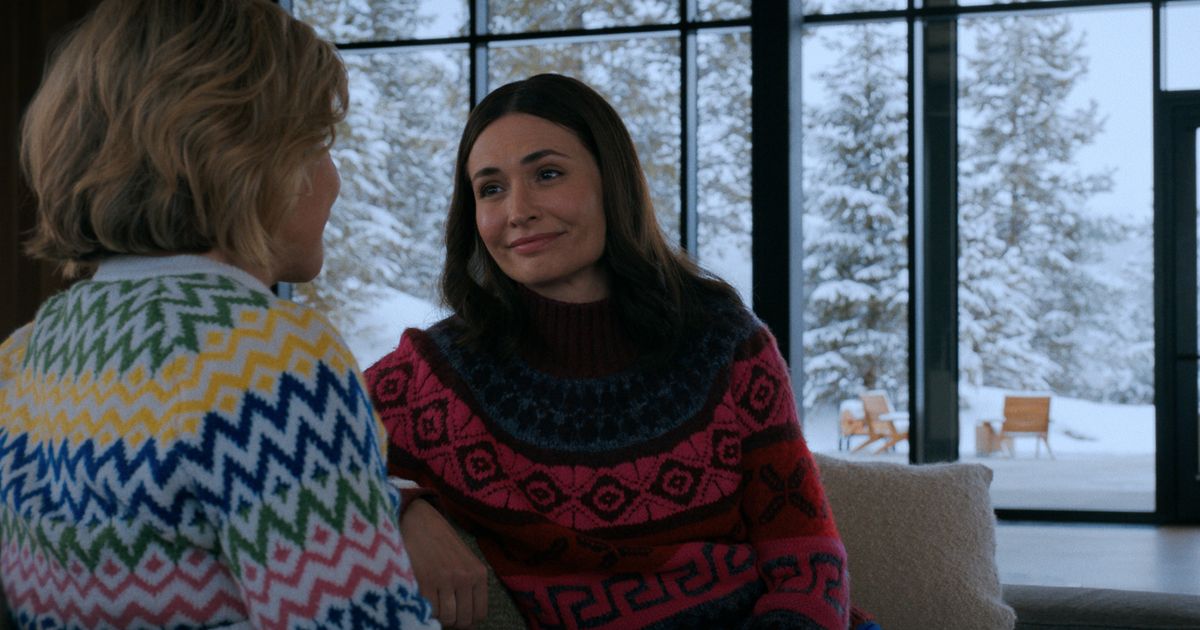
When Zosia says to Carol, “Soon enough you’ll understand everything, and you will feel so much better,” we’re not quite there yet. But we can get started with these queries about how the Others work and where their plan for world domination goes next.
Photo: Apple TV+
Spoilers follow for the first season of Pluribus through the season finale, “La Chica o El Mundo.”
The experience of watching Pluribus is, first, puzzling over what it’s really about; second, wondering exactly how many different expressions of longing and disgust Rhea Seehorn can make (so many!); and third, asking where, exactly, is this story about Carol Sturka’s experiences with the Others going? The literal bomb left dangling in the first-season finale leaves that last question extremely open to speculation, but when thinking about the second season, there are actually bigger questions to consider than Chekhov’s nuclear weapon — all of them having to do with the humanity-conquering entity that willingly provided it to Carol.
The first season’s deliberately slow pacing means that about three months have passed in show time since the series premiere. And while a second season is coming, no release date has been announced, which gives us lots of time to wonder about the Joined side of the Pluribus equation. When Zosia says to Carol, “Soon enough you’ll understand everything, and you will feel so much better,” we’re not quite there yet. But we can get started with these seven queries about how the Others work and where their plan for world domination goes next.
Aside from the broader question of “What are they up to?,” this is perhaps the most recurring curiosity throughout the season, one that Carol first asks of the Others and then realizes she has to ask of herself, too. When Carol meets Koumba (Samba Schutte) and discovers he has already surrounded himself with beautiful Joined women, she’s scathing toward him, noting he is “sticking [his] dick” into “a bunch of brain-damaged incompetents.” Zosia (Karolina Wydra) insists that the Others welcome affection and won’t engage with Carol when she asks whether she’s “some sex doll” with Carol as her “pimp,” so theoretically, the Others are okay having sex with Koumba. (Note, too, that they are capable of removing themselves from situations they don’t like or that put them in danger, like how they leave Albuquerque, Carol, and later Manousos behind.)
But there are still larger questions of consent and individuality here, since none of the Others agreed to the Joining; we don’t know if they actually have sex, of their own volition, for pleasure; and it’s unignorable that Zosia might have started a relationship with Carol to distract her or win her over to the idea that the Others are using her stem cells as a way to eventually make her one of them. Does sex not have any emotional meaning to the Others because romantic love accomplishes nothing for their biological imperative? Does reproduction not play any role in their understanding of love, since they reproduce in a way that is separate from sex? When Zosia tells Carol of Manousos, “We love him the same as we love you,” isn’t she essentially admitting that there is nothing special to the Others about romantic love? I don’t want to suspect that the ever-smiley Zosia purposefully used Carol’s desire for companionship as a way to lull her into the Joining, but if the Others will do whatever to make the un-Joined happy, then isn’t Carol doing with Zosia the exact same thing that Carol judged Koumba for doing? The Others are essentially love-bombing all the un-Joined, and for now that feels more conniving than romantic.
All season long, Zosia and the Others have been insisting to Carol that they value her happiness, which translates into meeting her wants, even if they put the Others in danger — they give her a hand grenade, they give her an atomic bomb. “We would move heaven and earth to make you happy, Carol,” Robert Bailey Jr.’s DHL delivery guy tells her. If Carol even lightly gestures toward wanting something, they’ll insist she take it or that they’ll provide it; this reminds me quite a bit of the Iranian practice of taarof, an extreme form of etiquette where if you compliment something, the other person will practically force you to have it. (This is why, at the end of an Iranian dinner party, you’ll probably walk out of the host’s house with all the leftovers and some random thing you mentioned liking that they’ll slip into your purse.) But are the Others really experiencing happiness or simply placidity? How do their emotions really work, chemically or otherwise? Does “happiness” feel different for them? Zosia lists to Carol how serotonin, dopamine, and oxytocin work together to elevate her mood, but once the Joining occurs, do those chemicals still work in the same ways, or are the Others also changed biologically? “Happiness” as a physical or psychological process, and how it works for the Others versus the immune is worth teasing out.
When Pluribus begins, Carol couldn’t be more dismissive of her fans, the people who consumed her “speculative historical romance literature” and helped provide a very nice life for herself and her partner and manager, Helen (Miriam Shor). She’s stuck in the Wycaro trilogy — which now comprises four books — and frustrated with how obsessed her fans are with the “fucking proud and haughty pirate” Raban, who Carol had first wanted to make a woman and then didn’t for fear it would out her. All of that is to say, when the Joining occurs, Carol isn’t exactly in love with her own work. But the Others are; as Jeff Hiller’s Larry tells her, they equate her work with that of Shakespeare, and they can’t wait to learn what she has in store for her fifth book. Zosia is similarly praiseful when Carol, inspired by their first sexual encounter, writes a new chapter and lets Zosia read it. Now, no shade to the Wycaro books, because the romance genre should be taken seriously! But, uh, if all the Others’ minds are connected, and if they all share each other’s ideas, does this mean that they can’t produce any new ideas, which is why they’re so jazzed for Carol to keep writing? In the nearly three months Pluribus has shown us the Others, we get very little sense of their internal culture, their social priorities, or what they do with their time. Are they capable of producing art, or do they even care to? All of this is complicated by the fact that they are actively working on turning Carol into one of them, but we’ve gotten such a limited view of the Others so far that it’s hard to decipher what they actually value past survival and togetherness.
Aside from providing clarity on all of the above, a day in the life of a Joined being, from their perspective, would be fascinating. We got a very brief glimpse of this when the series first introduced Zosia, who, as Carol’s designated chaperone, seems to have a special, even elevated, status. Is there a hierarchy among the Others? Do all their minds operate in the same way? Internally, is anyone fighting against their Joined programming, as suggested by Manousos’s treatment of the Other known as Rick in the season finale? Give us some insight! That would maybe help explain …
Carol learns that nearly 900 million people died during the Joining, but that still leaves billions of people alive on Earth, and nearly 1 million living in Albuquerque alone. Where are they, exactly? Zosia explains that the Others reject the concept of private property, and we see a lot of people sleeping together at the Rio Rancho Events Center after abandoning their homes, and lines of cars and trucks leaving Albuquerque when the Others abandon Carol. But shouldn’t Carol still see someone — anyone! — when they return to Albuquerque or during her vacations with Zosia, which are both after she’s warmed up to the Others? We see some small pockets of people, like the Others indulging in Koumba’s James Bond fantasy and Kusimayu’s fellow villagers tending to their chores and tasks before she’s turned in the finale’s cold open. But by and large, countless people are missing. Wherever they’ve moved to, and whatever they’re up to outside of working on a way to contact planet Kepler-22b, is still nebulous. (We already know one thing they are up to, which is abandoning domesticated animals that need their care. The newly Joined Kusimayu walking away from that goat who is bleating after her is heartbreaking!)
We know that John Cena is now an Other, bless his heart. Pluribus mentions a few other celebrities pre-Joining: George Clooney, who Carol used as a cover for her Raban inspiration, and Rick Steves, the public-TV icon who has long advocated for traveling the world cheaply and unconventionally. (Carol hating the ever-pleasant Steves is a real sign of her crankiness.) Are they okay, too? The president is gone, but which other celebrities are just living their lives now as regular ol’ Others, like Albuquerque’s mayor? I don’t want Pluribus to go full The Bear and get overloaded with cameos, but it would be fun to cut away to some unexpected people doing whatever it is the Others do. May I suggest Vince Gilligan reach out to his former employee, Breaking Bad alumni Jesse Plemons?
This is just me being a dummy who never gets an answer right when Jeopardy! has anything remotely resembling a “science” category. But if radio waves are what helped the Others’ initial message reach Earth, then radio waves — as Manousos discovered — could help reverse the Joining, right? Manousos being surrounded by books about radio waves and taking notes on loops and circuits all feel like clues worth paying attention to. Sure, Carol has a bomb, but it seems like Manousos’s theories about the Others may turn out to be the more valuable weapon in season two.