
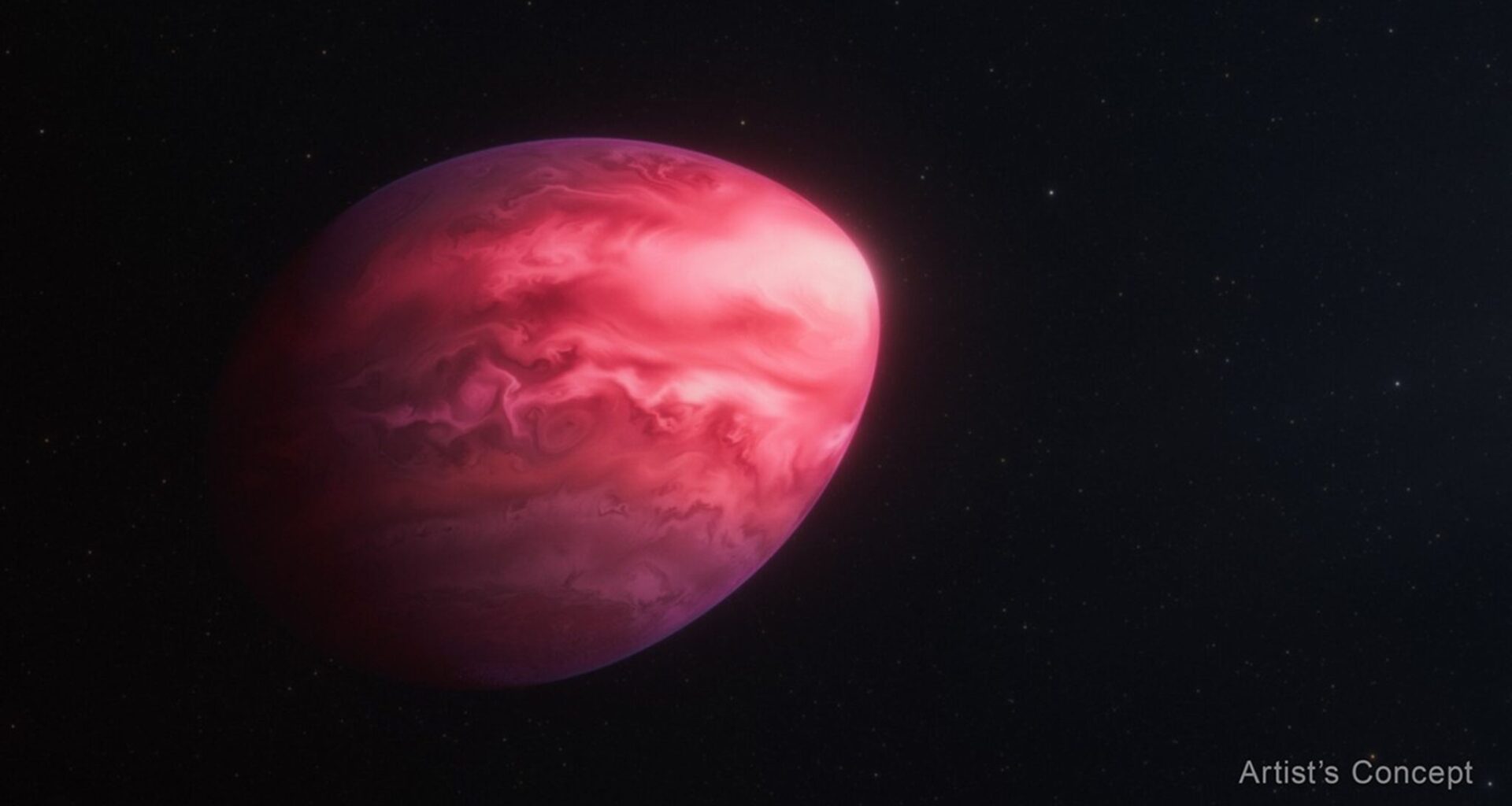
 An illustraion of the lemon world – credit, NASA, ESA, CSA, Ralf Crawford (STScI)
An exoplanet located 2,000 light years from Earth is so unusual it’s given astronomers the idea that it could be a totally new type of object.
That’s because it’s shaped like a lemon, with a small tip just like the fruit has, and a free-floating carbon atmosphere where rain might turn to diamonds in the planet’s extreme temperature.
The authors of the astrophysical analysis on the object have already spoken to a variety of science media outlets and the general consensus is this: there’s no object known that has similar conditions or characteristics.
“I’m open to the possibility that this is an entirely new type of object,” Michael Zhang, one of the authors, told Scientific American, and said to the New Scientist, “we don’t know of any other planetary atmosphere that looks anything like this.”
The exoplanet, or whatever it is, is called PSR J2322-2650b, and it orbits a pulsar at a distance of about 1 million miles, which is 100-times closer than the Earth is to the Sun. As dense as the Sun but as small as a city, a pulsar, which is the rapidly-spinning heart of an already collapsed star, has a strong gravitational field, and it’s believed to be the answer to the question of why PSR is lemon-shaped.
The belief is the intense gravity has literally elongated the sphere into a lemon shape. If you imagine the tip of a lemon, there is a point on the object where material is being drawn away and into the pulsar due to the intense gravity.
Of the 6,000 known exoplanets, this lemon planet is the only one reminiscent of a gas giant (with mass, radius, and temperature similar to Jupiter) that’s also orbiting a pulsar. Only a handful of pulsars are known to have planets, but none so close to it as this one.
“I remember after we got the data down, our collective reaction was ‘what the heck is this?’ It’s extremely different from what we expected,” said study co-author Peter Gao of the Carnegie Earth and Planets Laboratory in Washington.
ALSO CHECK OUT: ‘Starquakes’ Inside Universe’s Densest Objects May Have Seeded Earth with Large Amounts of Gold
The anomalies don’t stop with the shape, however. This Jupiter-mass object appears to have an exotic helium-and-carbon-dominated atmosphere unlike any ever seen before. Soot clouds likely float through the air, and deep within the planet, these carbon clouds can condense and form diamonds.
MORE INTERSTELLAR BIZARRITIES: The Wild Quadruple Star System Contains Not One, but Two of the Most Elusive Objects in the Galaxy
“In order to have molecular carbon in the atmosphere, you have to get rid of pretty much everything else—all of the oxygen, all of the nitrogen—and we just don’t know how to do that,” Zhang told New Scientist.
For reference, Smithsonian Magazine reports, the planetary temperatures can reach as high as 3,700 degrees Fahrenheit, but even at one-third of that temperature, pure carbon binds to other molecules. Free-floating, pure carbon, is just not compatible according to current theories with the atmosphere of the lemon world.
SHARE The Story Of This Bizarre Lemon World Of Diamond Rain…