
Posted on December 24, 2025
Posted by John Scalzi

My senior year of college, I was invited by the Dartmouth Alumni Magazine to come and write a story about the college’s Green Key Weekend, a weekend of partying and games and partying and also partying with partying on the side (why did they invite me? Because I was from the famously unfun University of Chicago, and they wanted to see what the weekend looked like from the view of an outsider with that sort of perspective).
There was much of the weekend I don’t remember (ahem), but one thing that sticks in my mind is the Spring Sing concert, in which the several acapella groups of Dartmouth got together and did their thing. I thought they were all fantastic, and also, during the concert there was one girl who took a penny, balanced it on the end of a stretched-out wire coat hanger and spun it, keeping it stuck on the end of that coat hanger while singing the Toy R’ Us jingle, backward. I remember thinking this was the most hilariously amazing thing I’d ever seen, and also, I wanted to marry that girl, whoever she was.
Spoiler: I did not marry her. But neither has a year gone by that I have not thought about her and wondered what she was doing with her life now. We don’t always pick the things we remember. They make an impression nevertheless.
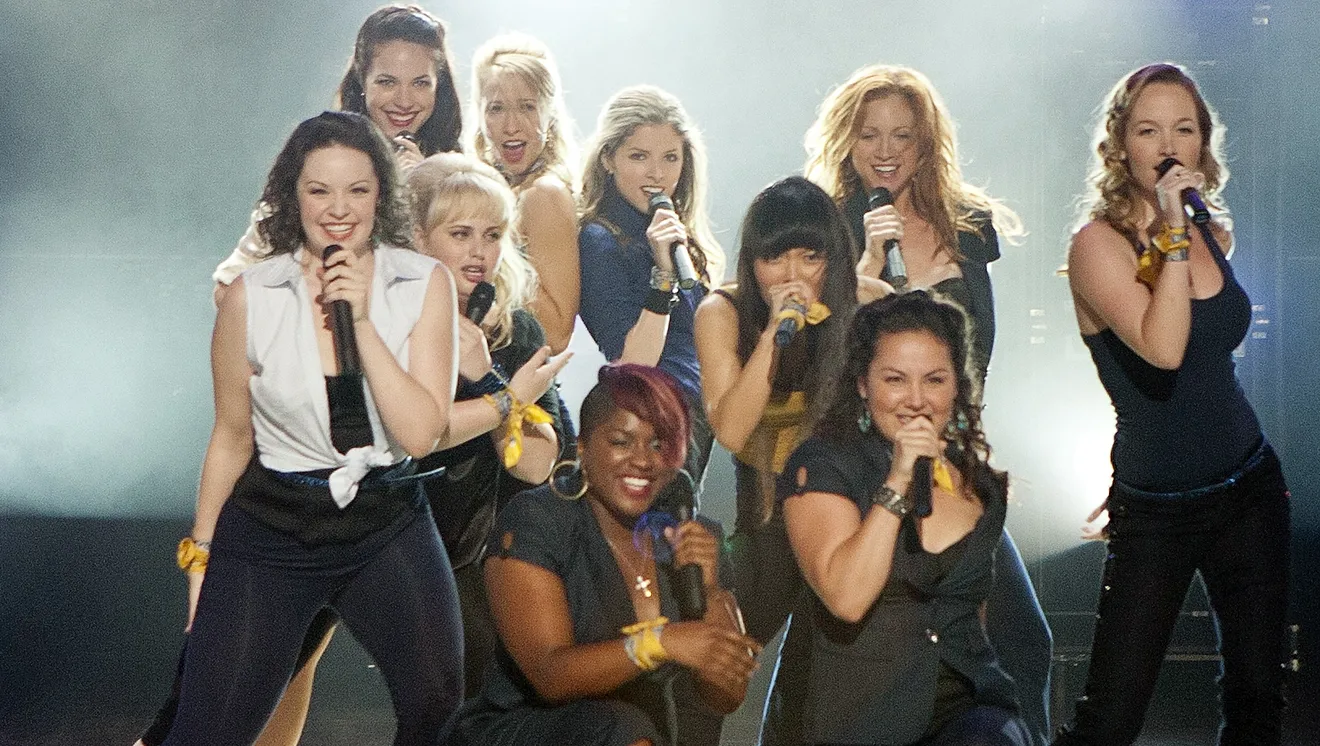
It is perhaps this personal history with acapella that primed me to enjoy Pitch Perfect as much as I did. It is a very silly film about something that doesn’t have much consequence, namely, the hyper-competitive college acapella circuit. This is obscure to the real world (or was, until this film), but is life-or-death to the theater-adjacent-kids who yearn to get out and sing without instrumental accompaniment. I first watched Pitch Perfect not expecting much, and came away having laughed more than I thought I would, and having been unexpectedly moved in a couple of places.
The plot: Beca (Anna Kendrick) is a jaded wanna-be DJ attending Barden University, mostly because her dad’s on the faculty so presumably she’s getting a tuition discount. She mostly wants to work at the college radio station and focus on her remixes, but one day Chloe (Brittany Snow) hears her singing in the shower and basically dragoons her into auditioning for the Barton Bellas, a once-proud all-girl acapella group now struggling because of an infamous event at the previous year’s national competition (which I will not relate, you will see it soon enough if you watch the film).
Beca auditions, gets in and immediately butts heads with Aubrey (Anna Camp), the group’s type-a leader, who wants to do things just so. Beca wants to loosen things up, whether everyone else agrees or not, and eventually there’s a battle of wills for the future of the group, interspersed with various competitions and run-ins with the Treblemakers, Barden’s all-male acapella group, who include Jesse (Skylar Astin), a fellow freshman who is sweet on Beca more than Beca is sweet on him.
Truth to tell, Beca is not a hugely sympathetic main character, even if she is played winningly by Kendrick. Beca gets a lot of mileage out of not being a joiner and being her own person, but mostly it just means she’s unhappy and maybe a little miserable to be around, and causes more trouble than needs to be caused. This is not bad for the movie, since it precipitates at least a couple of amusing scenes (including an acapella rumble, which is as ridiculous as it sounds). It does make you wonder what everyone in this film sees in her. Usually when someone is this casually dismissive of everyone and everything, you just let them get on with being their own little ball of gloom.
But no, the film and its characters are determined to pull her out of her shell, mostly because otherwise there wouldn’t be much of a movie, but also because they intuit that Beca’s lone wolf act is just that, an act. She likes being part of a group, and having friends, and being someone that others can rely on. The question for the movie is whether all of that can be achieved through the power of song, and whether Beca’s own particular set of musical skills will come into play. Inasmuch as this is a crowd-pleasing comedy, you will get no points for guessing how it’s all going to turn out.
No points, but that doesn’t mean it’s not still fun and even affecting. Acapella doesn’t mean anything in the real world, but there are worse things to get wrapped up in as a college-age person, and there’s something to be said about the joy you can have, getting into the same groove as all your friends. This movie is a jukebox musical and all the music is diegetic, but when you’re with a group of people who will naturally burst into song just because they feel like it, that diegetic nature doesn’t feel materially different from a standard musical. There’s something winning about a bunch of people just singing because, you know, why not? Why not sing? Even Beca eventually gives in to it. The power of pop compels her!
Naturally this all leads up to the movie’s final musical performance, where Beca has come up with a way to bring the underdog Bellas back to glory. I don’t know enough about the state of collegiate acapella in the early 2010s to know if what occurs here is an actual innovation or just the film reinventing the musical wheel, but at that point I also didn’t care. It’s a banger of a performance, so full of music nerd energy that I couldn’t help but smile all the way through it, and maybe even tear up (I am a weeper, deal with it). As musical payoffs go, it’s a winner.
Does the world change because of it? Not really, no. But not everything has to change the world. Sometimes just saving a dour little freshman from her own self-imposed alienation is enough. And in the meantime, the movie packs in a lot of snark along with the songs, thanks to a fun script, a very funny supporting cast (including Rebel Wilson in her star-making role), and a greek chorus in the form of two acapella color commentators (John Michael Higgins and Elizabeth Banks, the latter of whom also produced, and who would direct the sequel). It even made a pop star out of Anna Kendrick, as “Cups,” a version of a song she performed in the film, went to number 6 on the Billboard Hot 100 chart.
Pitch Perfect was a moderate-sized hit at the box office and blossomed in home video. Its two successors were box office smashes and there was even a TV series spin-off that detailed the adventures of a Treblemaker named Bumper (Adam DeVine) following up a fluke hit in Germany. None of these quite had the magic of the original, but they didn’t have to have that full measure of magic. Turns out people just seem to enjoy low-stakes comedy with a lot of music thrown in. I’m somewhat surprised that this film hasn’t yet been turned into a Broadway musical. If ever there was a property designed for the a long Broadway run as a tourist favorite followed by an eternal life as a touring show, it is this one. I suspect it’s a question of when, not if.
I watch Pitch Perfect when I need a little pick-me-up, because it’s fun, it has music, and inevitably it makes me smile. I suspect I am not alone in this assessment; I imagine every single acapella kid ever feels the same way, up to and including that penny-swinging, backwards-Toys-R-Us-theme-song singing girl. I know she’s still out there. I bet she loves this film to death.
— JS
(PS: If you want to read that story I wrote about Dartmouth’s Green Key Weekend, 34 years ago now, it’s here.)
Like this:
Like Loading…
← The December Comfort Watches 2025, Day Twenty-Three: Monsters, Inc