
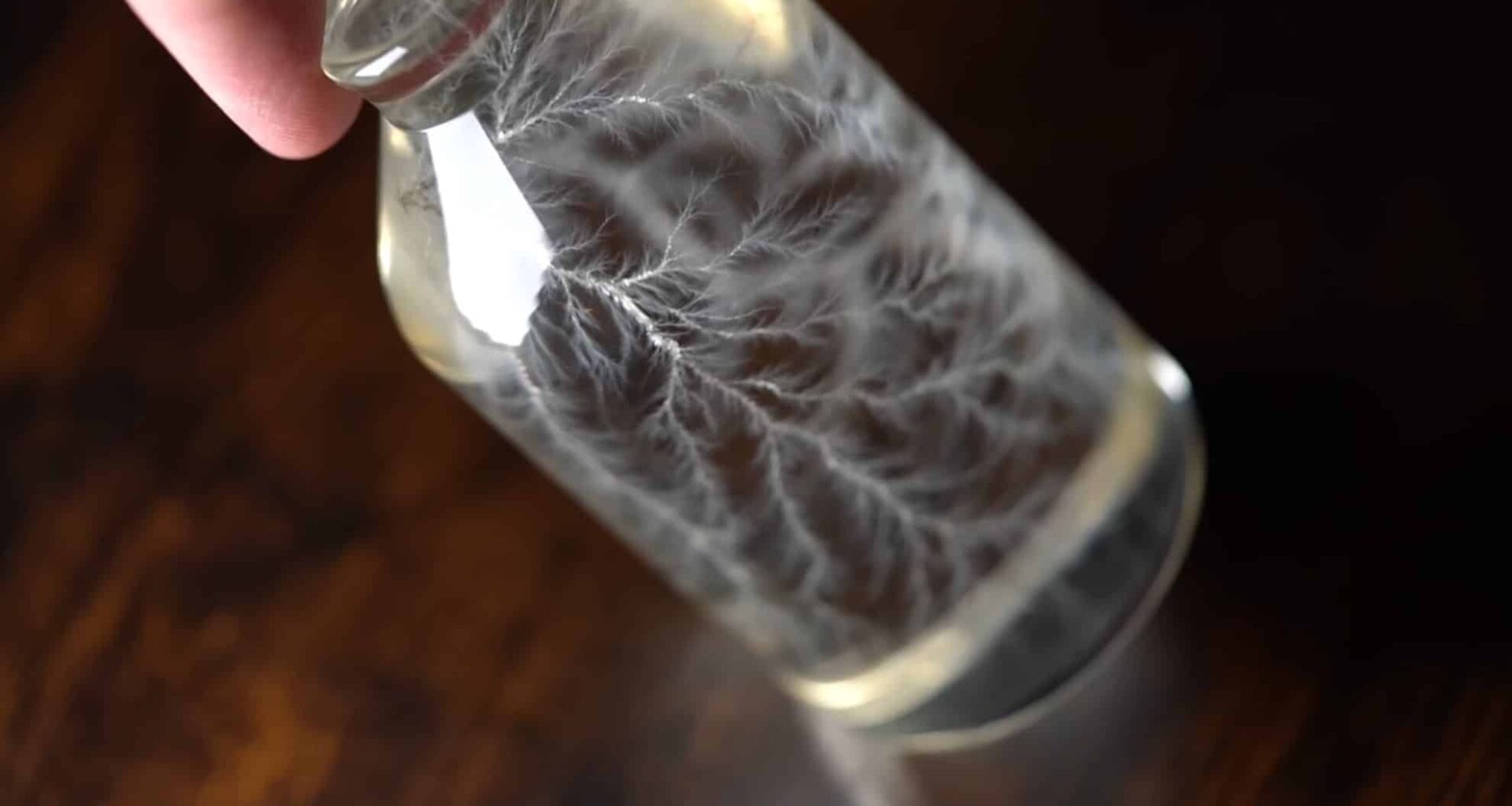
A YouTube creator has managed to turn a familiar idiom into a literal experiment. Using a particle accelerator, Electron Impressions succeeded in creating a three-dimensional lightning-like pattern suspended inside a transparent acrylic cylinder, a real “lightning in a bottle.”
The achievement marks a significant step in the art and science of Lichtenberg figures, those intricate electrical fractal patterns normally confined to flat acrylic sheets or blocks. This time, the lightning branches through an entire cylinder, glowing from within like frozen plasma. According to the same source, the process required not only precision engineering but also creativity to overcome the limits of conventional electron irradiation.
From Flat to Cylindrical: Pushing the Limits of Lichtenberg Figures
For years, Electron Impressions has been experimenting with Lichtenberg figures, producing them by bombarding acrylic with high-energy electrons. These electrons penetrate deep into the material and deposit electrical charge until the acrylic reaches a breaking point. When released, the charge fractures the structure internally, leaving behind permanent, branching patterns that resemble miniature lightning bolts.
In most experiments, the figures formed inside flat sheets or discs, where it was easier to control the electron penetration depth. Creating a similar pattern inside a cylindrical object, however, presented a new challenge. Irradiating from one direction would lead to an uneven distribution, concentrating the charge on a single side of the cylinder. The only solution was to rotate the acrylic tube itself during exposure, ensuring that electrons entered from every possible angle.
Engineering Under Radiation: Building a Rotating System for the Accelerator
Designing a rotating mechanism capable of operating inside a particle accelerator meant confronting extreme conditions. The high-radiation environment would destroy most modern electronics almost instantly. According to Electron Impressions, the setup was deliberately kept simple, using a brushed DC motor powered by a 12-volt lead-acid battery, chosen for its radiation resistance.
A protective lead sheet surrounded the battery, though the creator described it as an extra precaution. The rest of the assembly was 3D-printed from black PETG plastic, a material known to withstand radiation well. The rotation speed was critical: too slow, and the beam would charge only one section; too fast, and the exposure would be insufficient. After testing, the cylinder was set to spin at around 150 revolutions per minute, fast enough for the entire surface to receive a uniform dose during a one-to-two-second exposure.
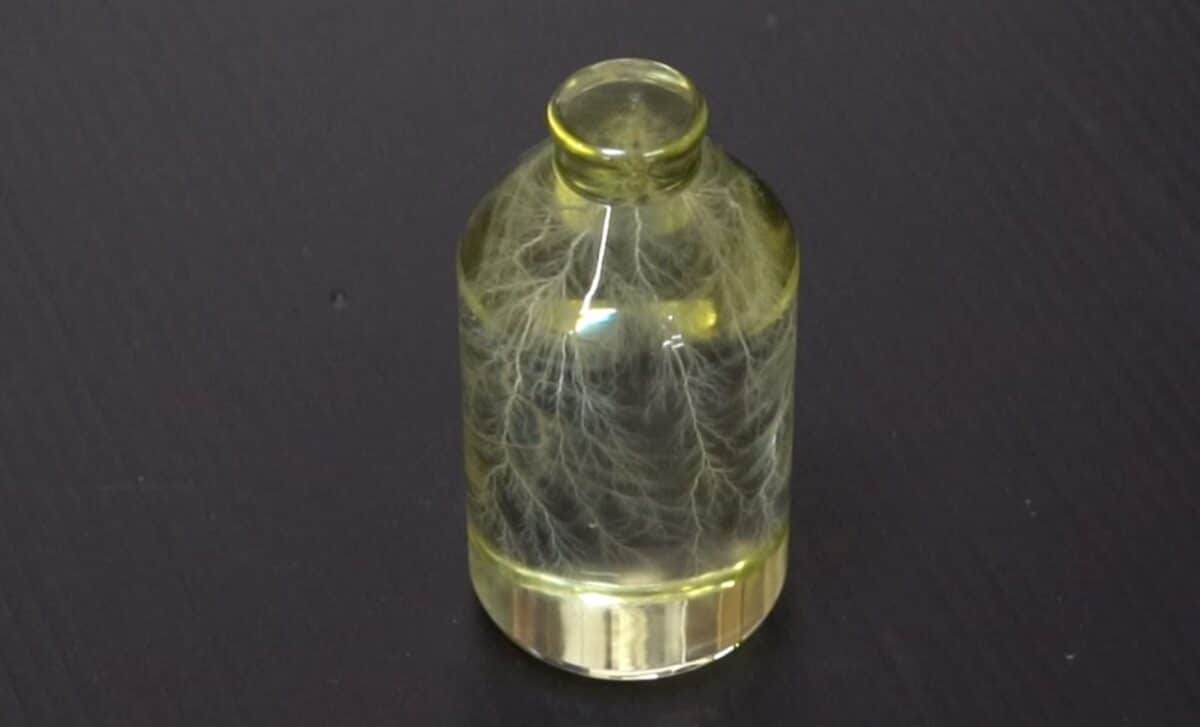 The branching lightning patterns throughout the acrylic cylinder ©YouTube/Electron Impressions
The mechanical design resembled a convenience store hot-dog roller, with staggered printed wheels that allowed the cylinder to turn smoothly. The compact, radiation-proof motor assembly operated reliably within the accelerator, proving that a minimalistic design could handle one of the harshest environments on Earth.
The Moment Lightning Forms
Once charged, the acrylic cylinder stored enormous electrical potential. One of the two cylinders prepared for the experiment was successfully discharged by tapping its surface, triggering a burst of energy that etched symmetrical lightning-like veins throughout the material. The other cylinder, as stated in the YouTube video, self-discharged during exposure and developed a more chaotic internal structure.
Both outcomes were recorded by a radiation-shielded GoPro that captured the blue Cherenkov glow as electrons struck the acrylic. The resulting images revealed a hollow, tube-like discharge pattern, with the internal lightning appearing larger than it truly was due to light refraction through the curved surface. This optical illusion gives the impression that the lightning expands inside the cylinder, as if suspended in motion.
The finished pieces demonstrate how geometry, radiation physics, and careful engineering can merge into a single visual experiment. For the first time, the phrase “lightning in a bottle” has taken on a literal, glowing form, not through metaphor, but through the precision of high-energy science.