
 Credit: ESA
With the announcement of two new launch contracts for its Vega C rocket, totalling more than €100 million, Italian rocket builder Avio appears to have revealed that the launcher could remain operational until 2031. This, in turn, raises questions about when the company plans to introduce its successor, Vega E, and how long it would remain in service before being replaced by its next-generation Vega Next rocket.
On 19 December, Avio announced that it had signed launch service agreements with two undisclosed customers to deploy multiple satellites into Sun-synchronous orbit using the Vega C launch system. The company added that the launch services outlined in the two agreements would be carried out between 2028 and 2031. This would imply that Vega C could remain in operational use until 2031.
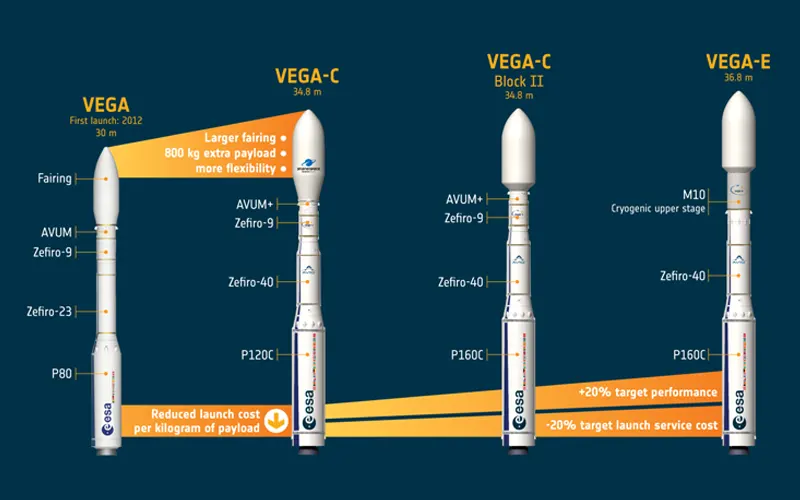
Currently, Vega C is flown in its Block 1 configuration, using the P120C solid-fuel booster as its first stage. On 19 December, the European Space Agency announced that it had completed a final qualification review of the P160C booster, which will form the basis of the more powerful Block 2 configuration of the Vega C rocket. As part of the announcement, ESA revealed that the booster is expected to fly aboard Vega C for the first time in 2028, again implying that Vega C would remain operational at least until that point, and likely beyond.
In its 2023 half-year financial results, Avio revealed that the inaugural flight of Vega E was expected in late 2026. A year later, in the company’s 2024 half-year financial results, it pushed the rocket’s debut to 2027. Vega E is the planned successor to Vega C and will retain the first and second stages of the Vega C Block 2 rocket, replacing the third and fourth stages with a single stage powered by its new MR10 methalox rocket engines. The rocket is expected to deliver 20% greater payload performance than Vega C Block 2 at around 20% lower cost.
While Vega C utilizes the same launch infrastructure at the Guiana Space Centre as its predecessor, Vega E will be launched from the old Ariane 5 launch facility, which will need to be repurposed to accommodate the smaller rocket.
In December 2024, ESA awarded Avio two contracts totalling €350 million to increase the launch cadence of Vega C and complete the development of Vega E. Speaking to European Spaceflight at the time, an ESA spokesperson explained that approximately 85% of the total funding would be allocated to the development of Vega E. The amount will cover both the development of the rocket and the construction of the launch infrastructure. Additionally, during the agency’s Ministerial Council meeting held in Bremen last month, member states committed another €47.82 million to the development of Vega E, notably without any contribution from France.
While Avio works towards upgrading Vega C and completing the development of Vega E, the company is also projecting the introduction of its “post-Vega-E Vega Next launcher” as early as 2032. The rocket would leverage technologies developed under Avio’s Space Transportation System (STS) initiative, which is funded by the Italian government and aims to develop two demonstrators using the company’s MR10 and future MR60 rocket engines. These demonstrators will also mark Avio’s initial foray into reusable launch vehicle technologies, which are expected to be incorporated into the Vega Next rocket.
As it stands, it remains unclear when Vega E will be introduced, whether it will operate alongside Vega C beyond what is strictly necessary for a smooth transition, and how long it will remain in service before Vega Next is introduced. With well over €300 million already committed to its development, the lack of clarity around Vega E’s role and longevity raises legitimate questions about its long-term value proposition.
Keep European Spaceflight Independent
Your donation will help European Spaceflight to continue digging into the stories others miss. Every euro keeps our reporting alive.