
There’s plenty of detail still to come.
But what is on the table is significant and a fillip for our exporters and investors over time.
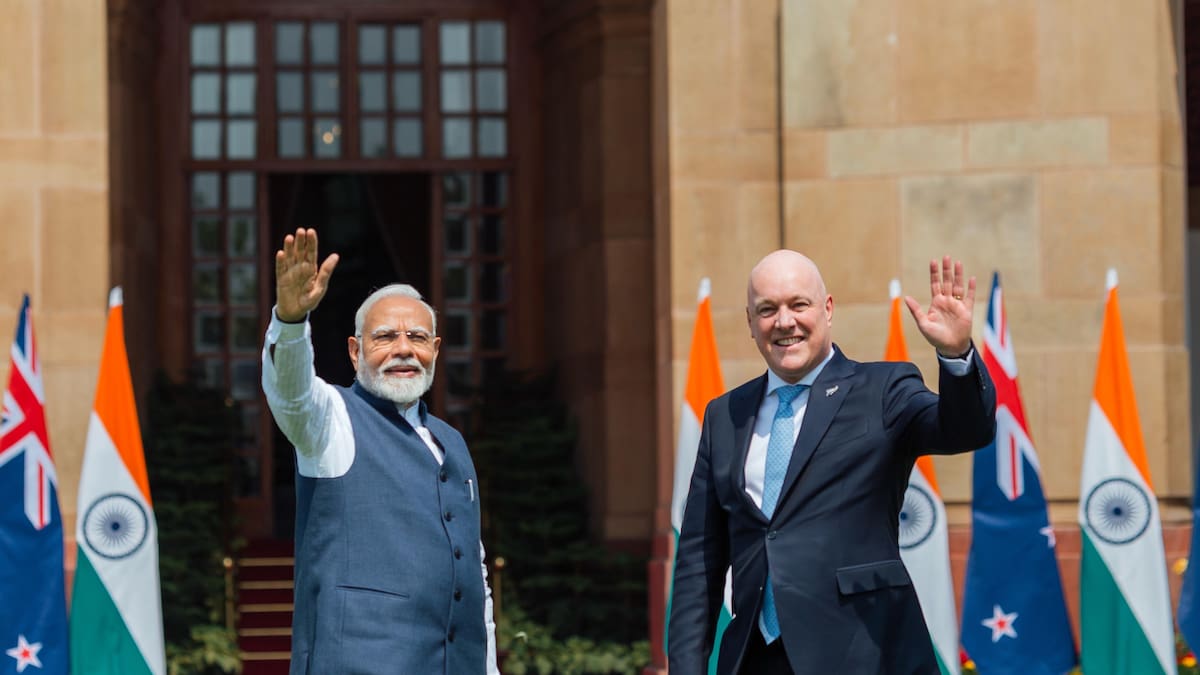
Luxon has issued an open invitation to his Indian counterpart Narendra Modi to come to NZ to witness the signing of the bilateral trade agreement. The Indian PM is said to be very excited about the deal.
There hasn’t been a visit by an Indian PM to NZ for 40 years.
If Modi can’t visit, the plan is for Luxon to travel to India for the signing of the agreement by McClay and Indian Commerce and Industry Minister Piyush Goyal.
It’s expected there will be more clarity after discussions are held on the Indian PM’s travel agenda in the early months of 2026.
It’s no secret that it took time and a great deal of patience for Luxon to get onto Modi’s dance card in the first place.
Potential official visit times came and went for him to go to India, but Luxon credits time sitting alongside Modi in international forums as enabling him to build the necessary rapport first which provided an impetus to kick off free trade talks when he finally got to visit New Delhi.
The deal will eliminate or reduce tariffs on 95% of NZ’s existing exports to India, providing a competitive edge over Australia.
Key sectors benefiting include sheep meat, wool, coal, forestry, seafood, and high-value dairy products.
The agreement aims to double NZ’s exports to India within five years.
What does India get?
The big plus for India is the precedent-setting effect on the elimination of tariffs which Goyal will endeavour to play forward in negotiations with larger players.
It’s another agreement in India’s growing matrix of trade deals at a time when the Trump Administration’s tariffs have thrown the prior rules-based order into chaos.
It also is another building block in Viksit Bharat 2047 – the government’s vision to transform the country into a self-reliant and prosperous economy by 2047.
Goyal told a press conference the India-NZ FTA was concluded in nine months and is significant for its rapid completion and strategic importance.
It is India’s third FTA with a “Five Eyes” nation and opens up opportunities in various sectors, including agri-tech, food processing, clean energy, and education.
The agreement offers enhanced market access, visas for Indian professionals, and a fast-track mechanism for pharmaceutical product approval. It aims to double trade in five years and benefits farmers, dairy producers, and micro SMEs.
Modi later praised as insightful an article by Goyal that explained India’s FTAs today go well beyond tariff reductions, forming part of a broader mission to strengthen the economy and improve the lives of millions.
“It is India’s first women-led FTA. Almost the entire negotiating team comprised women,” Modi said.
There is also an electoral calculation with India aiming to finalise the deal before their 2027 state elections.
‘Pay to play’
The “pay to play” concept is well established when it comes to securing international market access.
Typically, a developing economy – even one now on track to be the world’s third largest – requires a partner to make substantial direct investments in return for greater access to their fast-developing consumer market.
At first blush, New Zealand’s investment commitment is heroic.
New Zealand has committed to promote investment into India with the aim to increase private sector investment by US$20 billion ($34.253b) over 15 years.
McClay maintains the target is aspirational. India will establish a bespoke “New Zealand Investment Desk” to assist New Zealand investors.
But Goyal says there will be clawbacks if it is not achieved.
McClay emphasises the Investment Chapter is not subject to dispute settlement, including Investor-State Dispute-Settlement, though there is a “remedial” process available to India.
It’s all relative: Switzerland – with an admittedly much larger economy – has agreed to pony up US$100b of direct investment as their “tickets to the game”.
The flipside?
It’s up to NZ companies to take advantage of the door the Indian Government has opened wide to them to invest in India.
While the aspiration target seems huge, the plus factor is it does not impose a low ceiling on NZ investment into India. Quite the opposite.
Already companies like Slumberland have manufacturing deals with Indian partners seeking to provide mattresses to the growing middle class.
Fonterra already has a food service company there.
Even back in 2018, Fonterra was forecasting that over the next seven years, the demand for dairy from Indian consumers is set to increase by 82 billion litres – seven times the forecasted growth for China.
The country’s young population was looking to level up its dairy consumption with new products that met with their expectations of higher quality and nutrition.
There are opportunities now to invest in food manufacturing, infrastructure – including digital services and more to meet market demands.
One of the more interesting aspects is the ability to form joint-venture manufacturing facilities in India for exporting product into third markets.
Chinese dairy firms have exploited a similar regime in NZ to produce product for export to South East Asia.
Racism and election politicking
Does Foreign Minister Winston Peters really believe India’s Subrahmanyam Jaishankar is going to accept Peters’ outright antipathy to the agreement?
Peters’ implicit exaggeration of the numbers of Indians who will come to NZ under the deal and take Kiwi jobs has sparked a wave of xenophobic and quite racist comments on social media.
Those comments are an only too sharp a reminder of the bilious venom that spilled out when Nikhil Ravishankar was appointed CEO of Air NZ.
Peters told Politik’s Richard Harman that the 5000 cap on new visas does not include family members who will be eligible to come.
“You’ve got to read it very carefully. If you can see who can come, it’s plus family. And it can be three or four. You go from saying it is one child – 10,000 to quickly possibly 25,000 or more.”
McClay says that is simply not correct – the door is not being opened to a major immigration wave.
Credit where it is due
The Ministry of Foreign Affairs and Trade team has worked its heart out to get this deal agreed.
The public glory belongs to Luxon and McClay for setting a big ambition and getting an agreement in place before Christmas.
For this, they are my joint politicians of the year.
Catch up on the debates that dominated the week by signing up to our Opinion newsletter – a weekly round-up of our best commentary.