
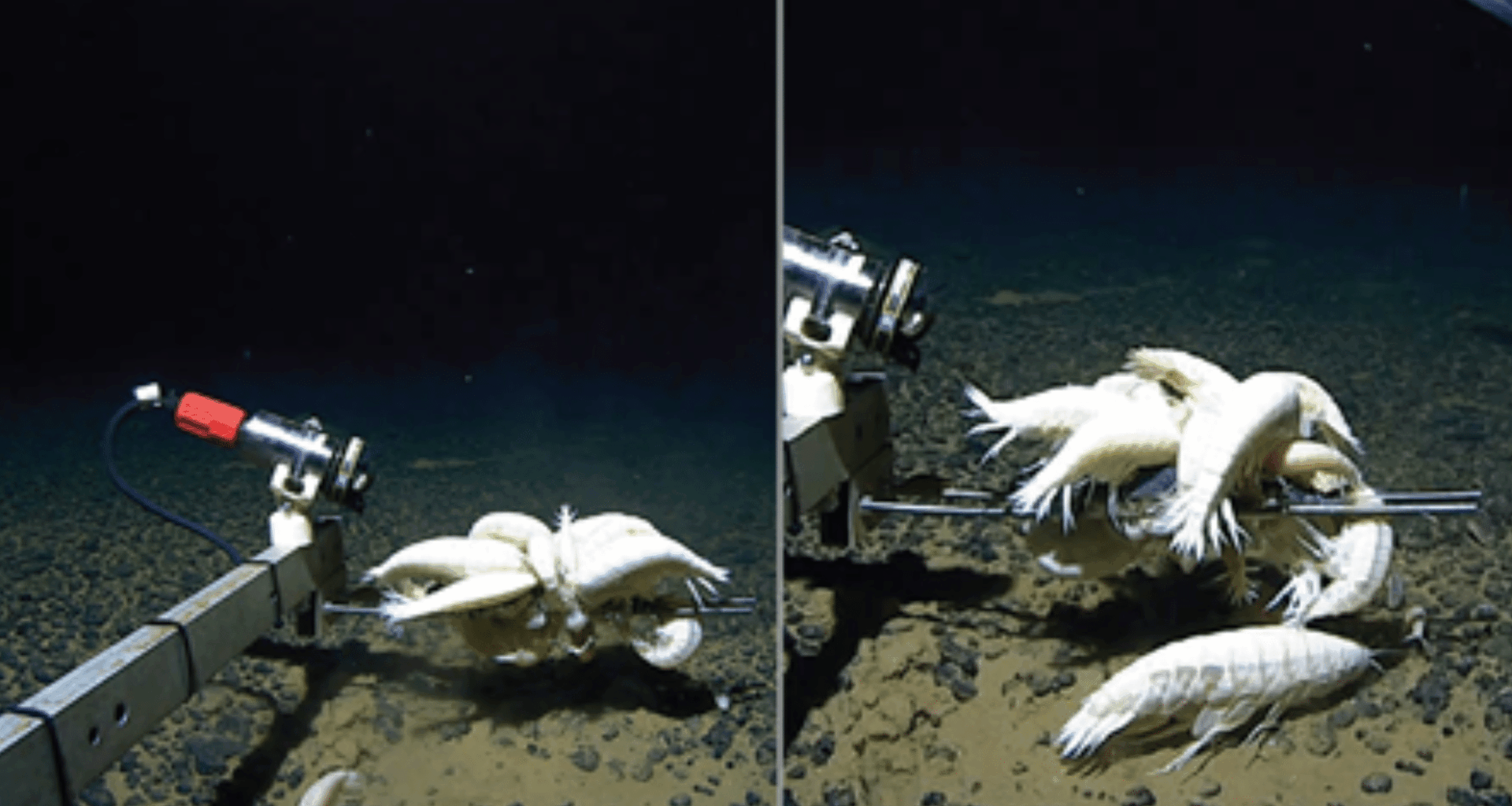
The deep sea, home to some of Earth’s most enigmatic creatures, has recently revealed new insights into one of its giants. Alicella gigantea, a supergiant amphipod, has long been considered rare. However, recent research has challenged this assumption, unveiling a widespread and thriving population across the ocean’s most extreme depths.
A Closer Look at Alicella Gigantea: The Giant Amphipod of the Deep Sea
For many years, Alicella gigantea—a massive, shrimp-like crustacean—was considered an oddity of the deep sea, its sightings infrequent and often regarded as anomalies. This amphipod, which can grow up to 13.4 inches, was believed to be a rare species, with only scattered reports and physical samples supporting its existence. Yet, a groundbreaking study has revealed that the species is far from rare, with a more extensive distribution than scientists initially suspected.
The study published in Royal Society Open Science , conducted by Dr. Paige J. Maroni from the University of Western Australia, leveraged a combination of genetic research and global deep-sea expeditions to reassess the status of Alicella gigantea. “Historically, it has been sampled or observed infrequently relative to other deep-sea amphipods, which suggested low population densities,” Dr. Maroni explained. This lack of data led to the belief that the species existed in isolated pockets, possibly in dwindling numbers. However, genetic studies from a variety of samples worldwide have proven that Alicella gigantea is thriving across vast regions of the deep ocean floor.
From Rare to Widespread: New Evidence Unveiled
As more samples were collected from diverse expeditions across the Pacific, Atlantic, and Indian Oceans, a new picture began to emerge. Using genetic analysis of mitochondrial and nuclear genes, Dr. Maroni and her team discovered minimal genetic variation across populations, indicating that this species spans vast oceanic regions with little differentiation.
“As exploration of the deep-sea increases to depths beyond most conventional sampling, there is an ever-growing body of evidence to show that the world’s largest deep-sea crustacean is far from rare,” Dr. Maroni said.
This revelation challenges earlier assumptions that Alicella gigantea was confined to small, scattered regions. Instead, it appears to occupy a broad network of oceanic trenches and plains, inhabiting extreme environments from around 17,400 feet to over 29,300 feet below the surface. The species’ ability to survive and thrive in these depths, where temperatures are near freezing and pressure is immense, further underscores the adaptability of life in Earth’s most hostile environments.
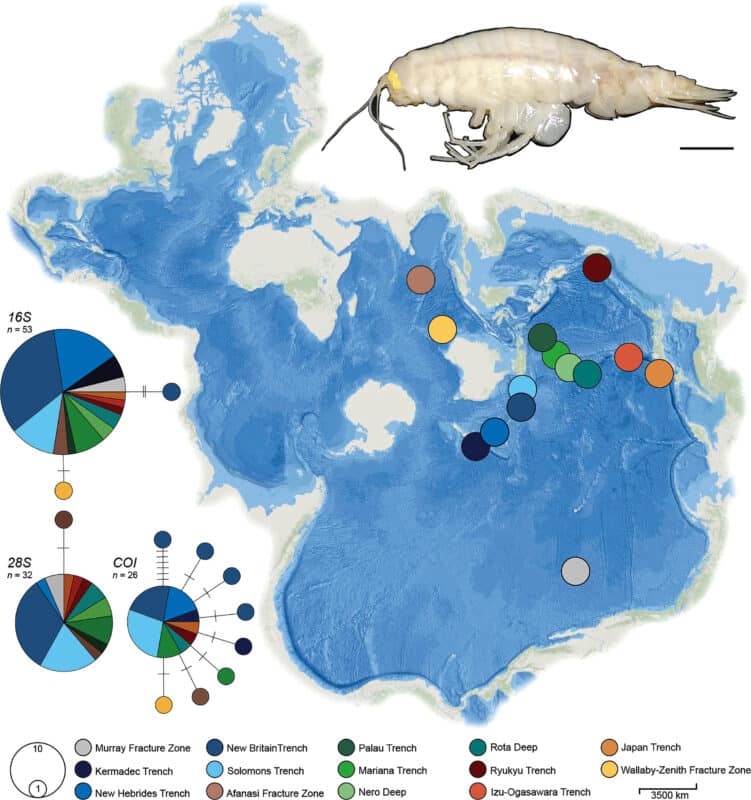 Spilhaus world projection showing the sample sites of all sequenced Alicella gigantea specimens used in this study. Each site is denoted by a circle and color-coded by deep-sea feature. Bottom left: Three TCS haplotype networks depicting the sequenced material.
The Genetic Mystery: Why Is Alicella Gigantea So Similar Across Oceans?
One of the most intriguing aspects of this discovery is the genetic homogeneity found among Alicella gigantea populations. Despite occupying vast and geographically distant regions of the deep sea, the species shows very little genetic differentiation. This raises questions about the mechanisms that allow the amphipods to spread so widely across such isolated and extreme environments.
Some marine specialists hypothesize that the slow rate of evolutionary change in the deep sea, due to the stability of temperature and other environmental factors, may contribute to this lack of genetic diversity.
“And, because it was not often found, little was known about the demography, genetic variation and population dynamics with only seven studies published on DNA sequence data,” Dr. Maroni noted.
Another possibility is that ocean currents or tectonic shifts over millions of years facilitated the movement of these creatures, allowing them to colonize new areas without significant barriers.
Resilience in the Deep: How Alicella Gigantea Survives Harsh Conditions
Aliella gigantea is not just a marvel in terms of its widespread distribution, it is also a remarkable example of resilience. In the deep ocean, where food is scarce, temperatures are near freezing, and pressure is crushing, survival is a constant challenge. Yet, this amphipod has found a way to thrive in the deep-sea trenches and hadal zones. The amphipod is a scavenger, feeding on carrion and organic matter that sinks to the ocean floor. This diet allows it to endure in remote regions where food sources are intermittent.
The creature’s ability to inhabit such extreme depths and conditions highlights its remarkable adaptability. Stomach content studies of Alicella gigantea have shown that it can endure environments with low food availability, relying on the sporadic supply of sinking organic material to sustain itself. This ability to survive in nutrient-poor waters may help explain the species’ widespread presence across deep-sea trenches and plains.
The Significance of Alicella Gigantea in Marine Conservation Efforts
The discovery of Alicella gigantea’s true abundance also brings with it important implications for marine conservation. While much of the focus in ocean conservation has been on more charismatic or well-known species, the deep-sea ecosystems that are home to creatures like Alicella gigantea are equally important. These ecosystems play critical roles in global processes such as carbon storage and nutrient cycling, and understanding how organisms like Alicella gigantea spread and maintain populations can offer valuable insights into the health of the deep-sea environment.
With human activities increasingly encroaching upon these remote ecosystems—through sub-seafloor mining, deep-sea exploration, and climate change—studying the biodiversity of the abyss is more crucial than ever. As Dr. Maroni emphasized,
“The advancements in next-generation sequencing technologies and an increase in deep-sea exploration will allow research into the evolution of hadal amphipods to grow rapidly in the coming decades.”
These advancements will likely unlock further mysteries about the creatures that inhabit the deep, revealing new information on how they adapt to extreme pressures and temperatures.