
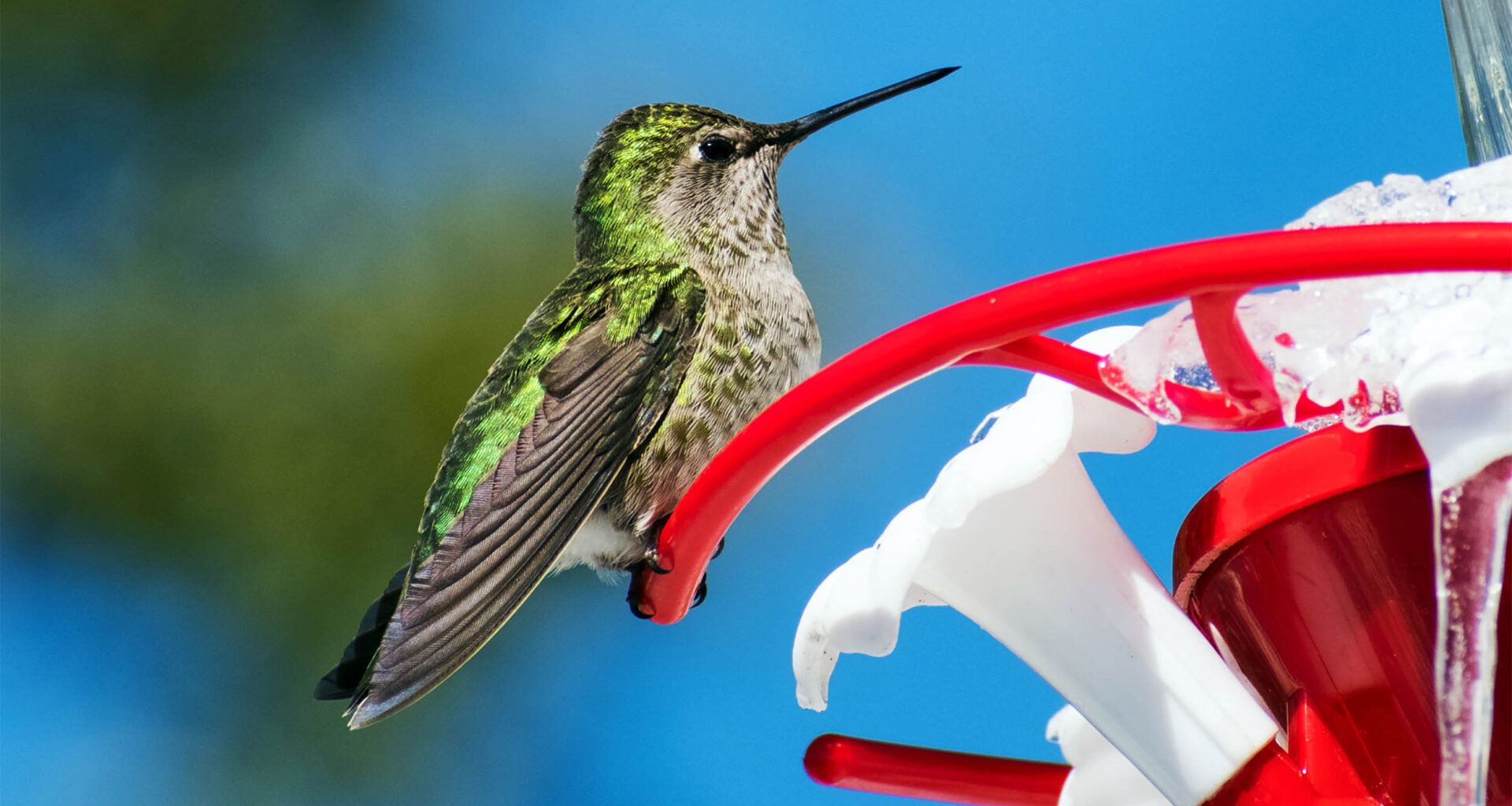
A hummingbird feeder looks simple. It hangs from a porch. It holds sugar water. A tiny hummingbird darts in, drinks with its bill, and zips away. Plenty of people keep feeders up year-round, and millions hang them during summer and spring year after year.
That habit raises bigger questions.

When humans give wildlife a reliable food source, do the animals simply accept the free meal and continue living as they otherwise would? Or can that steady handout start to shape those animals over time, both mentally and physically?
A study from the University of California, Berkeley asked that question. The researchers chose Anna’s hummingbirds (Calypte anna) because this species often thrives near people and expands into new landscapes.
Their research highlights how these birds have learned to thrive alongside humans, and as a result, how they’ve evolved.
Hummingbird bills and humans
If you spend any time at all outdoors, chances are you’ve seen Anna’s hummingbird. These iridescent green-and-bronze hoverers are very common in North America, especially along the West Coast, and growing more so.
While human expansion has taken a toll on most wildlife, Calypte anna stands out as an exception. Over the past century, this hummingbird species has expanded its range, and its population appears to be on the rise.
“They seem to be moving where we go and changing quite rapidly to succeed in their new environments,” says co–lead author Nicolas Alexandre, who conducted the work when he was a graduate student at UC Berkeley. “We can think of Anna’s hummingbird as a commensal species, similar to pigeons.”
Anna’s hummingbirds use energy quickly, so they must eat often. Their bills (the scientific word for “beaks”) are central to their survival. Bill shape affects how efficiently a hummingbird feeds and how it competes with other hummingbirds.
Over the last century or so, Anna’s hummingbirds have experienced two major human-driven changes. People planted non-native nectar sources, such as eucalyptus, which can flower when native plants do not.
In addition, humans invented hummingbird feeders, turning yards into reliable “nectar stations.” The birds also expanded into colder regions.
Anna’s hummingbirds do not live on sugar alone. They also eat small insects and spiders for protein, and they can enter a low-energy state called torpor on cold nights. Even so, an easy daytime energy source can matter, especially when winter flowers run thin.
Studying hummingbird bills
No one can run a controlled lab experiment for over 100 years, so the scientists combined evidence from records that already existed. They measured hummingbird bills from museum specimens collected over many decades.
In one major dataset described in reporting on the study, scientists measured about 400 museum specimens spanning the late 1800s into the 2000s, using shape analyses that looked at hummingbird bills in more than one dimension.
They also tracked when feeders and eucalyptus became common in certain areas of the world by searching archived newspapers. Those papers included ads and everyday mentions that showed how these items spread across communities.
For hummingbird numbers and range, the team relied on long-running community science counts (volunteer-run bird surveys), especially the Audubon Christmas Bird Count, which uses standardized observations that let researchers compare regions and years.
How feeders shaped bills
When the researchers compared these lines of evidence, the availability of feeders and eucalyptus matched increases in Anna’s hummingbird numbers.
That pattern went beyond “more food equals more birds.” The researchers found that feeders, in particular, were linked to changes in hummingbird bill shape, not just changes in where the hummingbirds lived.
The study shows how hummingbird bills became longer and more tapered as more humans hung feeders in their yard, with a distinct constriction noticeable in the upper bill.
Discovering that exact pattern is important because it points to a specific reshaping rather than a simple “everything got bigger” effect.
The researchers also saw a sex difference: males had a more pointed upper bill, and the team suggested this trait could help in aggressive encounters around feeders.
Feeding fast, fighting faster
Many people assume hummingbirds drink through their bills, but they do not. They use a tongue-based system that moves in and out very quickly.
At a feeder, the situation changes. Instead of sampling many flowers that each offer a small sip, hummingbirds can use their bills to drink from one rich source until another bird swoops in and drives it off.
In those situations, a bird that feeds quickly and maintains access can gain an advantage. A small change in hummingbird bill length or shape could affect how quickly a bird feeds, and tight crowding at a feeder can raise the odds of conflict.
Feeders did not explain everything. The study reports that hummingbird bill size decreased at higher latitudes, where temperatures are lower. A smaller bill can reduce heat loss because exposed body parts can leak warmth to the air.
The research also notes that hummingbird bills can release heat while a bird is perching. That means the bill plays a key role temperature control, not just feeding.
Hummingbird evolution and humans
The team at UC Berkeley separated “association” from “proof.” They combined museum measurements, feeder and eucalyptus history, bird count records, and climate patterns, then checked whether those independent clues agreed.
People often talk about evolution as something that only happens over millions of years, but this study tracks change over decades and across relatively few hummingbird generations.
No single bird “decides” to grow a different bill. Populations change and species evolve when individuals within a group vary, and the environment repeatedly rewards some traits more than others.
Human influence on other species is often framed in terms of habitat destruction or intentional domestication, but this research suggests a more subtle role.
People can also drive rapid, unintended evolutionary change simply by reshaping the environments in which species like Anna’s hummingbird now thrive.
The full study was published in the journal Global Change Biology.
—–
Like what you read? Subscribe to our newsletter for engaging articles, exclusive content, and the latest updates.
Check us out on EarthSnap, a free app brought to you by Eric Ralls and Earth.com.
—–