
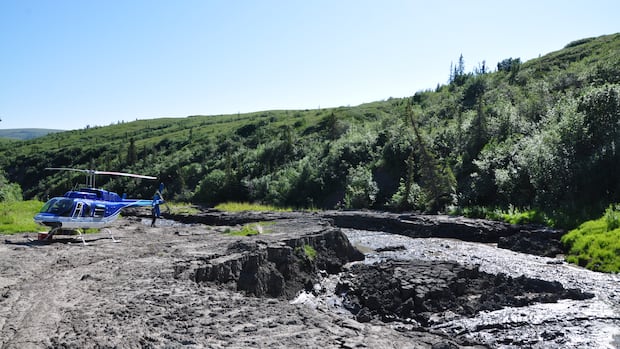
Researchers at the University of Alberta are looking to pull back the veil on how much carbon from melting permafrost is contributing to climate change.
“The purpose of this research is to just give us a sense of where we stand,” Suzanne Tank, a biological sciences professor at the university, said in an interview with CBC News.
U of A researchers will play a key role in Canada as part of a global research project trying to better understand where permafrost thaw is likely to be most rapid. The initiative is also quantifying carbon and organic matter in northern soils and how it is dispersed in order to look at measuring carbon dioxide emissions.
A researcher who worked on an international study on permafrost and climate change that was released in 2022, said at the time that the thawing of the frozen ground could contribute the same amount of greenhouse gases to the atmosphere as a large industrial nation by the end of the century.
“There have been studies that have looked at this at relatively small scales,” said Tank, who is the Canada Research Chair in Land-Ocean Biogeochemistry.
“This ability … to extrapolate and understand how the Arctic is changing as a whole, is … it’s a big challenge, right? And so [it] requires this interdisciplinary approach.”
Nearly half of Canada is covered in permafrost, which is a dense layer of soil and sediment that remains frozen for years.
WATCH | How permafrost is impacting our changing world: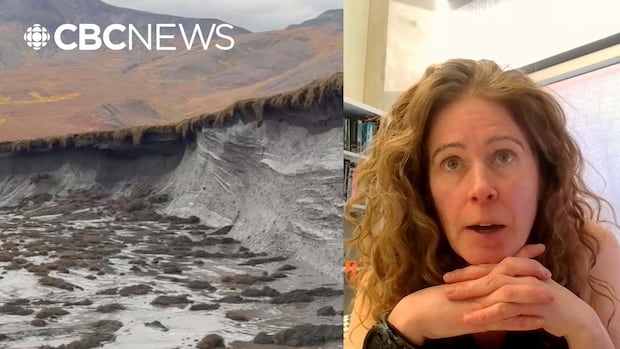
U of A researchers want to know how much carbon is being released from melting permafrost
Permafrost is thawing in our warming climate, releasing carbon which in turn feeds into climate change. But we don’t yet know how much carbon is being released. That’s what researchers at the University of Alberta and beyond are working to find out.
Permafrost serves as the foundation for a lot of infrastructure in the North, like homes and roads.
The ground and ice also holds thousands of years worth of microorganisms and carbon, and as permafrost thaws in our warming climate, it releases that carbon which in turn feeds into climate change.
But we don’t yet definitively know how much carbon is being released.
Non-profit organization Schmidt Sciences has backed the research efforts by contributing $1 million to the U of A unit to lead the Canadian team that’s part of a $45-million international effort to look at how the global carbon cycle drives climate change.
The global carbon cycle looks at how carbon moves between the atmosphere, oceans and the land, which includes permafrost.
The fieldwork in Canada will focus on permafrost landscapes in and around the Mackenzie Delta, the central Mackenzie Valley, Fort Simpson, Norman Wells and Yellowknife.
In addition to those from the U of A, researchers are from the Northwest Territories Geological Survey, the Aurora Research Institute and the University of Alaska Fairbanks.
At the U of A, Tank will work with environmental soil scientist David Olefeldt and permafrost expert Duane Froese.
“We’re primarily interested in depicting the characteristics of permafrost through mapping,” said Steve Kokelj, the senior permafrost scientist at the Northwest Territories Geological Survey.
“And the other way that we also do that is we track the evolution of these different environments through repeat surveys of how the landscape is changing.”
Kokelj said drone work will be done to track large areas to get a wider sense of changes on the land.
Climate consequences
Both Tank and Kokelj spoke of the need to work with communities in the North given that impacts of thawing permafrost and climate change are felt most acutely by these populations.
“The effects of climate change on permafrost … there’s really an equity consideration there,” Tank said.
“Because this is a problem that is — from the perspective, for example, of Canada’s North — … a problem that’s caused in the South, but that is really felt disproportionately in Canada’s North.”
Kokelj said the work is being done in partnership with Indigenous organizations and land users.
“We’re pretty dependent on working with people from the communities,” he said, noting he wants there to be a reciprocal relationship whereby communities can access the data to help inform their way of life and mitigate the growing impacts of thawing permafrost.
People in communities that live on permafrost say they have been seeing the changes for decades.
The Gwich’in Renewable Resources Board has already been working to monitor changes to the region’s environment for years.
Robert Charlie-Tetlichi, board chair and chief of the Inuvik Native Band, situated in the Northwest Territories, said incidents like a house tipping over in 2009 due to the permafrost suddenly giving way, have highlighted one of many ways in which climate change has been affecting the community.
“But we knew even before that, there were hunters and trappers saying they were noticing changes on the land,” Charlie-Tetlichi said.
“Since then, the melt has been increasing. We’re seeing a lot of different climate impacts that are affecting people that live in this region, and globally.”
Other infrastructure like highways is also being impacted by melting permafrost, he said.
“We have highway systems and it’s our lifeline to the South,” Charlie-Tetlichi said, adding that higher rainfall can make it unsafe to use some roads in the North.
He said migration patterns for animals in the region have been disrupted because of the thawing permafrost, which also impacts people in the North.
“We’re so remote that the cost of living up here is really high,” Charlie-Tetlichi said. “So because of that, people are still dependent on going out and harvesting caribou, moose and small, small game, as well as dependent on the fish in the summer.”
He said he’s heard from elders who are worried that future generations will pay the price by not being able to learn essential cultural traditions.
“The work that we do today is always for our grandchildren in the future, so that they can still enjoy what we’re enjoying today,” Charlie-Tetlichi said.
The data that the U of A and collaborating institutions gather will be used for the Global Carbon Budget, an annual report tracking carbon dioxide emissions and sinks around the world.