
Of his two paternal uncles, one, Frank died at Gallipoli, and the other, Herbert died in a military camp in Wiltshire in 1917 while awaiting deployment to France. That left Dad’s father, Fred Clark, as the only surviving child in the family, as two other siblings had died very young.
When my father reached school age, the public education system had not reached the then remote, back-country community where his family farmed. Then the Kaniwhaniwha School opened in a small building, which the Education Board rented from Bert Steel for five shillings a week, in October 1928.
Steel was the teacher. A new one-room school opened in 1931.
My grandparents valued education, and sent Dad and his older brother, Tom, to Auckland together to board at Mount Albert Grammar School. After three years in Auckland, both boys came back to the farm in the late 1930s. World War II intervened.
Dad became a member of the Te Pahu Home Guard and ran the farm with his father.
It was to that farm that my mother, Margaret McMurray, came as a bride in 1949, and where we four daughters grew up. We were Dad’s farmhands – and seldom Mum’s house help. It was much more fun riding on tractors and horses and rounding up sheep and lambs.
Dad and Mum wanted the very best for their daughters, and supported us after our years at Te Pahu Primary School to attend boarding schools and tertiary education. It is fair to say that what Dad probably saw as the city ideas I came home with from Auckland were often at variance with his, and my teenage years and early twenties featured disagreements between us – not least over sporting contact with South Africa.
To my chagrin, Dad went to South Africa on an All Blacks supporters tour in the 1970s. Then in 1981, he was one of the outraged fans at Rugby Park, Hamilton, where protesters occupied the field and prevented the game from proceeding.
This was also an era when he chaired the local National Party branch and was a strong backer of Marilyn Waring as the MP for Raglan.
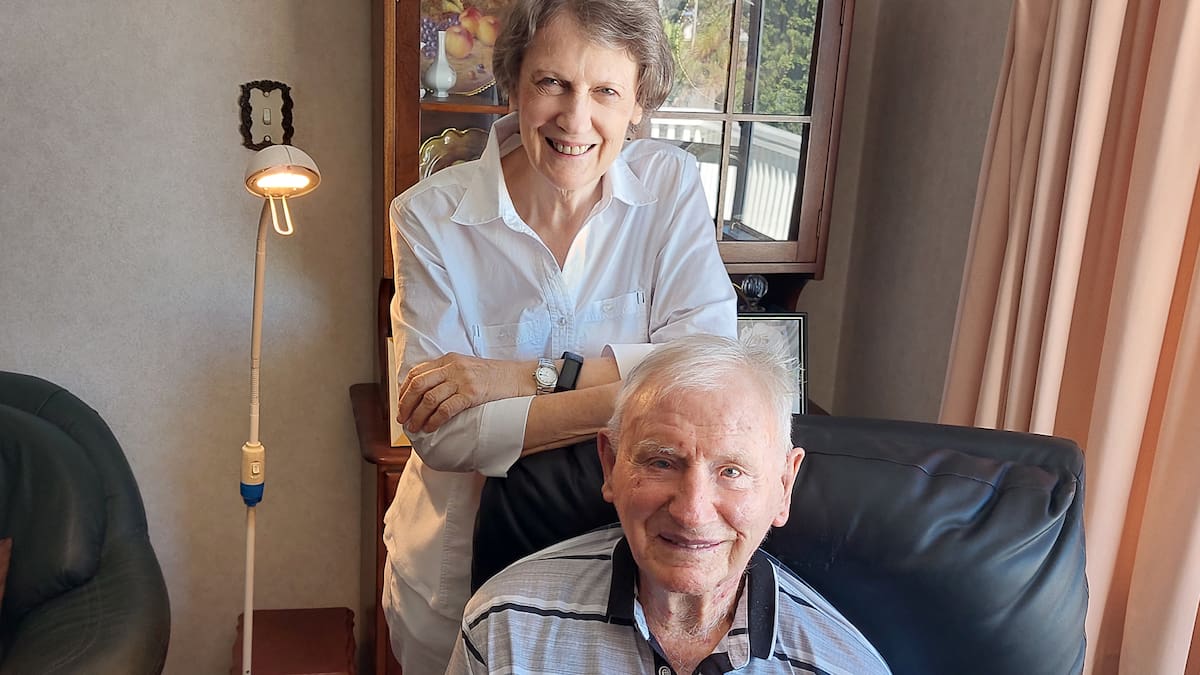
George Clark at home in Waihī Beach. Photo / Bob Tulloch
All that seems a very long time ago, and all is, if not forgotten, certainly forgiven. When I entered Parliament in 1981 for a political party, Labour, which had little support in the farming community from which I came, Dad and Mum gave me very strong family support.
They loved coming to the openings of Parliament, and eventually to swearing-in ceremonies at Government House and to stay at Premier House. In 1987, Dad and Mum sold the family farm and moved to Waihī Beach. Dad’s politics changed over time, too.
As our mother’s health declined, Dad was her primary caregiver, which became an increasingly demanding task. After Mum passed away in August 2011, Dad proved to be very resilient. He made new friends a generation younger than himself. We called their Wednesday afternoon meetings each week the “coffee club”.
When I came home from New York in 2017, Dad was still sprightly in his mid-nineties. Over time, though, he needed increased support to continue living at home. With the pandemic I was grounded at home and able to help a lot more, which, with family and local support systems, I was able to do until Dad’s passing on December 6.
The gathering at the Waihī Beach RSA highlighted George Clark’s experiences through significant historical events and his evolving political views, Helen Clark writes. Photo / Bob Tulloch
A lot happened over that more than a century of Dad’s life. And it was that “flux of life” which was reflected at the gathering in the RSA. Two former Governors-General were present, as were two leaders of the Opposition past and present, from both sides of the House.
Yes, Red mixed with Blue in the audience. As did Town and Country. There was a large representation of extended family, and many others from rural and provincial New Zealand who knew George. And, given my biography, friends and colleagues also came from the cities, Auckland and Wellington especially.
The Ode of Remembrance was read. A bugler sounded The Last Post and Reveille to bring proceedings to a close.
And so it ended. Vale George Clark. Haere rā. A life well lived.
Sign up to The Daily H, a free newsletter curated by our editors and delivered straight to your inbox every weekday.