
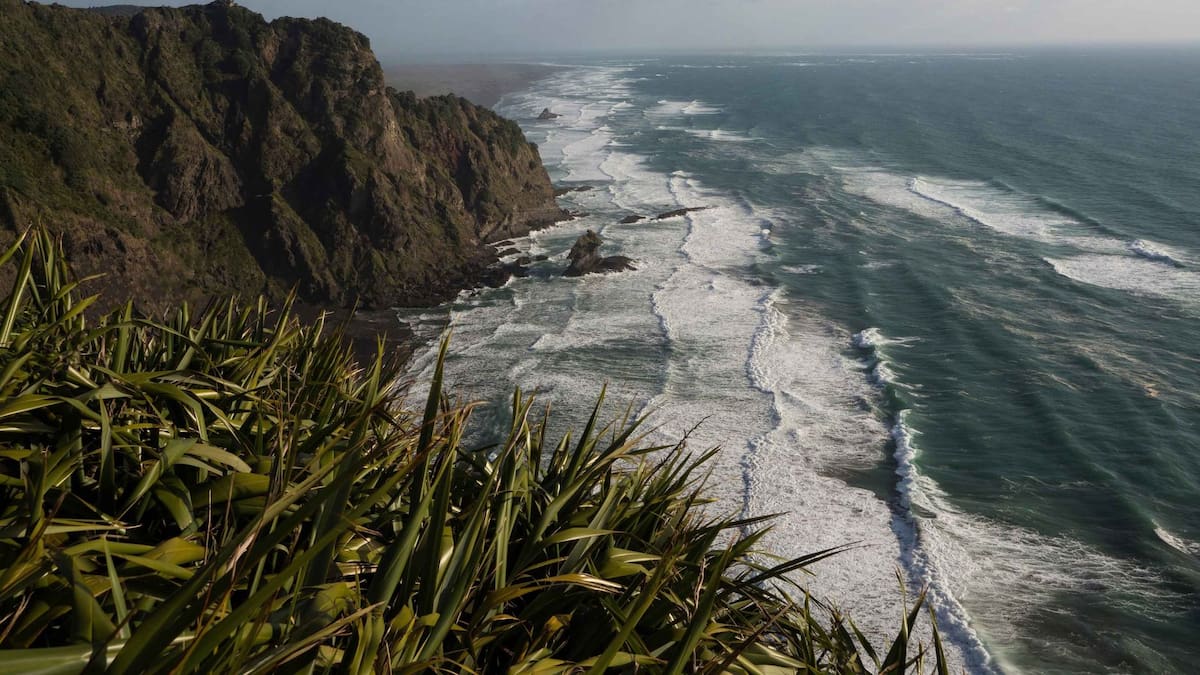
The dramatic cliffs of Te Ahua Point are the lip of the ancient Waitākere volcano. Erupting about 15 million years ago, the volcano was active for about six million years and at its greatest extent had a diameter of 50km. The centre of this gigantic volcano was 20km to the west, but over a period of five million years the Tasman Sea eroded all trace of the volcano above sea level. Further earth movements tilted the eastern rim, causing it to rise again above the sea, forming the present Waitākere Ranges.
This is also the location of a haunting love story. Once there was a beautiful chieftainess, Hinerangi, who fell in love with a chieftain from Karekare and moved there to be with him. But then, as now, the west coast was notorious for dangerous surf and one day Hinerangi’s husband and two companions were swept off the rocks and drowned while fishing at the southern end of Te Unuhanga o Rangitoto (Mercer Bay). Searching desperately for her husband, Hinerangi climbed to the top of this headland to scan the sea. She refused to leave the spot and eventually died of a broken heart. Her sad face is now forever outlined in the rocks below the headland on which she sat, which became known as Te Ahua o Hinerangi (the likeness of Hinerangi).
Getting there: The track begins at the end of Te Ahuahu Rd/Log Race Rd, which turns left off Piha Rd before the road descends into Piha.
The Warkworth and District Museum sits next to the impressive Parry Kauri Park. Photo / Supplied.
North Auckland: Parry Kauri Park
Covering 2ha, this tiny reserve is the best example of kauri forest in the Auckland region. Parry Kauri Park is unusual in the Auckland area, in that it is now one of the few places the public can see mature kauri trees, as the track is entirely on boardwalks and remains open as the forest has so far escaped kauri dieback disease.
By the carpark and at the entrance to the loop track is the majestic McKinney kauri, named after the first European landowner, the local Presbyterian Minister Reverend McKinney. Reaching a height of 38m, it is almost 12m to the first limb. The McKinney kauri is estimated to be approximately 800 years old and the largest kauri tree on the east coast.
In addition to kauri there are numerous kahikatea and good examples of rewarewa, rimu, tānekaha, kohekohe, taraire, karaka and tōtara, many of which are marked to assist in identification. The loop walk takes about 20 minutes. The park is adjacent to the Warkworth Museum and in the carpark are relics of the early saw milling operations.
Getting there: From SH1, 2km south of Warkworth, turn into McKinney Rd and then right into Thompson Rd and continue to the Warkworth Museum.
The Commercial Hotel in Auckland, circa 1925. It was replaced by the Hotel DeBrett on the corner of Shortland and High Sts.
Central Auckland: Auckland’s ‘Old City’
The idea is very European so it is odd to think of Auckland as having an “old town”, but it does – though naturally it is a good deal younger than its European counterparts. Both Māori and Europeans settled on what was known to early Europeans as Britomart Point, between Commercial Bay (Lower Queen St) and Official Bay (Beach Rd). Queen St at the time was a swampy creek, the Waihorotiu Stream. Running through the heart of this headland are three main streets, Shortland, Princes and Anzac Ave/Symonds St (previously Jermyn St), and in this small area are the majority of Auckland’s most important historic buildings. Before European settlement, two pā were known to occupy this area, one where the High Court now stands and the other in Albert Park, though no trace of either pā remains.
The area is packed with historic buildings, including:
Hotel DeBrett: Originally constructed in 1841, the hotel was rebuilt in 1860 and remodelled in the Stripped Classical style in 1926. Cnr Shortland St and High St.
Colonial Cottage: This lone survivor of a four-roomed workers’ dwelling was built in 1884 and is unusual in that it is built of concrete rather than wood. Bankside St.
Eden Hall: Striking mid-1930s Art Deco building, designed by architect Reginald Hammond as quality inner city apartments, highly unusual for the period. 3 Eden Cres.
The Northern Club: Originally built as a hotel in 1841, in 1867 the building was converted to government offices. Two years later it became and has stayed the Northern Club.
Parliament St: The name Parliament St is a reminder of Auckland’s brief period as New Zealand’s capital city from 1841-1865.
Corner Courtville, Middle Courtville and Braemar House: Three fine examples of early 20th-century flats built for professional city dwellers. Parliament St.
Auckland High Court: Constructed between 1865 and 1868 in the fashionable Gothic Revival style, particularly appealing are the carvings of local dignitaries. Waterloo Quadrant.
St Andrews Church: This Presbyterian Church is built in a simple style of local basalt and is Auckland’s oldest surviving church after opening in 1850. 2 Symonds St.
Old Choral Hall: One of the largest surviving 19th century buildings in Auckland, the hall, built in 1872, could hold more than 1000 people. 7 Symonds St.
Old Government House: Built for the Governor of New Zealand in 1856 when Auckland was still the capital. Waterloo Quadrant.
The Synagogue: Combining Moorish and Romanesque elements, the synagogue was opened in 1885. 19a Princes St.
Princes St – Merchant Houses: Princes St in the late 19th century was Auckland’s most desirable address and these five houses were built by Auckland’s leading merchants.
Old Arts Building, Auckland University: Designed by American architects and opened in 1926, this building was highly controversial at the time and criticised for being “not English enough”. Highly unusual for the use of New Zealand motifs in the decoration. 22 Princes St.
Tawhitokino, south east Auckland. Photo / Auckland Council
East Auckland: Tawhitokino Bay
It is hard to believe that in a city of almost two million people, this little-known bay on the Firth of Thames coast remains relatively obscure.
Safe for swimming in all tides, this long sandy beach is fringed by large, spreading pōhutukawa trees and has an uninterrupted view of the Coromandel Peninsula across the firth.
Possibly the 45-minute walk from the carpark to the beach via the equally pretty Tuturau Bay is just enough to put people off, but on a lovely summer’s day or a bright, clear winter’s afternoon this bay is a treat.
The beach has also become popular as a clothing-optional beach.
Getting there: From Kawakawa Bay, follow the coast road for 4km to Waitī Bay.
Pop in for a visit to the Kentish hotel. Photo / Supplied
South Auckland: Kentish Hotel
Is this New Zealand’s oldest pub? That’s open to discussion, but it is certainly a frontrunner and, without doubt, the Kentish is the oldest hotel in the Auckland region and one of the oldest buildings as well.
In the mid-19th century, Waiuku flourished as a portage town providing a vital link between the Manukau Harbour and Onehunga to the important inland waterway of the Waikato River and a steamer travelled from Waiuku to Onehunga three times a week.
Overlooking the tidal Waiuku Inlet, the Kentish Hotel was built in 1852 and obtained its licence the following year (the licence still hangs on the wall). Unusually for a 19th century pub it has not changed its name, been moved or burnt down.
Named after his native Kent by the builder and first publican, Edward Constable, the exterior of the pub has changed little. The hotel has been at the heart of Waiuku life since it was built and the Kentish has hosted visiting dignitaries such as the Māori King Te Wherowhero, Sir George Grey, Richard Seddon, Sir Joseph Ward and William Massey.
A popular local spot and now into the second half of its second century, the Kentish is set to be the favourite watering hole for some time yet.
Getting there: 5 Queen St, Waiuku
thekentishhotel.co.nz
This is an extract from Worth a Detour: North Island by Peter Janssen $39.99, White Cloud Books from Upstart Press. Out now.