
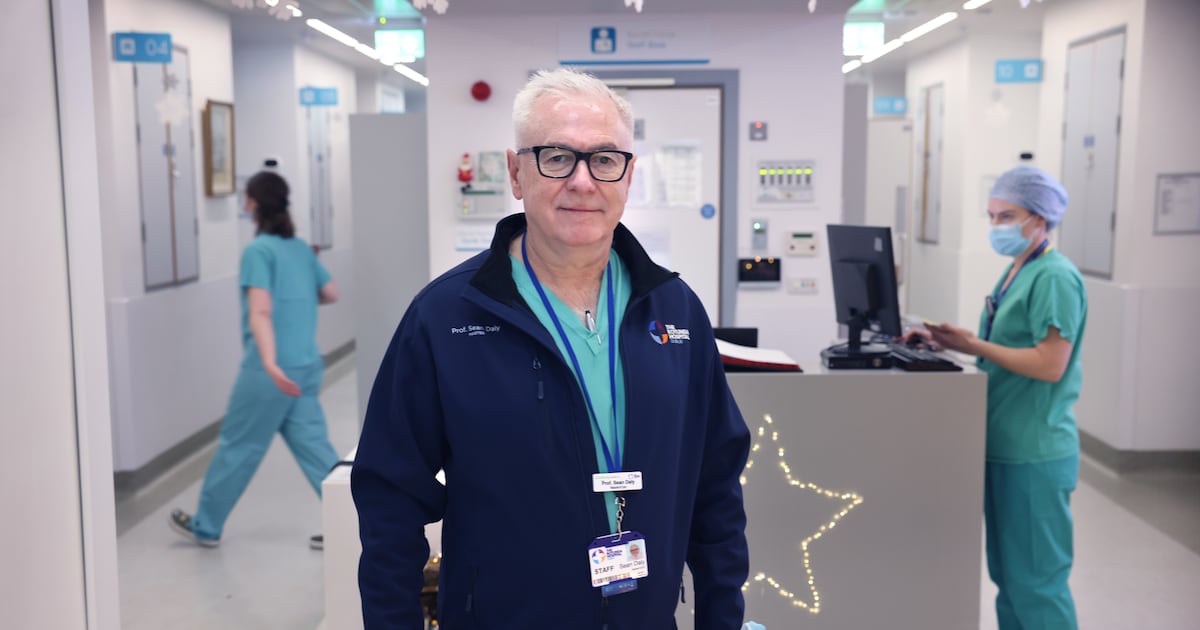
It was a Monday evening in mid-December and a woman was in labour in the Rotunda Hospital when the healthcare facility learnt there were no neonatal beds available in Dublin.
Consequently, the woman was transferred via ambulance to deliver her baby in Drogheda hospital, says Prof Seán Daly, master of the Rotunda.
“We’re seeing that a bit more frequently now,” he says of the need to transfer women to other hospitals. “In general, the reason people are transferred is because we believe they need delivery. And when it comes to delivery, you need to have space for the baby.”
“We’re opening up a postnatal ward, ward 14, and we will put three or four babies up there and then we will transfer babies into these spaces. So it’s really, really acutely busy at the moment.”
But it’s not just the last month of the year that’s busy. In fact, the number of babies delivered at the hospital is up 2 per cent, year on year. October marked the highest number of monthly deliveries in 10 years, when it delivered 804 babies.
In the first 11 months of the year, Daly says the Rotunda delivered 1,100 more babies than the National Maternity Hospital at Holles Street, and almost 1,700 more babies than the Coombe. In 2026, the hospital will deliver its millionth baby.
“Everything is a little more complex here. We had a multidisciplinary team meeting this morning; there were eight sets of twins presented at that meeting. There’s currently 31-week twins being delivered on the labour ward and there’s no neonatal bed in Dublin,” he adds.
The number of twins being born in the hospital is increasing at around 140 sets per year, Daly says, which he attributes to mothers giving birth at a later stage in life.
[ Women to face curbs on private maternity care access from next weekOpens in new window ]
“As a woman gets older she is more likely to have a twin pregnancy spontaneously. And obviously with IVF you’re more likely and there are an increasing number of couples accessing assisted reproductive services,” he says.
But twins can come with increased risk for both babies and mother, he adds, which has a knock-on effect on the complexity of care delivered to these patients.
“The ones that are high risk are the ones that share a placenta. That can be complicated by something called twin-to-twin transfusion syndrome [unequal blood flow],” he says.
“We had a very complex case here that required laser treatment. You put in a foetoscope and we ran a laser fibre in and you essentially divide the placentas into two so one can’t take from the other.”
The other thing that’s factoring into these capacity difficulties, Daly says, is that treatment has advanced and medicine is now able to care for much more vulnerable babies than they would have previously.
“Twenty years ago, we didn’t really consider babies viable unless they weighed more than about 700 grammes and they were 25 weeks or more,” he says.
“Now we’re looking at 22-weekers. Obviously, if you can imagine that for a pregnancy and a baby to develop properly it needs to be in its mother’s womb for 40 weeks. If you’re born at 25 weeks, you need 15 weeks of care. And it’s incredibly complex.”
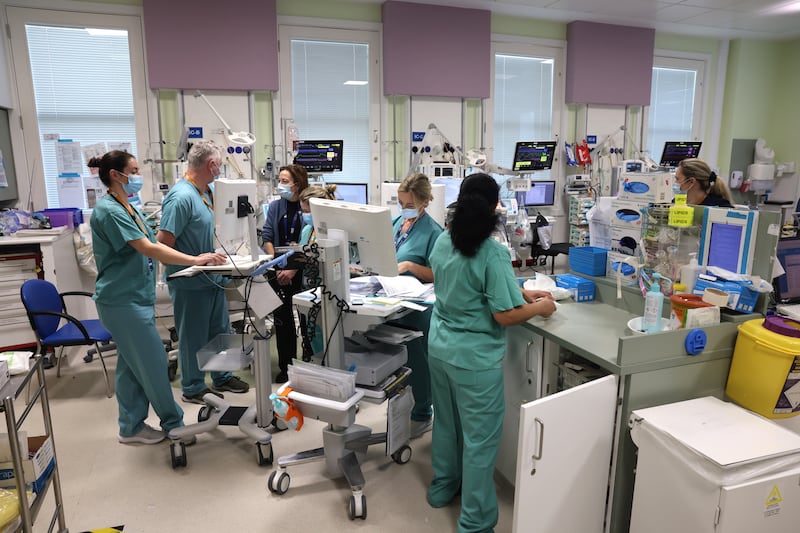 Neonatal intensive care at the Rotunda Hospital in Dublin. Photograph: Dara Mac Dónaill
Daly is critical of the infrastructure currently in place in the Rotunda’s neonatal unit, describing it as a “huge room” with all the babies lined out around it.
“They should all be in individual spaces because of the risk of the spread of infection and the ability of facilities for parents to be with their baby and not be bumped into.”
The hospital has sought planning permission to construct a critical-care wing, but it is currently in the appeals process after objections were made.
Daly says he subsequently wrote to 46 politicians – including Minister for Health Jennifer Carroll MacNeill – calling for changes to the planning system.
“This is national infrastructure. There are four level-three neonatal units in the country – three in Dublin and one in Cork. None of the ones in Dublin are adequately structurally designed to care for those babies. We desperately need those facilities,” he adds.
[ Almost €150m spent on preparations for new National Maternity HospitalOpens in new window ]
What will happen if the appeal doesn’t go the way he wants? “There is no plan B,” he says. “We’re not moving anywhere and so it’s then, how do we cope with demand?”
The hospital’s location in north inner city Dublin is one of its key strengths, according to Daly, who says the Rotunda is able to collaborate with the nearby Mater hospital to meet the needs of the population it serves.
David Begg resigned as chairman of the board of the Mater following a tense meeting with the Minister in September, but Daly is quick to defend the institution.
“The Minister is elected; she has a job to do. I don’t know what went on it that room but I know she left, according to the media. And then on the other hand you have to honestly think, is the Mater not doing a good job?” he says.
“I know there’s a legacy debt there but I suppose they might reasonably argue that there was legacy underfunding. The Mater is a public hospital and it works with the same population that we do and it does a phenomenal job. It’s a phenomenal hospital, in my view.”
[ These three Ministers are doing something welcome – making enemiesOpens in new window ]
Maternal medicine is not the only service the Rotunda provides; it is now also the centre for benign gynaecological referrals in the north Dublin area. It receives 1,400 referrals per month, but only has the capacity to treat 850-900 cases, meaning waiting lists can be long.
“We don’t have the physical space,” says Daly. “Once we have access to the surgical hub [in north Dublin], that will help, and we are developing [facilities at] Dominick Street which will increase our capacity hugely. But the problem is everything takes longer than it should, or you think it should.”
Endometriosis, a potentially debilitating condition in which cells similar to the lining of the uterus grow in other parts of the body, has received significant public attention but Daly says it is not the only gynaecological condition that needs service improvement.
“There’s a lot of benign gynaecology that needs more service; there’s a whole cohort of women who have urogynaecology difficulties. It’s a matter of trying to prioritise everything – uterovaginal prolapse, stress urinary incontinence. There are multiple opportunities,” he says.
Carroll MacNeill had asked the hospital to deal with an additional 10 endometriosis cases in the last quarter of 2025, something Daly describes as a “struggle” due to a shortage of beds, though achieveable.
The long-time physician is almost half way through his tenure as master of the hospital. He appears proud of the work that has been done under his leadership to date, but there are a number of key issues he wants to be completed by the time he hands back the title.
He adds: “It’s about developing the campus, getting more beds and taking better care of people.”