
It is easy to hate Lester in Sam Mendes’ American Beauty. He is quite a controversial movie character. For me, there are mainly two ways to view this polarizing character: term him as a pervert and shun him (because, why not), or step into his shoes to understand his woes.
The first one is definitely the easy way out, but we’re not here for that. For the second one, while I do not condone his actions, I am open to giving him a fair chance. Mostly because he isn’t malicious, more like a man who has gone astray.
In this article, we’re examining Lester through his last monologue—a recollection of his life drenched in regret.
To Give You a Little Context…
A man in his early 40s, Lester, is drowning in a midlife crisis when he sees Angela, his daughter Jane’s conceited, high-school-cheerleader friend. His life is pathetic in the truest sense—he has a job he despises, a wife who is more interested in her work than him, and a daughter who couldn’t care less. Lester doesn’t really have any friends, either.
Those few moments at the basketball game, as Lester sees Angela perform a short routine, translate into complicated feelings.
Lester becomes infatuated with Angela, so much so that he begins getting recurring dreams about sexual encounters with her, in which blood-red roses are a constant. Things get seriously complicated after one day, when he overhears Angela telling Jane that she would have sex with Lester if he became physically fit and attractive.
In the end, they do have an intimate encounter, but it doesn’t conclude in sex as Lester realizes the weight of his actions.
The Scene
After his moment of conscientious breakthrough, hearing that Angela is a virgin and that he is about to be her first, Lester finally finds peace. He comforts Angela, and they talk about the distress in each other’s lives, as if they are long-lost friends with no sexual intentions whatsoever.
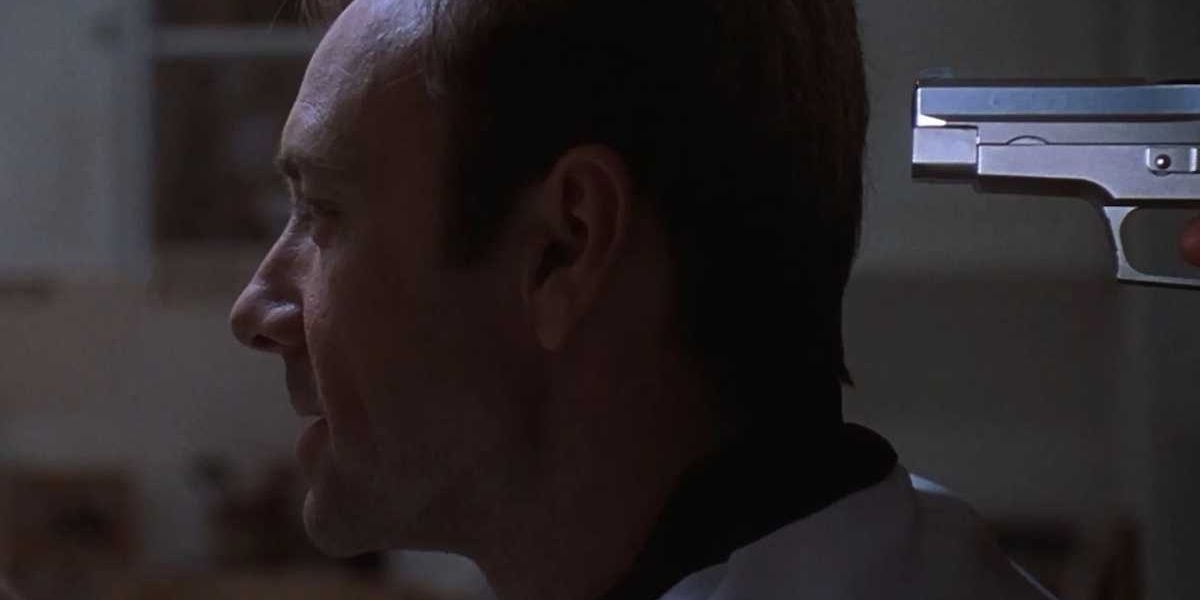
After talking, Angela goes to use the bathroom. Lester, left alone in the room, picks up a family picture of him, Carolyn, and young Jane smiling. A moment of peace settles on his face when we see a gun settling right behind his head.
Bam!
The white wall in front of Lester is now sprayed in crimson.
Ricky and Jane, hearing the gunshot, follow the sound. They discover a pool of blood first, and then the cold body of Lester, covered in blood.
The monologue begins.
Analyzing Lester’s Monologue from the Afterlife Moments After His Death
In the monologue, Lester recounts his entire life—the moments that mattered the most to him.
A particular day of camping from his childhood, the moment of awe and jealousy when his cousin got his first car, his wife, who felt insufferable in his last few days, and his daughter, whom he loved more than anything. It’s interesting how few of the things he despised in his last few days also made it to his last recollection of life, moments after his death.
It’s indeed an emotional moment, but there’s something more there that often gets missed—it’s the regret.
Lester regrets pushing away beautiful things in life to pursue what looked shiny. He pushed away the possibilities to turn things around that ultimately led him to doom.
While judging Lester, an important question that often comes to my mind is how he, as a father, could allow himself to act upon his feelings for Angela, his daughter’s 16-year-old friend. Angela is young and naive, but not Lester. He knows his place in society, and so, when he acts upon his blasphemous desires, there’s every reason to despise him.
But let’s set aside his social responsibilities for one second, then review his circumstances once again.
He’s a man in his 40s with no one to care about whether he lives or dies. For him, Angela’s attention is the flicker of hope he needs to survive.
A human without a purpose is often attracted to walk the path of self-destruction. We can hate him all we want for choosing himself over his family here, but he was drowning in a kind of failure that might be alien to most of us.
The chat with Angela is enlightening for Lester in many ways. Most importantly, it gives him closure; also, maybe the answer to why he does what he does.
So many times we fail to reason our actions, so an epiphany sure helps. Lester dies shortly after his epiphany. He probably feels a little regret about not making the most of the life God gave him, and about not being grateful when he had the time.
What do you think of the ending of American Beauty?