
Most importantly, the party has succeeded in steadily improving its polling each quarter through 2025, reaching an average of 9.5% in Q4 2025.
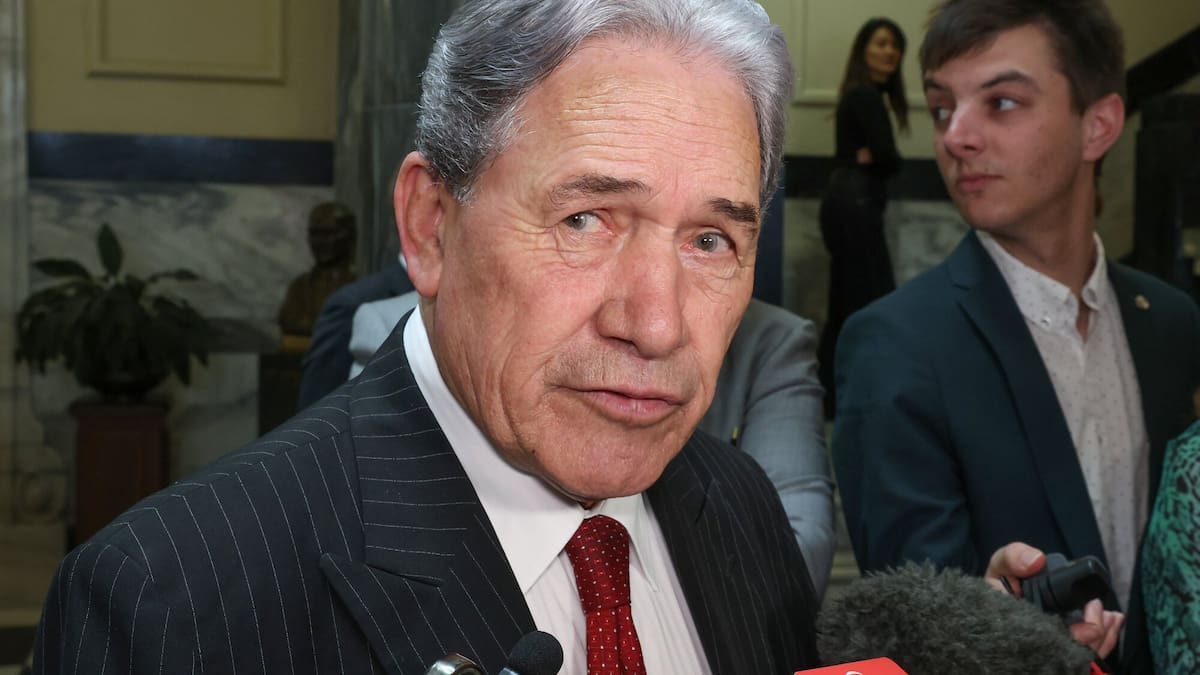
Thanks in part to domestic rabble-rousing but more to the statesmanlike manner he conducts himself as Foreign Minister, Peters is decisively ranked third as preferred Prime Minister, not too far behind the hapless Christopher Luxon and invisible Chris Hipkins.
Even the business community rates Peters above them.
The upshot is that, heading into election year, NZ First and Peters have a material lead over coalition rivals Act and David Seymour.
NZ First’s worst-case scenario for 2026 is that it will again hold the balance of power and Peters will again become Deputy Prime Minister.
But NZ First strategists say the objective is no longer just to fulfil the role of kingmaker but to make the leap to medium-sized party status.
That looked possible in the 1993-96 and 2014-17 Parliaments.
This time, with both National and Labour bobbing around 30%, party strategists calculate 2026 offers NZ First an even better opportunity to finally break the two-party duopoly and create a ternary system.
Depending on your outlook, history has finally caught up with NZ First or regressed back to it.
Formed in 1993 at the peak of globalisation and the new world order, Peters’ vehicle was largely an odd fellow through its first quarter century.
But the rise of Donald Trump in the US, Xi Jinping in China, Sanae Takaichi in Japan, Narendra Modi in India, Nigel Farage in the UK, Marine Le Pen in France, Giorgia Meloni in Italy, Recep Tayyip Erdogan in Turkey, Prabowo Subianto in Indonesia, Geert Wilders in the Netherlands and Viktor Orban in Hungary – and the unravelling of the global rules-based system – has seen the current of history flow to where NZ First has always stood.
That mainstreaming makes it easier for Peters and others to more clearly position the party and sell their message.
It is no longer merely the party that sits between National and Labour. As Peters describes it, NZ First is New Zealand’s only anti-globalist, nationalist party: unashamedly patriotic, socially conservative, anti-woke and driven by self-declared “commonsense”.
NZ First strategists see little value in trying to win more votes off National or Act, although are confident some will continue flowing their way.
They say a key objective for 2026 is to gut Labour over wokeness. Since the mid-2010s, Labour’s and NZ First’s polling has tended to move inversely, suggesting they compete for the same voters.
Peters has already begun referring to NZ First as New Zealand’s only true “workers’ party”.
By this, he primarily means manual workers but also includes the likes of teachers and nurses who just want to get their day’s work done rather than attend union meetings to argue over gender identity or Gaza. In contrast, Peters mocks Labour as “the wokesters’ party”.
Seymour has suggested such positioning is about Peters preparing the ground for NZ First to support Labour.
All’s fair in love and war between Act and NZ First, but in this case Seymour’s charge isn’t true.
Peters says that of course NZ First supports capitalism – but he means the more managed form of capitalism as found in East Asia, combined with a more reliable safety net, especially for the elderly, as in Scandinavia.
NZ First strategists say Peters is talking Labour language not to praise but to bury it.
NZ First’s goal is to increase its vote at Labour’s expense to – at the very least – strengthen its hand with National and Act in a second Luxon Government.
Ideally, it would be more a National-NZ First Government, with Act tacked on, than the genuine three-way coalition Luxon insisted he would negotiate in 2023.
It’s assumed that, by now, Luxon has worked out Act has no leverage.
However, if history keeps flowing NZ First’s way, the party has a stretch target. Instead of a National-NZ First Government with Luxon as Prime Minister, why not, NZ First strategists ask, a NZ First-National Government with Peters as Prime Minister?
The argument goes that if, by mid-year, NZ First has climbed its way into the high teens, with both Labour and National polling in the 20s, a UK-style re-alignment would become possible.
Given a choice between a hopelessly weak National-NZ First-Act Government or a radical Labour-Green-Te Pāti Māori arrangement, why wouldn’t even more Labour voters switch to NZ First to strengthen it in the former along with more National voters wanting insurance against the latter?
First, of course, NZ First has to win another 5-10% of the vote from Labour. As in 2023, it plans to flood the country with public meetings.
New candidates with existing national name-recognition are said to be in the wings. NZ First’s social-media game is as good as those of Act, Te Pāti Māori, Labour and the Greens and much better than Luxon’s cringeworthy efforts.
NZ First strategists can’t believe their luck in National handing it the open immigration provisions of the proposed free-trade agreement with India without having locked in Labour’s support, meaning that issue will dominate the early part of the year.
Ultimately, it’s assumed Labour will support the deal for fear of losing its Kiwi-Indian vote but that decision will no doubt be preceded by a lengthy “release the text” campaign by the party and wider left.
Through all the controversy, voters will know that only NZ First is unequivocally against Luxon’s promise that our private sector must invest $34 billion in India over the next 15 years when New Zealand itself has an infrastructure deficit of over $200b, the new quota of 5000 visas for migrant workers, and the removal of all limits on Indian students and their families coming to New Zealand and doing up to 20 hours paid work per week with further work rights thereafter.
If lifting all limits on Indian students is such a good idea for New Zealand, Peters will ask, how come no other country has ever agreed to India’s demands to do it?
Could anyone have scripted a better election year opening for Peters in what will surely be his last hurrah before handing the party over to Shane Jones and the next generation of socially conservative, working-class, Kiwi nationalists?
Catch up on the debates that dominated the week by signing up to our Opinion newsletter – a weekly round-up of our best commentary.