
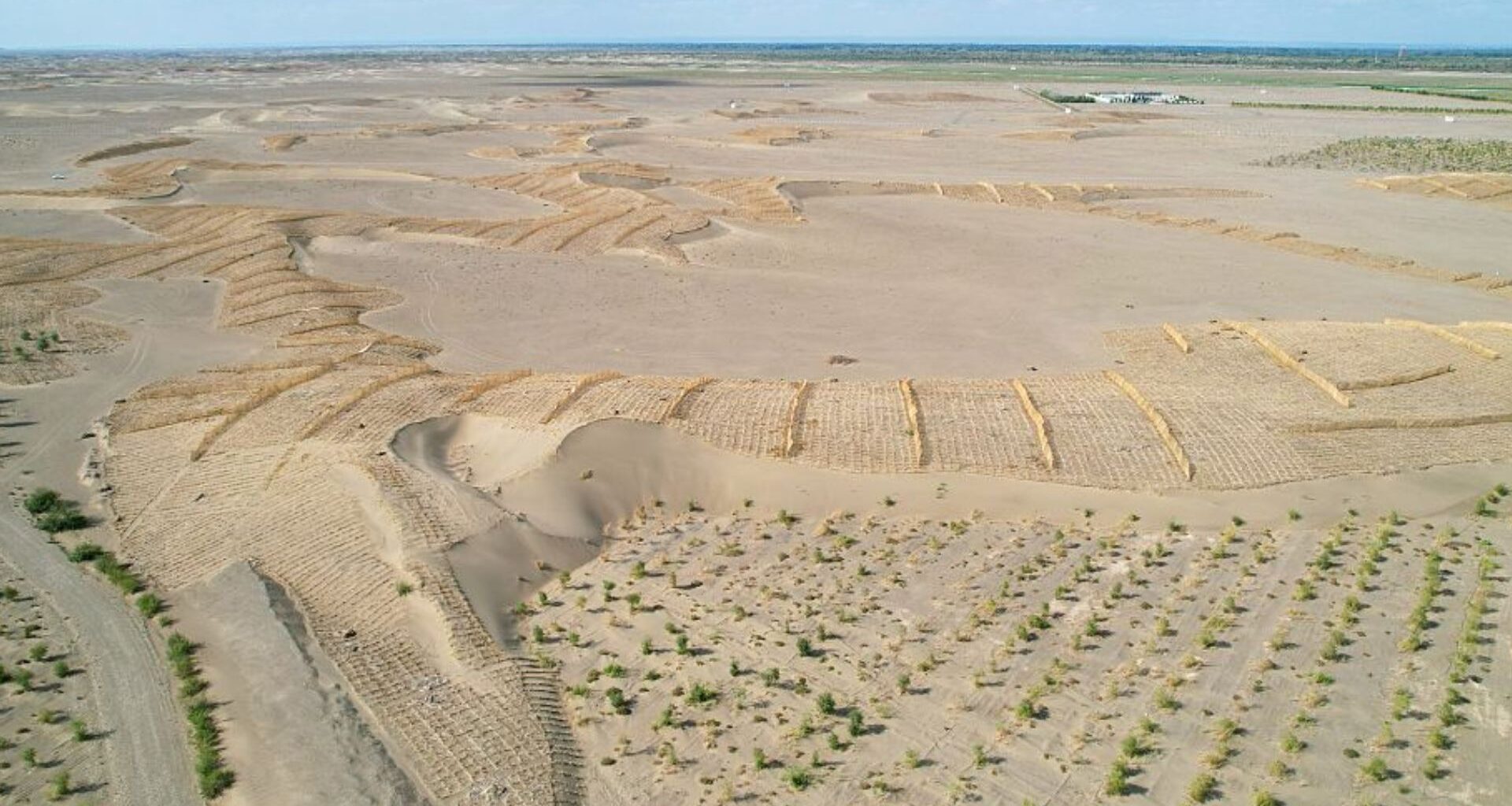
Chinese researchers are working on a massive geoengineering project of “artificial crusting.” They are using vast amounts of blue-green algae to turn barren dunes into stable, reclaimable land.
According to the South China Morning Post (SCMP), this method marks the first time microbes have been used on such a massive scale to reshape natural landscapes.
Known to have existed on Earth for billions of years, cyanobacteria are photosynthetic microbes found in almost every environment, from oceans to soil.
Developed at the Shapotou Desert Experimental Research Station, part of the Chinese Academy of Sciences (CAS), this innovative “biocrust” technology is a product of years of research in China’s Ningxia region.
This cyanobacteria-based crust, which can withstand winds of 36 km/h (22mph), is slated to reclaim up to 6,667 hectares in Ningxia over the next five years.
Interestingly, this low-cost, high-efficiency technology could serve as a blueprint for global desert restoration and climate change mitigation.
Reclaiming deserts
Deserts are notoriously difficult to reclaim. Most plants cannot survive the abrasive, shifting nature of sand.
However, researchers at a research station in Ningxia have found a way to glue the desert floor together by deploying specially selected strains of cyanobacteria.
SCMP explained that this creates an “ecological skin.” These microorganisms can endure extreme heat and bone-dry conditions for years.
Upon hydration from even slight rain, the cyanobacteria activate and proliferate, secreting a biomass-rich matrix that binds sand particles. This biological soil crust immobilizes shifting dunes and establishes a nutrient-rich substrate essential for the successional development of plant life.
In the natural world, a stable desert crust can take 5 to 10 years to form. This new blue-green algae technique cuts that time to just one year for the formation of soil crust.
Solid seed method
The process was perfected through trial and error. Initially, scientists tried spraying liquid algae, but the method was too reliant on heavy infrastructure.
After screening over 300 species, researchers identified seven key cyanobacterial strains as the foundation of the project. These strains were blended with organic matter into a nutrient-rich paste and cast into hexagonal molds.
The result is a specialized “solid seed” — a portable block designed to survive the journey into the deep desert and thrive upon arrival.
Once dispersed across the parched landscape, these engineered blocks lie in wait for moisture; the moment it rains, they burst into growth, knitting the sand together into a resilient, protective crust.
This technology is no longer just a laboratory experiment. Ningxia is preparing to apply the technique to over 6,000 hectares of desert in the coming years.
The geoengineering project is part of China’s ambitious “Great Green Wall” to fight desertification. It moves beyond traditional tree planting to address the root cause of desertification: shifting sands.
These strategies are now being scaled globally to Africa and Mongolia.
With the recent completion of a massive 1,856km (1,153-mile) sand control belt in Inner Mongolia, China continues to advance core technologies to fulfill its long-term mission of halting desertification and restoring arid landscapes on a planetary scale.