
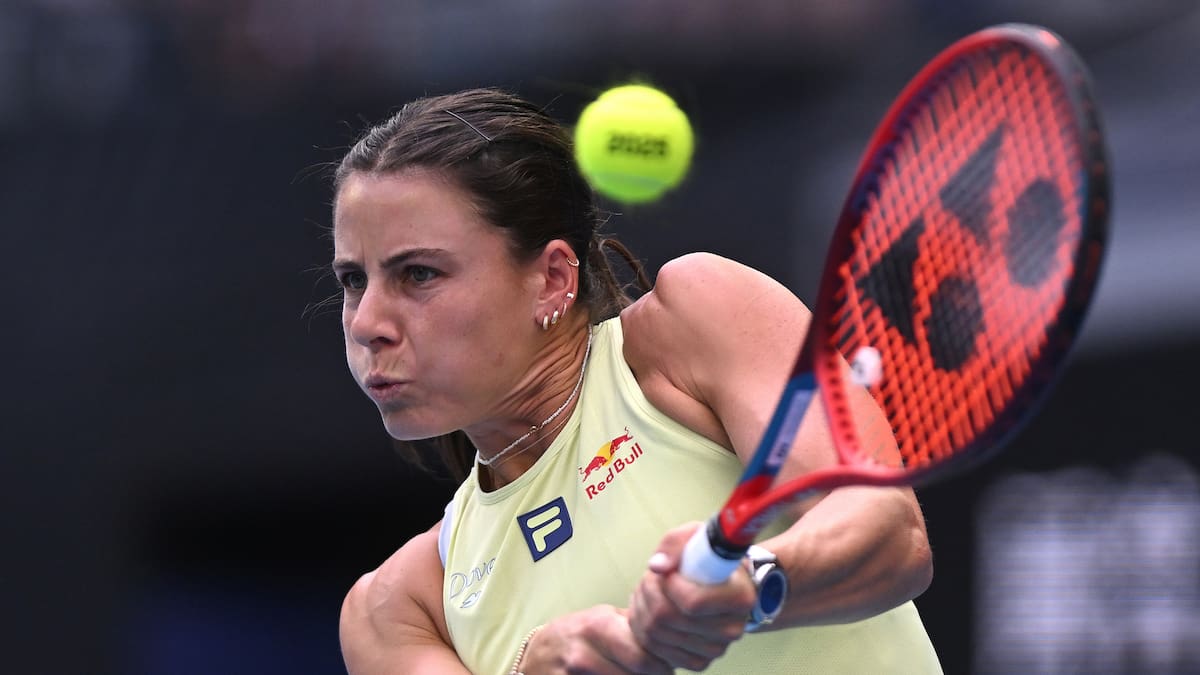
She had reached No 143 by the end of that year before skyrocketing through 2023, jumping more than 100 places to No 32. Navarro, who first picked up a racquet as a 3-year-old, then doubled down with a spectacular 2024 season.
It started with a semi-final appearance in Auckland, beaten by eventual champion Gauff, followed by her first WTA title in Hobart the following week. There was more to come, including a win over world No 2 Sabalenka in reaching the quarter-finals at Indian Wells, then a run to the last eight at Wimbledon, where her victims included Naomi Osaka and Gauff.
There was a last-four appearance at the Canadian Open – a WTA 1000 level event – before the apex came at Flushing Meadows, where she reached the semi-finals of a major for the first time. That pushed her into the top 10, before more recognition as the WTA’s most improved player of the year.
Given all that success, it was always going to be difficult to back up in 2025. But it was solid. She won another title (at Merida), reached the Australian Open quarter-finals and garnered a solid 32-25 win-loss record, even if there wasn’t the same run of head-turning results across the second half of the season as the year before.
“It had its ups and downs for sure,” says Navarro of 2025. “People always talk about the sophomore season being the hardest and maybe that was the case for me a little bit.
“[But] I have to remind myself to not overlook or underestimate the challenge of it all; it is really tough and a lot of the girls are really good.
“Just the way professional sports are and the way the tour is… it’s not easy, it’s a lot of travel, there’s pressure, there’s expectations, you’re away from your family. I’m always learning and I feel like the level gets higher and higher.”
‘Great role model’ for being successful
Though she doesn’t always like talking about it, Navarro’s family lineage is one of the more interesting on the WTA tour. Her grandfather Frank was a famed American Football coach at four different universities, including Princeton and Colombia, while her father Ben is a billionaire who amassed his fortune through finance.
He is also a tennis nut. His company has a wide-ranging investment portfolio – from sport to hotels to real estate – and he owns two prominent tournaments, the Cincinnati Open and the Charleston WTA Open. He paid for a new stadium in Charleston – as a gift to the city – and committed to a US$260 million ($450m) renovation of the arena and facilities in Cincinnati. He is also heavily involved in philanthropy and teaches a class at the local university.
“He’s doing incredible stuff in a lot of different facets and he’s so giving and caring with his time and with money,” said Navarro. “He’s a really great role model for me as a daughter and for a lot of people that are looking to be successful.”
Some on the circuit might imply that things came easy, with the financial advantages, but there tend to be no shortcuts in tennis.
“It’s a label I don’t really like,” she told Tatler last year, when asked about being a “billionaire’s daughter”. “I didn’t grow up being handed things.”
Navarro has dedicated her life to the sport, with the example of rising at 5am as a 9-year-old for practice and then fitting in a three-hour training session after school.
Excited to compete again after break
Before the ASB Classic, Navarro is feeling recharged, after a longer than usual off season, with 10 weeks in South Carolina.
“I really enjoyed being at home and getting to not feel like a tennis player for a while but I am excited to get out and compete again,” said Navarro.
Navarro arrived here on January 1 – “I celebrated New Years’ Eve on the plane” – and has enjoyed catching up with compatriots here, including a practice session with Jovic. She doesn’t have an opinion on the strength of the field – “I honestly haven’t looked” – but is ready for whatever challenges come her way, starting with British world No 73 Francesca Jones in the first round.
“For me there will be nothing really too different or too new [this week],” said Navarro. “I’ll just keep on keeping on, I guess, and there’s a lot of stuff that I’ve been working on that hopefully I’ll be able to use in a good way.”
Michael Burgess has been a Sports Journalist for the New Zealand Herald since 2005, covering the Olympics, Fifa World Cups, and America’s Cup campaigns. He is a co-host of the Big League podcast.