
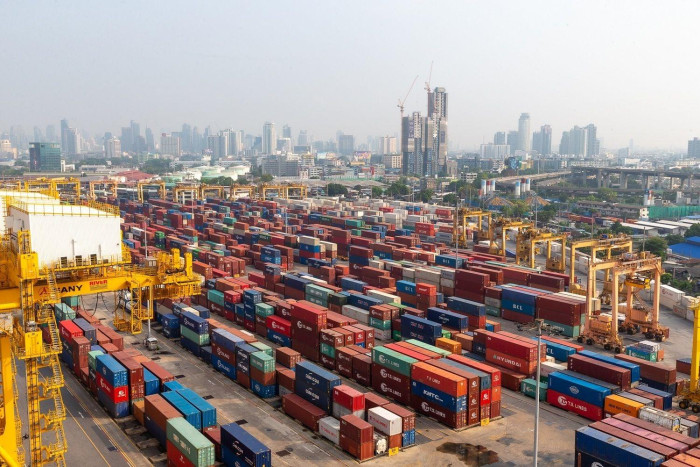
Containers are stacked at a Port Authority of Thailand site. Mr Dhanakorn says shipments this year will be gradual and uneven, rather than a clear upward trend, given the fragile global economy.
Thailand’s exports in 2026 are expected to face volatility and challenges due to a global economic slowdown that is dampening demand in key trading nations.
High household debt will curb purchasing power, while a sluggish recovery in the global labour market, geopolitical uncertainties, and rising trade protectionism will continue to influence this sector, noted the Thai National Shippers’ Council (TNSC).
Dhanakorn Kasetrsuwan, chairman of TNSC, said shipments this year will be gradual and uneven, rather than a clear upward trend, because of the fragility of the global economy.
The structure of international trade is shifting, moving from a focus on cost efficiency to greater emphasis on supply chain security, sustainability, and compliance with updated trade regulations, he said.
Export growth is likely to vary across different markets and product categories. Exporters who can quickly adapt, maintain credibility, and comply with environmental and labour standards are expected to gain a competitive advantage, said Mr Dhanakorn.
Key risks include the sluggish recovery of major trading partners, particularly the US and Europe, as well as geopolitical situations affecting shipping routes and logistics costs. Additional challenges arise from fierce competition from countries with lower production costs, exchange rate fluctuations impacting profitability, and emerging trade barriers, especially those related to environmental and carbon regulations.
On the positive side, diversifying import sources among trading partners enhances Thailand’s role as a reliable production hub. Strong demand for food products and processed agricultural goods persists, bolstered further by existing free-trade agreements that facilitate market access.
The council recommended setting realistic export targets aligned with the current global economic climate, suggesting a proper growth of 2-4%. This projection takes into account existing risks and enables the private sector to operate the businesses effectively.
The TNSC identified promising markets with growth potential: Southeast Asia; the Middle East for food and construction materials; India as consumer demand grows; and specific product categories in China.
Exporters should also maintain their existing market shares in the US, the EU and Japan.
TACKLING CHALLENGES
Mr Dhanakorn expressed concern about several export product groups including labour-intensive industries such as textiles and garments and primary agricultural products facing price fluctuations, and small and medium-sized enterprises (SMEs) that often face price competition.
To address these challenges, he recommended several solutions: adding value to products; reducing dependence on price competition; providing better support to exporters, particularly SMEs in managing exchange rate risks; and advocating for tangible measures to explore new market opportunities.
He also called for efforts to reduce logistics costs and expedite assistance to ensure compliance with environmental standards and new global trade regulations.
“This year is a period of adjustment and a test of exporters’ competitiveness, rather than one of rapid growth. Entrepreneurs who can adapt their strategies, diversify their markets, and effectively manage risks will find ways to remain resilient and achieve growth amid global economic uncertainties,” Mr Dhanakorn said.
PROMISING SECTORS
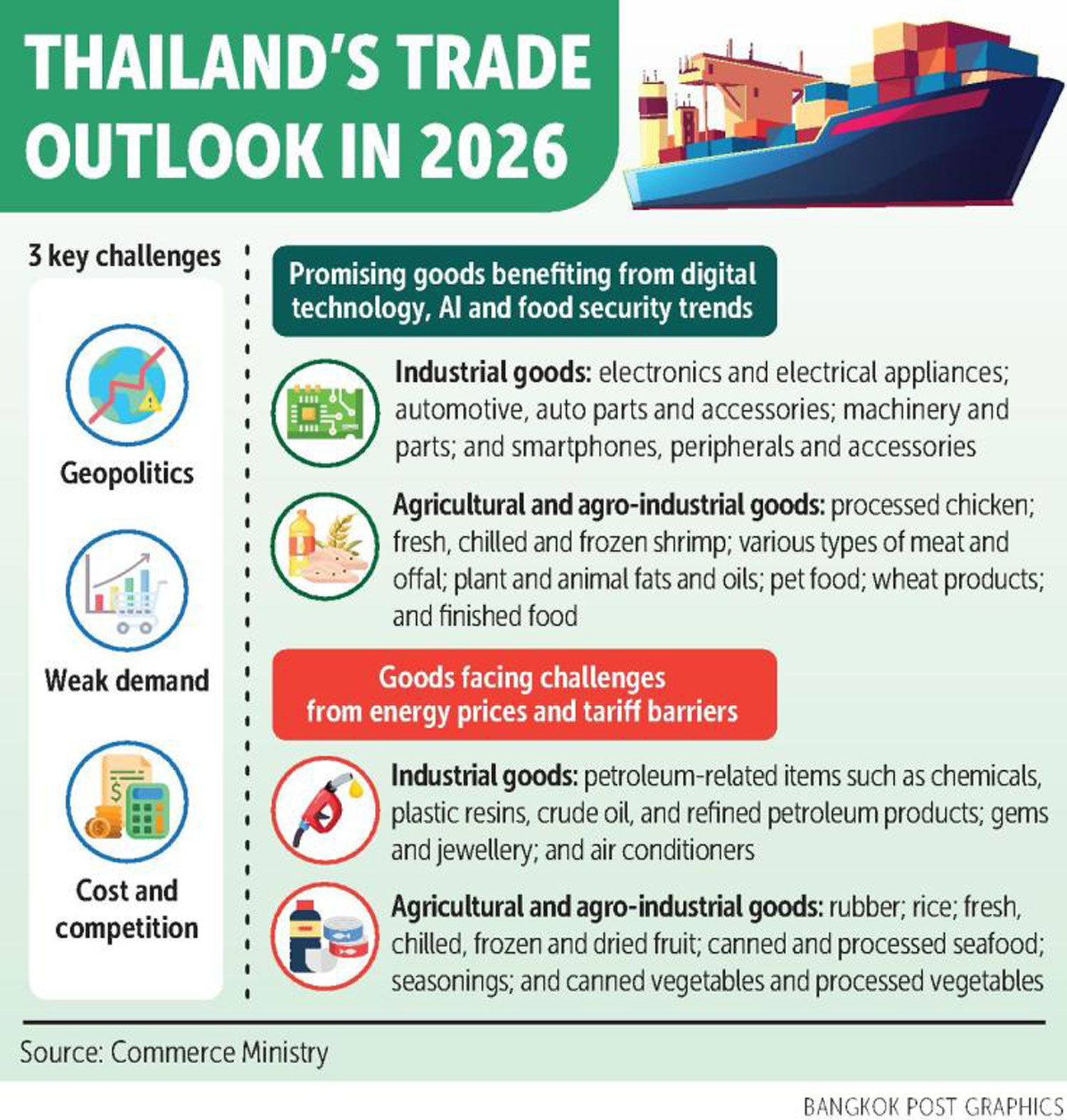
Sharing insights on the export outlook for industrial products in 2026, Nantapong Chiralerspong, director-general of the Trade Policy and Strategy Office, identified sectors with high growth potential including electronics and electrical appliances such as computers and peripherals, printed circuit boards, transformers, and other electrical devices. The automotive, auto parts and accessories; machinery and parts; and smartphone sectors are also expected to thrive.
These trends are largely attributed to structural shifts in the global economy towards a digital, artificial intelligence-driven world, coupled with the diversification of global supply chains that aim to elevate Thai products into high-value-added markets.
This shift is fuelling demand for advanced technology, efficient electrical devices, smartphones, tablets, and data storage solutions, in line with the growth of electric vehicle and advanced machinery sectors.
Mr Nantapong said exports of agricultural and agro-industrial products are also expected to benefit from the food security megatrend in 2026.
Despite challenges from trade barriers and market competition, several products show notable growth potential. These include: processed chicken; fresh, chilled, and frozen shrimp; various types of meat and offal; and plant and animal fats and oils like soybean and palm oil.
There is also an increasing demand for pet food, wheat products, and other finished foods, driven by trends in food security, health-conscious lifestyles, and the growing humanisation of pets. Together, these factors are driving the market towards high-value, innovative food products that meet internationally accepted sanitary standards.
SLOWING SECTORS
Mr Nantapong identified product categories that require close attention, which include petroleum-related items such as chemicals, plastic resins, crude oil, and refined petroleum products, as well as gems and jewellery and air conditioners.
These sectors are impacted by fluctuating energy prices, reduced purchasing power for luxury goods, and stricter tariff barriers in the US market.
To maintain competitiveness and ensure market stability amid stricter trade regulations in the future, Mr Nantapong urged Thai entrepreneurs to accelerate their adoption of smart technologies and sustainability standards.
Regarding agricultural exports, growth is expected to slow for products like: rubber; rice; fresh, chilled, frozen, and dried fruit; canned and processed seafood; seasonings, canned vegetables, and processed vegetables.
This slowdown is a result of tighter trade barriers in the US and China, coupled with lower competitiveness as a result of the baht’s appreciation and rising production costs compared to major competitors like India and Vietnam.
There are also high global supply levels and inventories in trading partner countries, Mr Nantapong said.
Mr Nantapong said in 2026, Thailand’s export sector must reassess its strategies in response to trade protectionism and geopolitical uncertainties.
He foresees heightened pressure on the export outlook this year from economic slowdowns in trading partner nations and US trade policies that are set to take full effect.
Mr Nantapong said while tensions among major global powers could show signs of easing, uncertainties persist, particularly as the US may implement more targeted trade measures or tariffs on circumvention goods.
Moreover, he said persistent global inflation constrains monetary policy easing and affects consumption in key markets, including the US, China, and Europe.
Despite these challenges, Mr Nantapong said there were opportunities for export growth in emerging markets, particularly in India, the Middle East, and the CLMV countries (Cambodia, Laos, Myanmar and Vietnam), which benefit from production relocation and strong domestic purchasing power. These regions represent a crucial factor for diversifying economic risks in the near future.
