
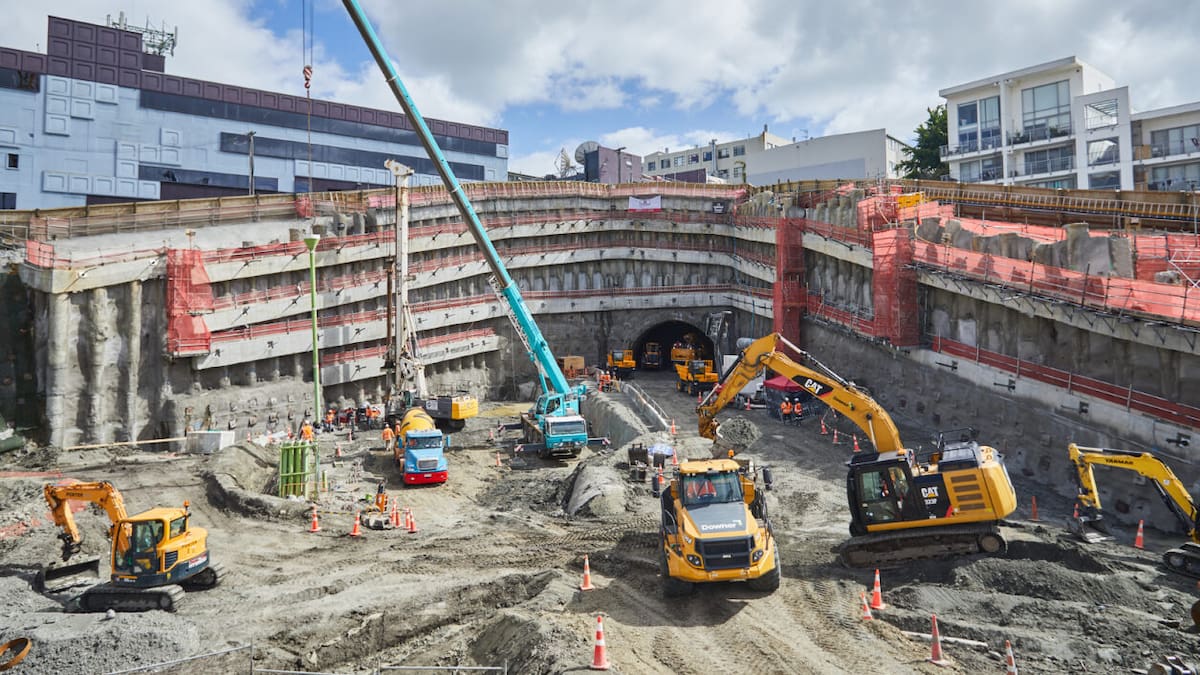
But after the doors open, the trains get moving, the pipes are operational, a larger question looms. What’s next?
The long-delayed International Convention Centre. Photo / Dean Purcell
Aside from the Roads of National Significance (RoNS), the pipeline for the next generation of national megaprojects is alarmingly thin. We are staring down a gap, in major construction activity and infrastructure ambition.
What is a megaproject? They are large-scale, multibillion-dollar, nationally significant projects that have long planning horizons and lifecycles but offer substantial economic, social and environmental benefits. For the United Kingdom, think high-speed rail or the “super sewer” Thames Tideway project.
Megaprojects thrive on continuity. Skilled workers, engineers, project managers and specialist contractors rely on a predictable flow of work to maintain capability. Stop-start investment, something New Zealand has become infamous for, drives talent offshore and inflates costs when we eventually decide to build again. A lumpy pipeline also undermines our ability to adopt engineering technologies, build institutional knowledge and by consequence, achieve productivity gains.
Cancelling projects, reducing the pipeline of work, means people leave our infrastructure workforce, or leave the country to go to places that have a decent pipeline and consistently show they want to get things done. To get those skills back when a project does crank up costs us more. We wonder why we only fall in the bottom 10% of OECD nations in the value we get from our infrastructure spend.
Recent data suggests those risks are real and growing. In the year ended September 2025, Stats NZ recorded a net migration loss of 46,400 New Zealand citizens, driven by a record 72,700 departures, primarily to Australia. In the construction sector, historically one of the largest employers in the country, employment dropped by 3.5% over the 12 months to March 2025, the largest annual decline in well over a decade. The sector has lost 16,000 jobs in the past two years, bringing construction activity to its lowest per-capita level since 2019. Our resources, people, skills and momentum are slipping away just when we should be building more and not less.
Successive governments have promised continuity, certainty and momentum in infrastructure delivery. The rhetoric has been loud, but the reality has been far quieter. Many of the projects heralded early in the term of the current Government are still stuck in business case development or early planning, while others have been delayed, rescoped or deprioritised.
This gap between promise and delivery matters. To prevent these stop-start cycles, megaprojects must be planned in an integrated way, with sufficient lead time to allow agencies with a stake in delivery to engage meaningfully. Aligning all perspectives, from government, local authorities and others, will prevent the delays that arise from siloed decision-making.
The country doesn’t need expressions of commitment, or promises, but a credible, sequenced programme of megaprojects with the funding to back them up. The funding commitment is the most important commitment needed to build a project, particularly a massive one that will go on for many years. No money, no project.
A second harbour crossing is a nation-building, multi-year, complex and high-stakes project involving many different interested parties. Image / Reset
Auckland is the powerhouse of the New Zealand economy, and all Kiwis need to be invested in its success. However, our infrastructure also needs to extend far beyond Tāmaki Makaurau. If we are serious about national connectivity and regional economic growth, we must broaden our vision.
New Zealand needs a coherent, multi-decade strategy for megaprojects, not a patchwork of politically motivated announcements. We need a shared regional vision, using infrastructure investment to drive nationwide growth.
Wellington needs more than repeated debates about a second Mt Victoria tunnel. Tauranga and Hamilton, two of the fastest-growing urban areas in the country, need major transport and housing projects to keep up with the population and economic demand they are capable of. The “Golden Triangle” generates a huge portion of national GDP, yet its infrastructure has not kept pace.
Canterbury and Christchurch would benefit from a discussion about what kind of large project could power their nation-leading growth even further.
A prime example is a second harbour crossing for Auckland. There’s no longer an argument about whether this is needed or not – it’s what form it takes and who pays that become the real questions. The crossing is a nation-building, multi-year, complex, high-stakes project with many different interested parties and lots of phases. Complicated, sure. A necessity, 100%.
Megaprojects are not simply about concrete poured or tunnels dug. They are commitments to our future as a nation. As we celebrate the completion of these long-awaited megaprojects, we should also be wary. Without a pipeline behind them, they are the end of an era rather than the beginning of a new one.
New Zealand stands at a crossroads. We can watch talent, expertise and resources drift away, or we can choose to build, connect and innovate with ambition and continuity. The question is no longer whether we can deliver megaprojects, we have proven that. The question is whether we will choose to keep going.
Catch up on the debates that dominated the week by signing up to our Opinion newsletter – a weekly round-up of our best commentary.