
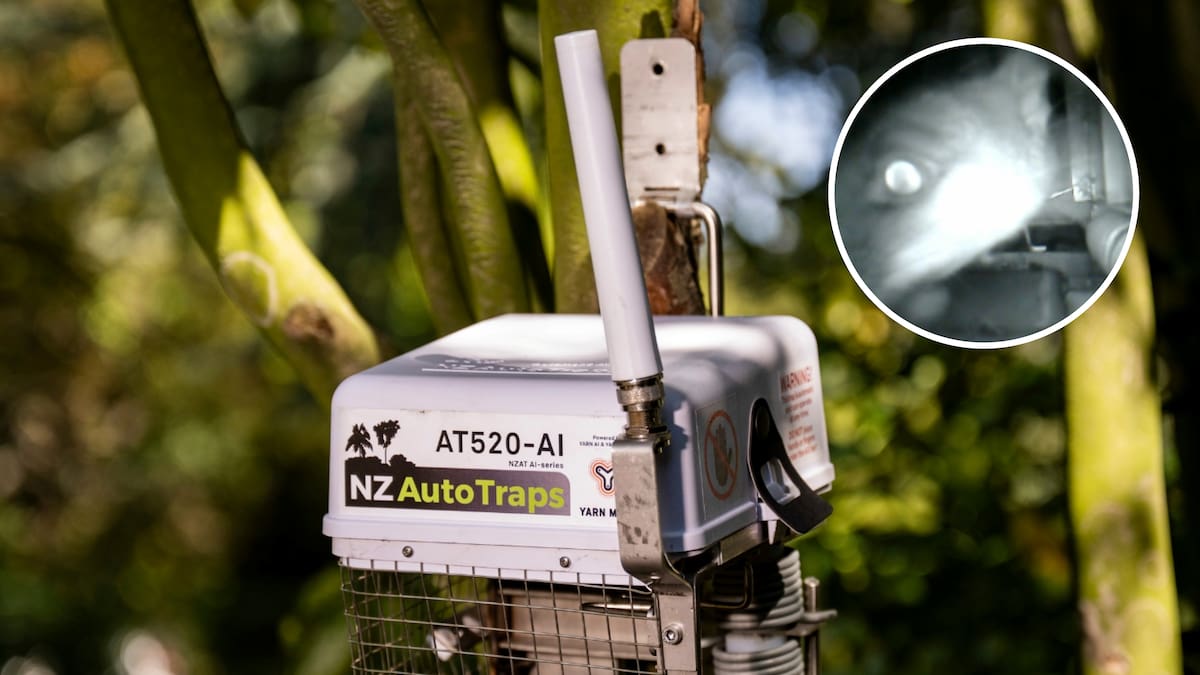
Between 2008 and early 2025, 17 kiwi were found dead or seriously injured in traps laid by the likes of the Department of Conservation, including one that died in Northland’s Puketī Omahuta Forest in January 2025.
Johnson says on top of safety, the traps can be left for up to three months instead of needing daily checking, leading to more effective use of people’s time.
In Whangārei Heads, the AT520-AI can be used effectively on privately owned farmland, where farmers may not want trappers coming on to their land every day, he says.
“Having people walking around their farm during calving and lambing time can be really disruptive. It’s been quite a game-changer when we’ve been working with a community hesitant to have our team on their property.”
The traps are also useful in Whangārei Heads’ steep and rugged terrain, where it is too hard to check traps daily over a large area, Johnson says.
AI traps are a potential game-changer in the war against possums at Whangārei Heads, says Northland Regional Council biosecurity manager Sam Johnson.
One AT520-AI that caught 28 possums in 14 days – two possums per night – which would have meant a huge amount of work if the traps had to be cleared and reset after each catch, he says.
Seventy-five AI traps are used at Whangārei Heads, with the project backed by Predator Free 2050 funding.
A further 75 traps are used by Predator Free Pēwhairangi Whānui, which is targeting pests on three different Bay of Islands peninsulas: Purerua-Mataroa, Russell/Kororāreka and Cape Brett/Rakaumangamanga.
While the Pēwhairangi Whānui project also gets funding from Predator Free 2050, it is led by community groups and iwi, rather than the regional council, Johnson explains.
Other tools include motion-sensing night-vision cameras, which are paired with an automatic non-toxic mayonnaise lure.
“When a possum accesses the mayonnaise lure, they trigger the camera which automatically takes a series of photos.”
The cameras, coupled with AI technology, help show when pests are present so action can be targeted efficiently, Johnson says.
Biosecurity officer Gaelyn Dewhurst and her dog Shaka got certified through the Department of Conservation, with Shaka now one of the few certified possum scat-detection dogs in the country.
Dog’s sharp nose important tool against possums
While the cameras are useful, they can’t beat the impact of a sharp nose: that of certified possum-scat detection dog Shaka and his handler, biosecurity officer Gaelyn Dewhurst.
“Shaka’s sharp nose is already bringing great outcomes to our project, helping to find and trap some hard-to-get possums,” Johnson says.
Drones equipped with thermal imaging cameras help identify kiwi and track down possums.
When cameras confirm the presence of possums, Shaka finds scat hotspots, indicating where possums are spending most of their time. This enables the team to be more targeted with trap placement and more successfully catch possums, he says.
As the programme removes possums, Shaka will be invaluable at sniffing out the last ones, Johnson says.
Drones equipped with thermal cameras are another tool, to scan large areas for possums.
In June 2025, the team ran a drone monitoring operation in the Kauri Mountain Reserve which found 22 possums in the canopies, indicating a sizeable population present given the “snapshot” in the canopy at the time, he says.
While AI is helping revolutionise trapping, Johnson admits the new technology can add complexity to the project, with staff having to balance old and new tech.
But the biggest concern is the projects potentially stalling due to a lack of funding, with the Predator Free 2050 contracts ending in June 2026 for the Bay of Islands and June 2027 for Whangārei Heads, he says.
Denise Piper is a news reporter for the Northern Advocate, focusing on health and business. She has more than 20 years in journalism and is passionate about covering stories that make a difference.