
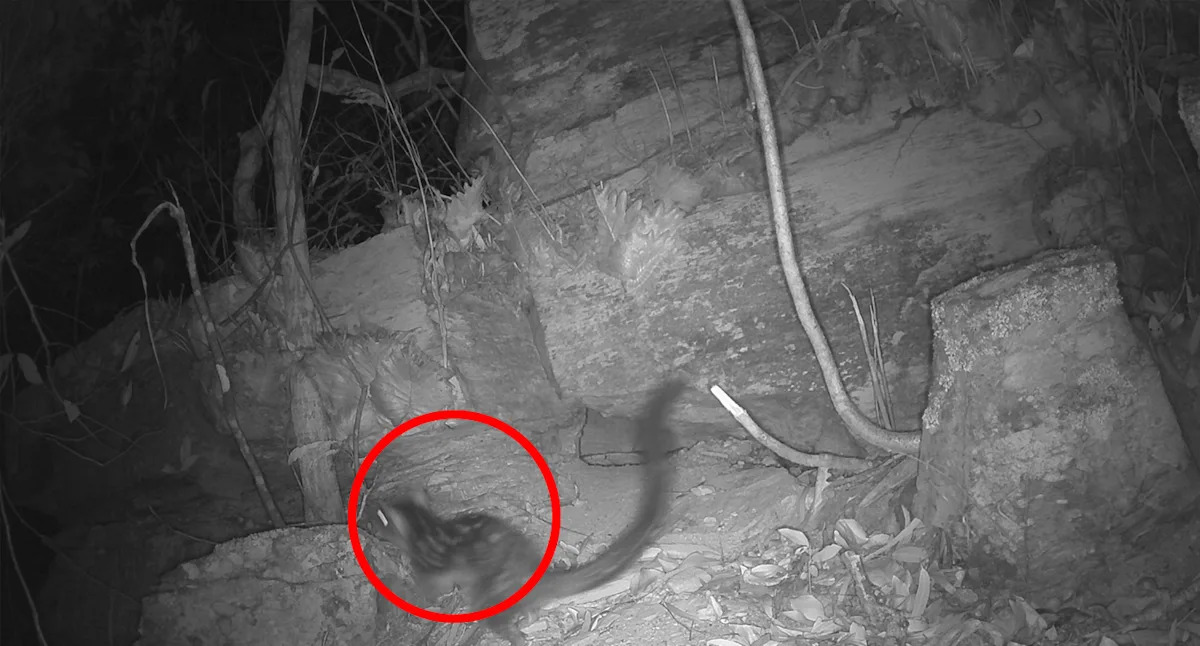
There were five missed calls on the phone of ecologist Dr Helena Stokes, leading her to panic. “I thought something serious must have happened,” she told Yahoo News.
Then she saw a series of grainy, black-and-white images taken at a Cape York wildlife sanctuary flood her inbox. Her mood instantly changed to one of excitement.
Jumping across the lens of a motion-activated camera was the distinctive shape of an endangered northern quoll, a cat-sized marsupial predator that hadn’t been documented in the area for 80 years.
Located in Far North Queensland, the sanctuary is owned by the Australian Wildlife Conservancy (AWC) and The Tony & Lisette Lewis Foundation, and is home to other threatened species, including black-footed tree rats and banidcoots.
Previous surveys of the 164,850-hectare Piccaninny Plains Wildlife Sanctuary over the last 17 years had failed to locate the species, despite the team using targeted camera deployments in 2015, 2021 and 2023.
Although a sighting at a neighbouring sanctuary in 2017 by Indigenous rangers had given the team some hope, numbers across Australia have been spiralling downwards.

A northern quoll sitting on a rocky outcrop at the sanctuary. Source: AWC
In their search for quolls, the sanctuary manager had choppered over a remote location they’d neglected to survey before, then set up camera traps around an isolated rocky outcrop surrounded by savannah woodland.
“It’s more than 10km from the last known record,” Dr Stokes said.
“It’s possible it was there all along, and possible it’s come back.”
Future of quolls threatened by invasive species
Despite efforts to manage invasive species, cane toads are known to have infiltrated the area, as they continue to spread across the country and decimate native wildlife.
The species has been identified as the greatest threat to the northern quoll’s survival, because despite being the perfect prey size, they have glands behind their eardrums that ooze deadly poison when disturbed.

Cane toads are the greatest threat to the survival of northern quolls. Source: Brad Leue
Hunt for more quolls set to begin
AWC believes the animal is likely a male, and it plans to set up more cameras around the area to ascertain whether it was an individual passing through or whether there is an established population.
“This record gives us a roadmap,” Dr Stokes said earlier in a statement.
“We now have a clear starting point for future surveys and research. It’s possible this quoll, and hopefully others, have adapted their behaviour in response to the presence of cane toads.
“Understanding that resilience could be vital for the species’ long-term survival.”
Love Australia’s weird and wonderful environment? 🐊🦘😳 Get our new newsletter showcasing the week’s best stories.
