
It’s early, but “Greenland: Migration” is already a candidate for worst movie of the year. I don’t say that because I have some knee-jerk aversion to Gerard Butler movies. I’ve been reviewing about one of them per year for longer than I can count (usually in January, the dumping-ground release period that’s become the Butler zone), and a few of them, like “Plane” and “Den of Thieves” and its sequel, have a pleasing pulp flair. When Butler plays bruiser cops or underworld dogs, he’s got a gruff charisma. But “Greenland: Migration” is one of the soggiest excuses for a sequel in memory. The first “Greenland,” released at the end of 2020, was an environmental disaster movie. The new one is a post-disaster slog. It should have been called “Rubble.”
The end-of-days scenario of “Greenland,” about a comet getting ready to hit the earth, rhymed, in a coincidental but resonant way, with the pandemic. It was like “Deep Impact” made on a B-movie budget, with a calamitous mood that was effective in a vérité way. But it was also a banal family-splits-apart-and-comes-together movie.
So now that that comet — or, in fact, a collection of rock fragments — has hit the earth, what is there left for “Greenland: Migration” to show us? I figured that the director, Ric Roman Waugh, returning from the first film, would find a contrived way to stage another extinction-level event. But no. “Migration” starts off in a bunker, where Butler’s John Garrity is waiting out the apocalypse with his wife, Allison (Morena Baccarin), and teenage son, Nathan (Roman Griffin Davis). Most of the planet has been destroyed; America, Canada, Iceland — all gone. The earth’s cities are wastelands (we see the twisted bottom of the Eiffel Tower sticking up out of the ruins), and if you go outside the radiation can kill you.
Yet there’s a place that awaits in Western Europe, an oasis of green salvation like that Whole Foods commune in the last “Mad Max” film. It’s called the Crater, and once the bunker is destroyed by a cosmic storm, that’s the destination that Garrity and his family head for. This means they will journey, with a handful of comrades, from the bunker to a small metal covered tugboat that takes them across the ocean (it’s like a bunker on waves), until they reach Liverpool (which is covered in water). Then they find dry land and hook up with a Nigerian van driver who tells them, “The world is a dangerous place now. People are so desperate they will kill you for scraps of food.” They wind up in the ruins of London in a cramped apartment full of Alzheimer’s patients that’s like one more bunker.
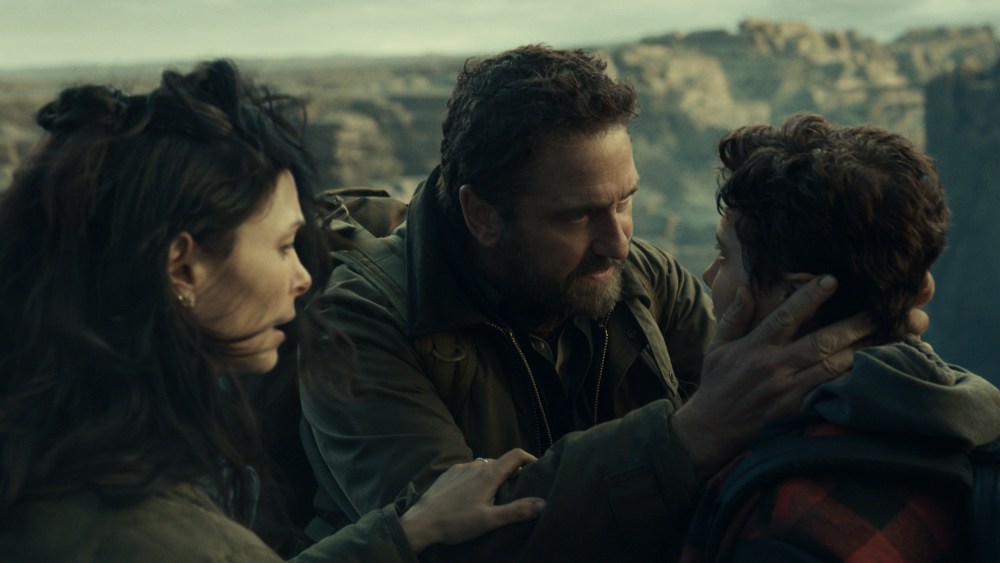
“Greenland: Migration” is a dystopian dud. It’s like the boring middle section of a picaresque disaster film, minus the showy kickoff and catchy climax. The characters sit, then drive, then fend off marauders, then come upon the former English Channel, which is now drained and looks like something out of “Dune” if it were set on earth. Butler, bearded and morose, has rarely registered with so little force onscreen. There are two action sequences that briefly wake you up: a comet shower over the woods, and a walk across a canyon on a treacherous rope bridge. But by the time enough people die in this sequence, it’s just John, Monica, and Nathan plodding onward.
I think the problem with “Greenland: Migration” is that the folks who made it (Butler is one of the producers) actually think that they’re crafting a serious social statement; that’s why they forgot to entertain us. The film has not one but two free-floating “political” themes. Like almost every disaster film, it presents itself as a didactic metaphor for man-made environmental catastrophe. But the other theme, suggested by the title, is that Garrity and his fellows aren’t just survivors wandering the wilderness. They’re migrants, which means that the movie can chime with the current global crisis regarding migrants and refugees everywhere. The trouble is that “Greenland: Migration” is so dull it makes you want to migrate out of the theater.