
The woman had to cope not only with grief, and with children devastated by the loss of their father, but also with hurriedly entering the workforce at too low a pay rate.
Insurance matters. And the sad thing is that the people who most need it – those on low incomes with not many resources – are the least likely to have it. Even if you’re not well off, please get some basic cover. There are tips below on how to keep the costs down.
But first, let’s look at the basic idea. It’s best to go through life feeling “ripped off” by insurance. If you never get your money’s worth, that means you haven’t had to make many claims.
The people on the other side – those who get back more than they ever paid in premiums (the money you pay for insurance) – are the unlucky ones. They’ve had lots of bad stuff happen to them, and while their insurance payouts helped, there’s still the hassle of claiming and replacing items, and sometimes the heartache of losing a home or a loved one.
It’s often said – at least by those in the insurance industry – that New Zealanders have too little insurance. And indeed, we rank pretty low internationally for life and disability insurance, although we’re not so bad on contents and cars. We used to be okay on house insurance, too, but some experts are worrying that our homes are now under-insured, since premiums rose a lot in the aftermath of the Canterbury earthquakes and several weather disasters since then.
Some tips on types of insurance:
Life insurance
The woman I described above, whose husband died without insurance, probably also didn’t have life insurance herself. It’s common for non-employed parents not to be insured.
But if they die, their partner can struggle with having to pay for child minding, cleaning and all the other tasks homemakers often do.
If you have dependants and you don’t want them to feel angry – as well as sad – if you’re hit by the proverbial bus, get life insurance. How much? There are several online life insurance calculators. Most are run by insurance companies, so they might be a tiny bit motivated to oversell. But you can rely on the calculator on Consumer NZ’s website, www.consumer.org.nz.
(To use it, you have to belong to Consumer NZ. If you don’t, I strongly recommend you join. You get unbiased advice on all sorts of products and services – based on trials and research and also surveys of members on things like brand reliability. I never make a major purchase without reading what Consumer says first. And it’s great on minor purchases, too. Also, Consumer will often go into bat for you if you have a dispute with a company that you can’t resolve.)
Choose term life insurance, which covers you for a fixed period – perhaps until your dependent children have flown the coop, or your mortgage is paid off, when you may want to reduce your cover or stop it altogether. On the other hand, don’t neglect to add to your life insurance if another child is born or you take on a new mortgage.
You can get much cheaper life insurance that pays out only if you die in an accident. But it’s cheap because few people die that way. Don’t be sucked in. Your dependants need money regardless of how you die.
Income protection or disability insurance
This is sometimes called loss of income or income replacement insurance. There are various types of policies, some of which come as part of life insurance.
Typically, you will receive money if you are unable to work for a month or three months. The payments may last for a fixed period, or until you’re 65.
If you’re employed, ask your employer how long they will continue to pay you if you are unable to work. You don’t want to pay for cover when your employer will cover you.
Just as with life insurance, non-employed parents also need disability insurance. If a homemaker becomes disabled, extra money would be really helpful.
House and contents insurance
Before non-homeowners skip this bit, it’s a really good idea for you to get contents insurance. Bad things are just as likely – if not more so – to happen to your stuff if you are renting.
For homeowners, of course, you need both house and contents covered. How can you tell if, say, a carpet ruined in a flood comes under house or contents? Imagine turning the house upside down and shaking it. What falls is contents.
So, with the example of the carpet, it depends on whether it’s tacked down or not.
Note that policies vary on whether your damaged items will be replaced with new ones or you’ll be given only enough to buy second-hand goods.
It’s a good idea to record the serial numbers of all your electronic equipment, to help prove you had it.
Car insurance
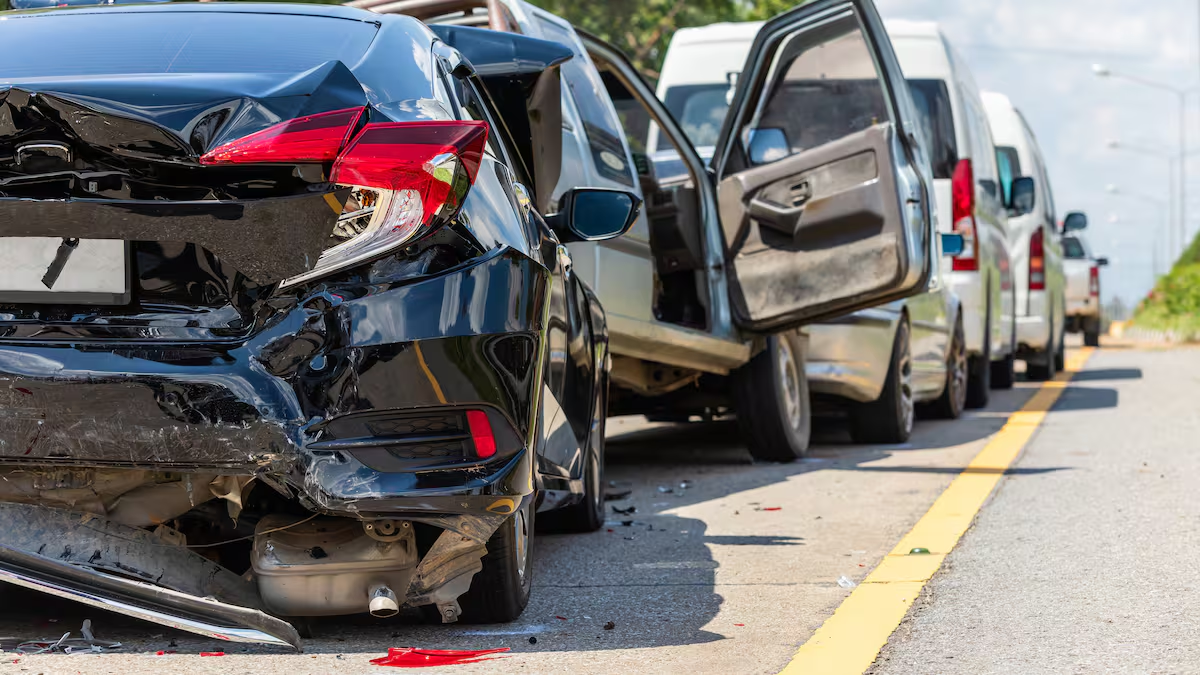
You should always get at least third-party insurance, which covers you if you accidentally damage someone else’s car. Your vehicle might be an old dunger, but what if you run into a Rolls-Royce and it’s your fault?
But of course it’s better to have cover for your car, too.
And be honest when you apply – not just because your mother said you should, but because it could cost you dearly if you’re not. It’s easy enough to “forget” when you’re applying for car insurance that you’ve been in a few crashes or committed a couple of serious driving offences. Or you forget to tell the company if you modify the car. Until you claim.
It’s much cheaper for the insurance company to check you out only at claim time. Many people never make claims, so the company never checks them. But when the company comes back after your claim and says, “Sorry, but you didn’t tell us, so you’re not covered,” you’ll wish you had listened to your mum.
Note that you won’t be covered if you’re doing something illegal when you crash the car, such as driving drunk. And that’s the very time when you’re more likely to have an accident. It’s simple really – don’t drink and drive.
As your car gets older and is worth less, keep an eye on the insured value. There’s no point in paying to insure a car for $10,000 when it’s now worth only $6000. Or is there?
With my previous car, I had an “agreed value” – how much the insurance company would pay if the car was written off.
Every now and then I would call them and say, “My car is no longer worth that much. So how much less would the premium be if I dropped the cover?” The reduction in the premium was always so pathetic that I left the agreed value as it was. And when a relative wrote off my car, I was pretty happy to get the higher amount!
However, if your cover is for the “market value” of your car, the company will pay out only what it’s currently worth, so don’t pay additional money for insurance above that amount.
True tale: What if the other guy is not insured?
“Something that made a huge difference to us with our car insurance was ‘cover for uninsured drivers’,” says a friend.
‘It means if you’re in a crash and the other driver is at fault and uninsured, the insurance company will cover your car. It wasn’t standard with our third-party insurance, but the salesman suggested it, and it cost something like $3 a year.
“When we had a crash on the motorway, the guy at fault wasn’t insured. He had been ordered by the courts to pay us off at about $7 a week. He made two full payments, then half two weeks later, then nothing.
“I had forgotten that I’d got that extra cover. But the company called me up and immediately paid out the full value of our written-off car (no excess), then tried to recover that money from the guy themselves. I was very glad I’d paid that few extra dollars.
“When I got insurance for the next car I had to specifically ask for it, and the salesman hadn’t sold it before. But again, it was about $3 a year.”
Moral: Get that extra cover.
Travel insurance
Dispute resolution schemes – which sort out problems between you and financial service providers – say travel insurance problems loom large on their list of disputes.
There are so many things that can go wrong when travelling, and we don’t always bother to read all the fine print of insurance that will last for just one holiday.
But it’s important to get good travel insurance. There are horror stories of people running up overseas bills of hundreds of thousands of dollars for medical care.
Who to go with – without spending hours researching it for one measly trip? This is the sort of situation when Consumer NZ comes to the fore. Check out their recommendations.
Health insurance
This is a bit like car insurance. It’s tempting when applying to “forget” earlier health problems or pre-existing illnesses. Your premiums will be lower if you don’t go into all of that.
Don’t be tempted. Again, you won’t be challenged until you make a claim. But “No cover” is the last thing you need to hear when you’re unwell.
Some people drop health insurance – perhaps in retirement when the premiums soar – saying the state system will take good care of them. After all, many top medical specialists work in public health as well as privately.
But I don’t recommend that. Often health insurance will enable you to get medical attention faster, with more choice about who treats you, and sometimes in a better facility.
When you’ve got medical problems, these issues – especially the faster service – might matter a lot. Looking at photos of your last holiday, funded by dropping your health insurance, won’t quite make up for slower action, less choice and fewer comforts.
Rich Enough? A Laid-back Guide for Every Kiwi, by Mary Holm is published by HarperCollins Aotearoa New Zealand.
Catch up on the debates that dominated the week by signing up to our Opinion newsletter – a weekly round-up of our best commentary.