
As unmissable as new year’s fireworks, the wolf moon held the heavens for the first few nights of January, casting an unearthly radiance over everything, night almost as bright as day. Now, as that moon wanes, prepare to be wowed by a true planetary A-lister: Jupiter.
Named after the king of the sky gods in Roman mythology, Jupiter rises each evening in the east, unmatched by any star save Sirius. Tonight, however, it will be at its biggest and brightest, having reached “opposition”, meaning we on Earth are directly between Jupiter and the sun. If you have never tried “star” gazing before, tonight’s the night to start.
Jupiter is truly a celestial titan. It is equal in volume to 1,300 Earths, with an atmosphere 1,000km thick, below which lies a sea of liquid hydrogen, 20,000km deep. It rotates much faster than Earth, a Jovian day lasting under 10 hours. Such motion fuels immense turbulence in its atmosphere, with wind speeds of almost 1,450km/h producing distinct colour-banding and vast, long-lasting storms such as the great red spot, which is three times the diameter of Earth and visible through binoculars.
An image of Jupiter, taken by Nasa’s Hubble space telescope, showing the great red spot, and Europa. Photograph: Space Telescope Science Institute Office of Public Outreach/AP
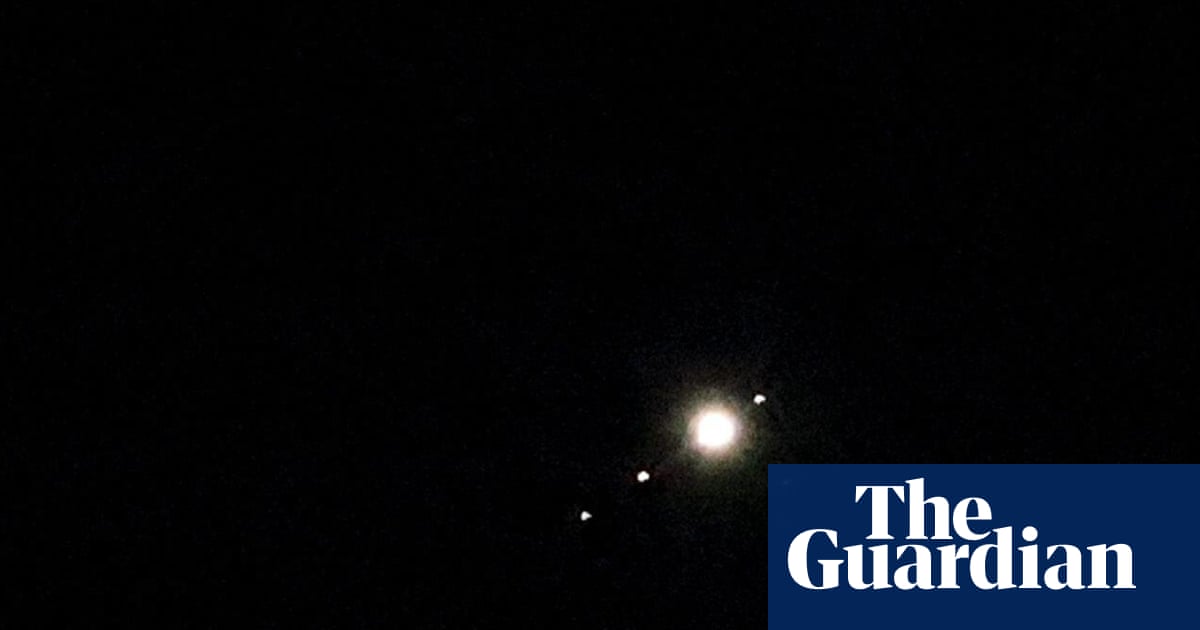
Binoculars also reveal the four largest moons of Jupiter – Callisto, Ganymede, Europa and Io – named after the lovers of the Greek god Zeus, and first observed by Galileo in 1610. Io is roughly the size of Earth’s moon and is thought to be the most volcanically active body in the solar system, constantly turning itself inside-out, spewing lava from countless volcanoes.
Included in Jupiter’s backdrop are Castor and Pollux – celestial Argonauts in Greek mythology, and the chief stars of the Gemini constellation. Together they form (from our perspective on Earth) a pleasingly close configuration, yet they are separated by light years of space.
Closer to home, the wolf moon tugs silently at the Earth and the Earth tugs back, keeping our sculpted satellite in orbit while generating spring tides that circumnavigate the world. All the night sky’s players perform a far-flung dance at gravity’s command. No orb is an island. No body or motion is without consequence.
From atom to star, the universe is defined by unseen forces of nature, and on a clear winter’s night, there’s no better spectacle.
Under the Changing Skies: The Best of the Guardian’s Country Diary, 2018-2024 is published by Guardian Faber; order at guardianbookshop.com and get a 15% discount