
The drug worked to manage his pain for a few years, but Fleming says he then developed an addiction.
“I had an experience where I was short of a dose and I felt not very well not having [it]. A couple of years after that, I was really struggling with all of the pain, and I was advised to give up those medications.
“Gabapentin wasn’t hard to get off, but I was addicted to Oxycontin.
“It was nine months of hell to get off it.”
Oxycontin (oxycodone) is an opioid that’s effective for managing severe pain, but comes with a high risk of side effects and addiction.
For years afterward, Fleming went without pain relief until he broke his leg in 2022 and his pain levels “ramped up”.
His GP suggested contacting the Cannabis Clinic, where he was prescribed medicinal cannabis.
“It has literally been a game-changer to my pain levels.
“I’d heard about the benefits of cannabis for years relative to pain and that it was legal in other countries, and I was waiting for it to come here. But I wasn’t even aware of it until at least a year after it was legal.”
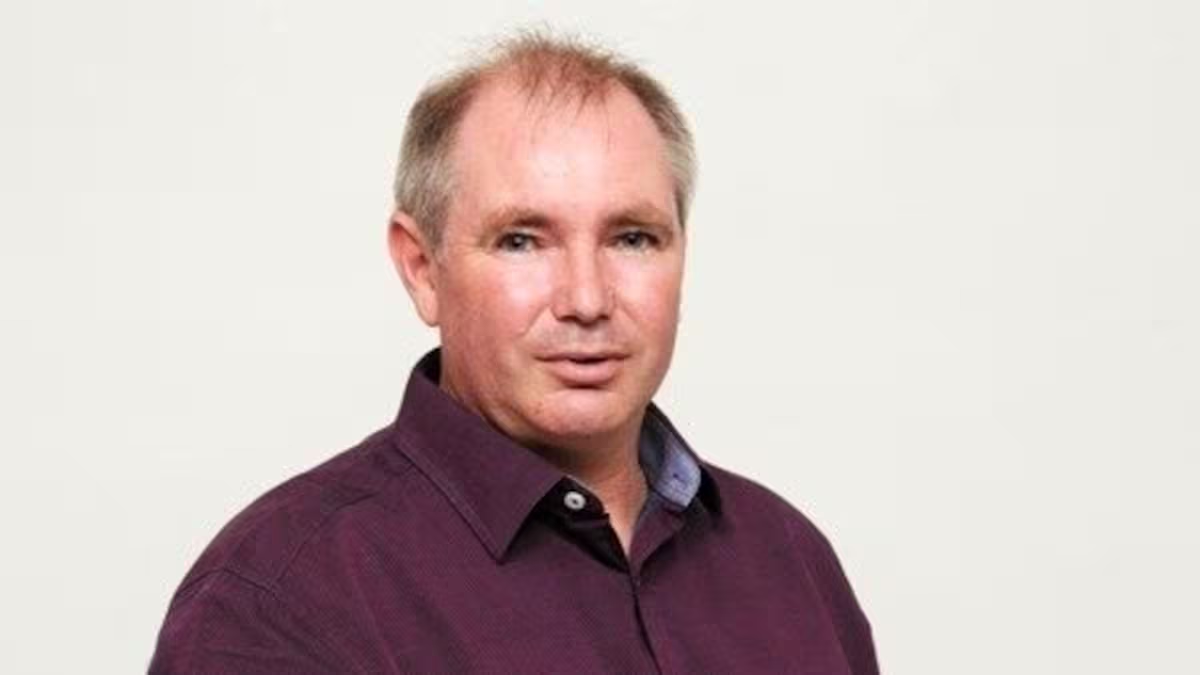
Andrew Fleming, 56, has been a paraplegic for 25 years and is a keen adaptive skiier.
It’s thought around 120,000-130,000 Kiwis have been prescribed medicinal cannabis. The Medicinal Cannabis Scheme came into effect in April 2020, with the goal of improving access to quality medicinal cannabis products, according to the Ministry of Health.
Patients must consult a doctor to obtain a prescription for medicinal cannabis under the scheme. People with conditions including chronic pain, epilepsy and glaucoma can qualify for medicinal cannabis in New Zealand, and the costs vary depending on the product and dosage prescribed.
Some medicinal cannabis products contain tetrahydrocannabinol (THC), the psychoactive, while others are made of cannabidiol (CBD) which does not intoxicate or become addictive.
Fleming says taking THC oil has halved his burning pain levels.
“I hardly ever get shock type pain. And if I do, it’s more like someone’s just pinching my thigh a bit, nowhere near as violent as it was.
“When you get shocks like that, it’s really dangerous with whatever you might be doing because you can’t ignore it like you can with other types of pain.”
He says he hasn’t personally felt any negative side effects, though others might have different experiences.
“It did take my body a little while to get used to it – a few times I felt a bit funny. But I don’t feel that anymore … and now the pain is so much lower.”
Andrew Fleming says medicinal cannabis has made all the difference to his chronic pain.
Fleming is a keen adaptive skier, and says he’s been able to ski while on medicinal cannabis.
“It does not impair me … Last year I skied a lot at Cardrona, and my pain levels were the best they had ever been up in that cold environment.
“It feels like I can flex the muscles in my thighs. When I lie in bed, I can actually lift my knees a little bit, which is probably a little bit of hip flexion.”
He knows people will have opinions about using this type of medication.
“There’s a lot of scepticism about THC because that’s what gets people high or stoned. It doesn’t affect me like that. It may affect someone else like that.”
CBD oil – which does not have THC in it – didn’t work for Fleming.
“But I am aware of other people with a range of different health issues, that it’s working for them.”
Medicinal cannabis is not funded in New Zealand; there are only two types approved by Medsafe for specific uses, though the Ministry of Health lists several that meet the “minimum quality standard” and can be prescribed legally.
The Royal New Zealand College of GPs’ official position statement on medicinal cannabis is that it “should only be considered when all first-line, conventional, evidence-based treatment options have been exhausted, and after detailed discussions of the potential benefits and harms of medicinal cannabis products with the patient”.
The college’s medical director Dr Prabani Wood says, “specialist GPs are sometimes faced with the need to help patients who are unable to manage chronic and debilitating conditions using conventional, evidence-based treatments, and, at times, patient requests to prescribe medicinal cannabis products”.
“However, as with all clinical decisions, GPs need to balance patient-initiated requests for treatment and the clinician’s therapeutic responsibility. The sole medicolegal responsibility for prescribing rests with the prescriber, so it is also imperative to consider legislative and professional requirements before prescribing medicinal cannabis products.”
Dr Prabani Wood is a GP at Waikato University Student Health and medical director of the Royal New Zealand College of GPs.
She says GPs should only prescribe medicinal cannabis if they are confident in doing so and familiar with the dosing regimes that can be used. “[They] may wish to undertake specific courses or training for this.”
More high-quality research into medicinal cannabis products’ safety and effectiveness needs to be done, Wood says.
“Balanced, evidence-based general education for the general public and medical practitioners should be made available. The Government should also start monitoring the prescribing and use of medicinal cannabis products to increase confidence in the Medicinal Cannabis Scheme.”
Doctors at specialist clinics can also prescribe medicinal cannabis. Cannabis Clinic CEO and founder Dr Waseem Alzaher says specialists will take someone’s health history and any other medications into account before prescribing.
“We also get people who are referred from their GP or specialist, or other health practitioners that refer them to come and see us and we offer a consultation,” he tells the Herald.
“We’ve seen cannabis turn people’s lives around on a daily basis. People come to us and say, ‘my chronic pain, my sleep has improved, [so has] my anxiety, my mental health, my focus’. People who are, for example, end of life and are vomiting or have nausea and chemotherapy side effects, they are being improved significantly with medicinal cannabis. That’s what keeps us going.”
Alzaher says some GPs’ hesitancy to prescribe is contributing to the enduring stigma around medicinal cannabis.
“It’s been illegal and criminalised for such a long time – of course there’s no research and research has to catch up. What are we doing as healthcare professionals to enable that research? We know that more and more people are going to be using it and they’re finding a benefit from it.”
Dr Waseem Alzaher, CEO and co-founder of the Cannabis Clinic.
Workplace drug testing that doesn’t account for people using legally prescribed medicinal cannabis also “reinforces the stigma”, he says – as will new drug driving rules.
“With ACC, in terms of funding cannabis, that’s quite difficult for people. We’ve got the drug driving laws that have been passed that are being rolled out now in Wellington, again penalising people for using cannabis and other illicit drugs, but not other potentially impairing medicines,” he says.
“Again, that just deepens the stigma.”
Fleming pays for a regular prescription of THC oil and has tried to claim the cost back through ACC, but has been told there is not enough evidence it works.
“As the only person that can feel my pain, I have plenty of evidence it works much better than any of the other medicines I had for the 22 years before I was prescribed medicinal cannabis,” he says.
“I’m waiting to see what changes happen.”
In Fleming’s mind, he has nothing to lose; he was told his accident would take a decade off his life.
He calculates that if he was still on his previous medications today, including Oxycontin, it would be costing the health system $40,000-50,000 a year – much more than the cost of medicinal cannabis, which for Fleming costs around $3500 a year.
Fleming hopes the “stigma around medicinal cannabis” will shift, and wants people to be aware of the benefits it can have for people like him as an alternative to drugs like oxycodone.
“I can understand that doctors need to be confident about what they’re prescribing … I think people should open their minds.”
Bethany Reitsma is a lifestyle writer who has been with the NZ Herald since 2019. She specialises in all things health and wellbeing and is passionate about telling Kiwis’ real-life stories.