
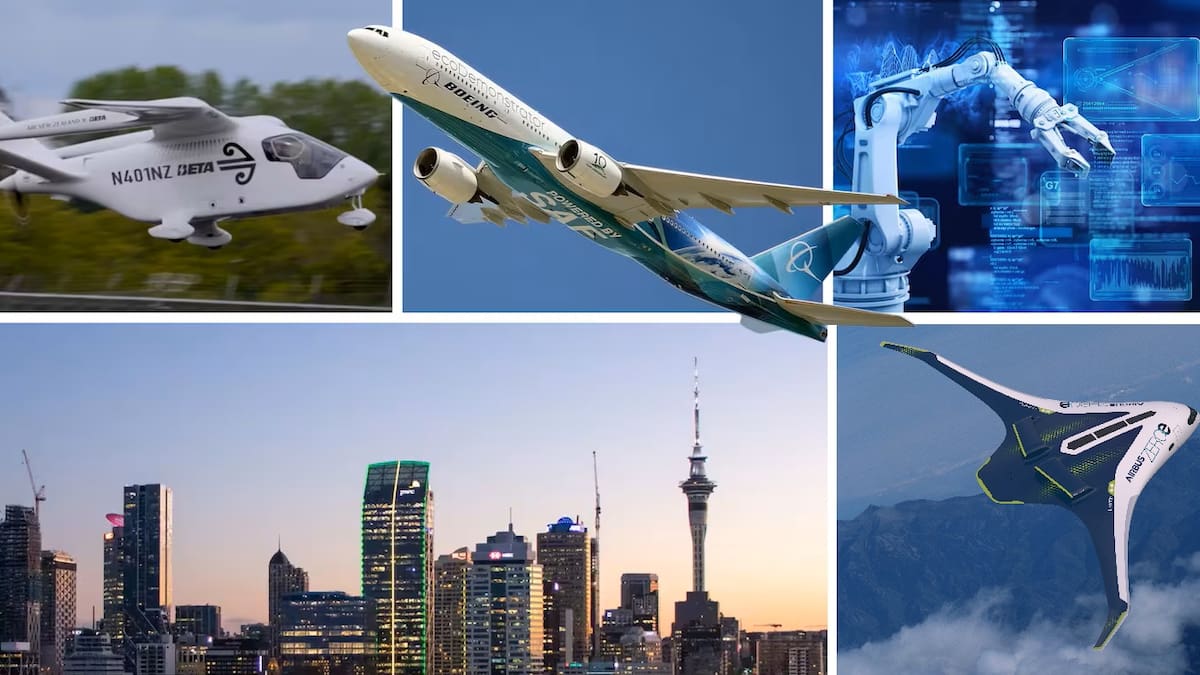
Imagining the future of flight, how might the world of aviation look 50 years from now? That’s not easy. But we might have more luck predicting the world of 2050 – and that’s exactly what some of the world’s aviation leaders have been doing.
Auckland to London direct
Qantas’ new A350-1000ULR (Ultra Long Range) aircraft at the Airbus factory in Toulouse, France. Photo / Qantas
Direct flight from Auckland to London, anyone? Or how about a winter getaway from Christchurch to Barcelona with no stopovers?
Flying between the furthest imaginable points on Earth in one journey might be far more common in 2050 than it is today.
The Qantas Project Sunrise initiative aims to make direct flights from Sydney to London and New York a reality.
Cam Wallace, Qantas International and Freight chief executive, discussed the project with the Herald when he visited Auckland in December.
“We’re still working with Airbus on Project Sunrise coming to life in 2027, and we released some photos of the aircraft coming out of the hangar in Toulouse.”
An announcement on the first Project Sunrise destination will likely be announced this year, and the airline hopes to start selling tickets at some point later in the year.
“We’ve got a number of ultra-long haul services: Perth-Paris, Perth-London, Perth-Rome, Rome-Sydney, Melbourne-Dallas, and obviously Auckland-JFK,” Wallace said.
Some of those are tantalisingly close to the distance of a London-Sydney or Sydney-New York flight.
Qantas is buying Airbus A350s specially designed for the ultra-long haul (ULH) trips, which could take up to 22 hours.
That requires a lot of fuel, and Project Sunrise aircraft have a high number of first-class, business and premium economy seats, and just 140 in economy.
In total, the cabins will have 238 seats, the lowest seat count of any A350-1000 in service.
In November the airline said all key airframe components including the forward, centre and rear fuselage sections had come together, along with the wings, tail section and landing gear.
Wallace told the Herald Qantas was working its way through a broader fleet renewal process, gaining flexibility to grow its capacity.
“It’s probably the most exciting time to be at Qantas in the 105-year history just because we’ve got so much growth coming.”
Other conceivable ULH trips for airlines could be Shanghai-Buenos Aires direct, instead of stopping in Auckland, Johannesburg-Honolulu, or Perth-Miami, all cities that are near-antipodes.
Integrated terminals with robot helpers
Your local airport hotel may also have more check-in staff similar to this dinosaur robot in Japan. Photo / Keita Iijima, The Yomiuri Shimbun via AFP
In some airports, it’s a short walk. In others, it’s a long walk. And in others, you need a bus or train to travel between the domestic and international terminals.
Global architectural firm Populous and infrastructure advisers The Mercurius Group published research last year highlighting the virtues of integrated terminals.
Using the same resources for domestic and international flights could bring major capital expenditure savings over time, Mercurius says.
The model does generally mean needing to clear security twice before boarding an international flight. But integrated terminal backers say the model can give travellers better shopping and dining opportunities, time savings and fewer overall hassles.
Integration projects are already happening or being considered in Perth, Brisbane, Sydney and Auckland.
Auckland Airport has said it wants more self-service technology and automated bag drops instead of dozens of traditional check-ins.
And across airport precincts, R2-D2’s mates might become more common.
Air New Zealand has teamed up with Spark, Ericsson and Canadian firm Cypher Robotics to get a robot-tethered drone working in a warehouse.
In December, Heathrow asked the public to suggest names for 20 autonomous cleaning robots.
Your local airport hotel may also get more robot staff.
Sudima Hotels has introduced wildly popular room service robots. And in Japan, the Henn na Hotels in Osaka’s Kansai airport and other places already have humanoid robots, and even dinosaur robots at check-in.
Green jet fuel
The International Air Transport Association (Iata) World Sustainability Symposium in Hong Kong heard one reason for so much focus on 2050 is because the global aviation community aims to meet a net zero carbon emissions goal that year.
That ambition seems resolute, despite some political turbulence.
For some, the answer is sustainable aviation fuel (Saf).
Boeing and DHL leaders visiting New Zealand last year also made it clear industry heavyweights were committed to steaming ahead with Saf.
DHL Express wants Saf to provide 35% of its jet fuel by 2030, up from 3.5% now.
Saf can be produced from sources including farm and forestry waste, animal fats, vegetable oils and municipal solid waste.
Aside from climate change, aviation has other reasons to look for low-carbon solutions. Oil prices can be volatile, and some countries, New Zealand included, face potential geopolitical risk from importing all their liquid fuel.
Soon after becoming Air New Zealand chief executive in late October, Nikhil Ravishankar discussed Saf with the Herald.
“Between now and 2050, Saf will have to be a fairly big part of that formula for decarbonising aviation,” he said.
“Jet travel is going to be very much part of the solution set. We keep a very close eye on how some of the alternative technologies are evolving and what sort of maturity curves they’re all on.”
But airlines will need partners. Ravishankar said Air New Zealand had no desire to become a fuel refiner.
In the US, the Securing America’s Fuels (Saf) Act has some bipartisan support and backing or interest from farming groups, who could supply the feedstock for a growing industry.
At the Hong Kong Iata summit in October, Cathay Pacific and Airbus announced a $122 million deal and pledged to identify, evaluate and invest in projects supporting scaling of Saf production towards 2030 and beyond.
“The production and distribution of affordable Saf at scale requires an unprecedented cross-sectoral approach,” Airbus president Asia-Pacific Anand Stanley said.
But there have been political tensions.
Iata in December said Saf output was expected to reach 1.9 million tonnes in 2025, double the amount produced in 2024. But that was still short of expectations and Iata blamed “poorly-designed mandates” for much of the shortfall.
Iata in June said average Saf costs were 3.1 times those of jet fuel, mostly due to compliance fees European suppliers levied to hedge potential costs because of mandates.
In the UK, a Saf mandate began last year and will require the sustainable fuel to comprise 22% of jet fuel by 2040.
“If the goal of Saf mandates was to slow progress and increase prices, policymakers knocked it out of the park,” said Willie Walsh, Iata director general.
“But if the objective is to increase Saf production to further the decarbonisation of aviation, then they need to learn from failure and work with the airline industry to design incentives that will work.”
Fewer contrails
Arcraft contrails seen over Ireland.
Contrails might be interesting to look at but are often not great news for the environment. And by 2050, they may be a less common sight in the skies.
Thomas Dean, research director from Contrails.org, addressed the Iata World Sustainability Symposium about contrail management. The vapour trails and artificial clouds cause 1% to 2% of global warming, as much as aircraft CO2 emissions do, his non-profit organisation said.
He said new technology meant we did not need to avoid forming all contrails, but could find ways to form less damaging contrails.
Contrails lingered, sometimes for hours, when the atmosphere stayed cold and humid.
Contrails early in the day in cloud-free conditions reflected some sunlight back into space before it reached Earth, and had a cooling effect.
But Dean’s organisation said other contrails acted like blankets and had a warming effect by absorbing heat that would otherwise escape to space. And the net impact of contrails is to have a warming effect.
“We can compute hypothetically what would the impact be from a contrail from an aircraft flying through any point on the Earth,” Dean told the Hong Kong crowd.
He presented data showing a high number of contrails in the mid-latitudes. And he said technology in the flight planning process could devise optimal routes that minimised the distance aircraft spent flying through areas susceptible to contrail formation.
“These are forecasts that flight planning tools can ingest, just like they would other weather data,” he added.
“What we’ve heard from dispatchers who look at these routes is there’s nothing really necessarily harder in terms of workload to evaluate these routes.”
Dean said the science was evolving fast and the issue was attracting more academic research.
“There is a really awesome opportunity here and we do need the support and engagement from airlines to understand the best ways that we can do this,” he added.
And once the emerging science turned into practice, there could be benefits for our climate.
Electric and hydrogen aircraft
For at least short-haul journeys, we might see far more aircraft resembling Air New Zealand’s Beta Alia CX300.
The aircraft arrived in Tauranga last year ahead of a journey down the line to Wellington, where it will demonstrate its abilities crossing Cook Strait.
Vermont-based Beta Technologies developed the aircraft and had passenger and cargo variants.
Elsewhere, the Pipistrel Alpha Electro trainer can fly with a takeoff weight of up to 600kg and its manufacturer has made inroads across the world, including finding a customer in Christchurch’s ElectricAir.
Iata expected small hybrid-electric aircraft with 15-20 seats to be viable later this decade, regional hybrid-electric aircraft in the 2030s and possibly bigger ones from 2040.
Airbus has proposed a zero-emission turbofan aircraft capable of taking 200 passengers with a modified gas-turbine engine running on hydrogen, rather than jet fuel. Photo / Airbus
Meanwhile, Airbus was working on hydrogen-powered aircraft and a blended-wing demonstrator design intended to have a range exceeding 3000km.
In that design, resembling a stealth bomber in some ways, the wings are merged with the main body of the aircraft.
There is still a bit of time before 2050 to test and develop these technologies.
But your future trips to regional centres – and other continents – could be on a much quieter, cleaner aircraft than current options.
John Weekes is a business journalist covering aviation. He has previously covered consumer affairs, crime, politics and courts.
Listen and subscribe to the Today in Business podcast – the top headlines from the NZ Herald business team summarised and delivered by an artificial intelligence (AI) voice as an easily digestible recap.