
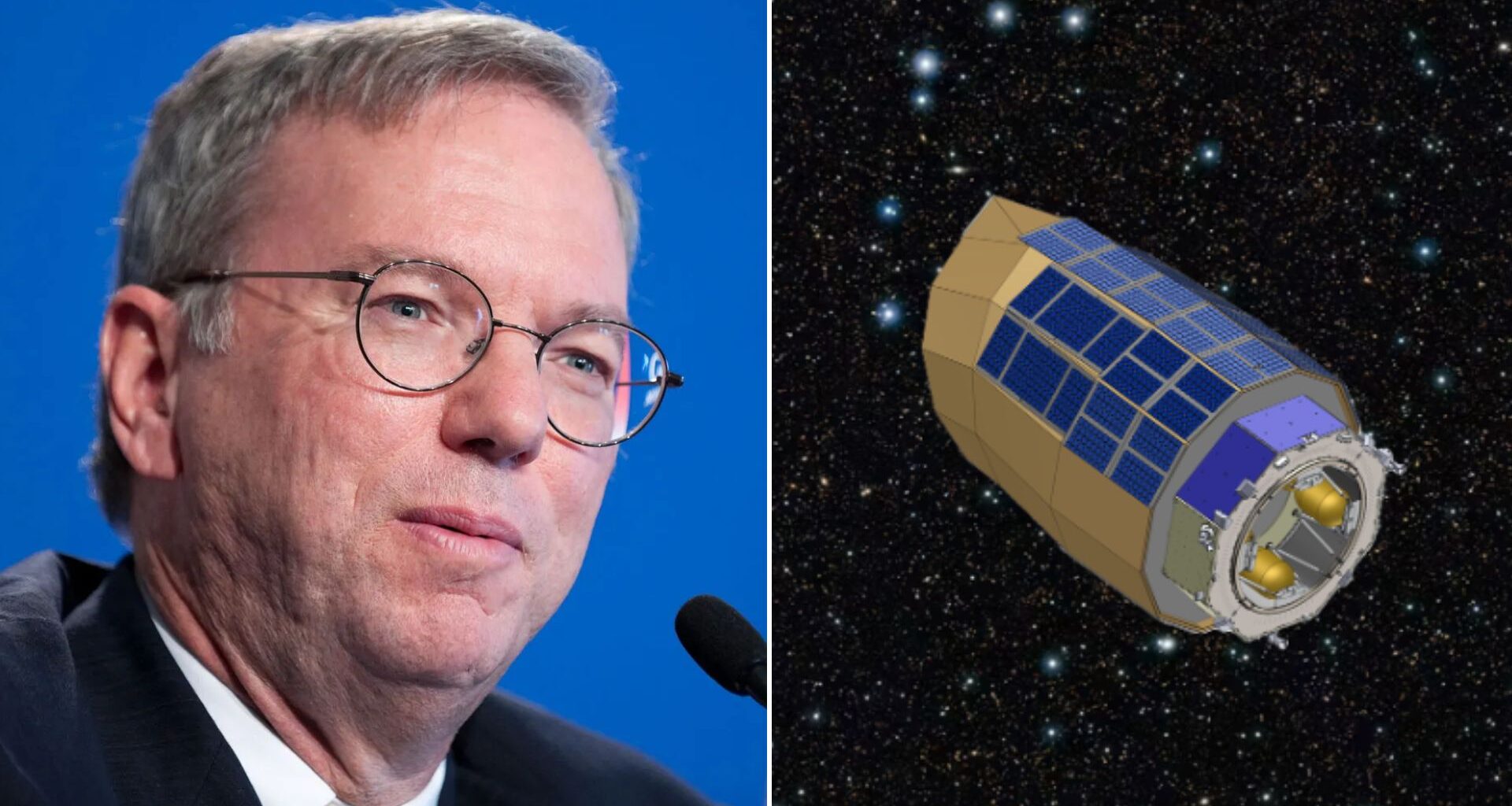
Former Google CEO Eric Schmidt and his wife Wendy are spearheading one of the most ambitious private astronomy initiatives in history.
The couple is funding four next-generation telescopes through their philanthropic organization, Schmidt Sciences.
The new telescopes, announced on January 7, 2026, at the American Astronomical Society meeting in Phoenix, Arizona, will be comprised of three innovative ground-based facilities and one pioneering space telescope, Lazuli. All four together are named the Eric and Wendy Schmidt Observatory System.
Lazuli: The first private space observatory
With Lazuli, the Schmidt Observatory System initiative aims to launch the first privately funded space observatory in history. Lazuli is designed to be a 3.1-meter (10.2-foot) space telescope with a light-collecting area 70 percent greater than NASA’s iconic Hubble Space Telescope.
If all goes to plan, Lazuli will launch by 2029. It will be positioned in a stable lunar-resonant orbit far from Earth—reaching up to 275,000 km (170,875 miles) at apogee. The space observatory will feature advanced instruments. These will include a wide-field optical imager, an integral field spectrograph, and a high-contrast coronagraph optimized for direct imaging of exoplanets.
The goal is for Lazuli to probe exoplanet atmospheres around sun-like stars, model supernovae, study the Hubble Tension, and complement upcoming missions like NASA’s Nancy Grace Roman Space Telescope.
During the press conference announcing the initiative, Pete Klupar, executive director of the Lazuli project, said, “We’re going to do it in three years, and we’re going to do it for a ridiculously low price.”
The Schmidt Observatory System’s ground telescopes
On the ground, the Argus Array, led by Nicholas Law at the University of North Carolina, will comprise 1,200 small-aperture telescopes forming an equivalent 8-meter-class instrument. The ground observatory could be operational by 2028.
Its massive 8,000-square-degree field of view will allow it to image the entire visible Northern sky in seconds without tiling. This will make it ideal for detecting transient events like supernovae or gravitational wave counterparts.
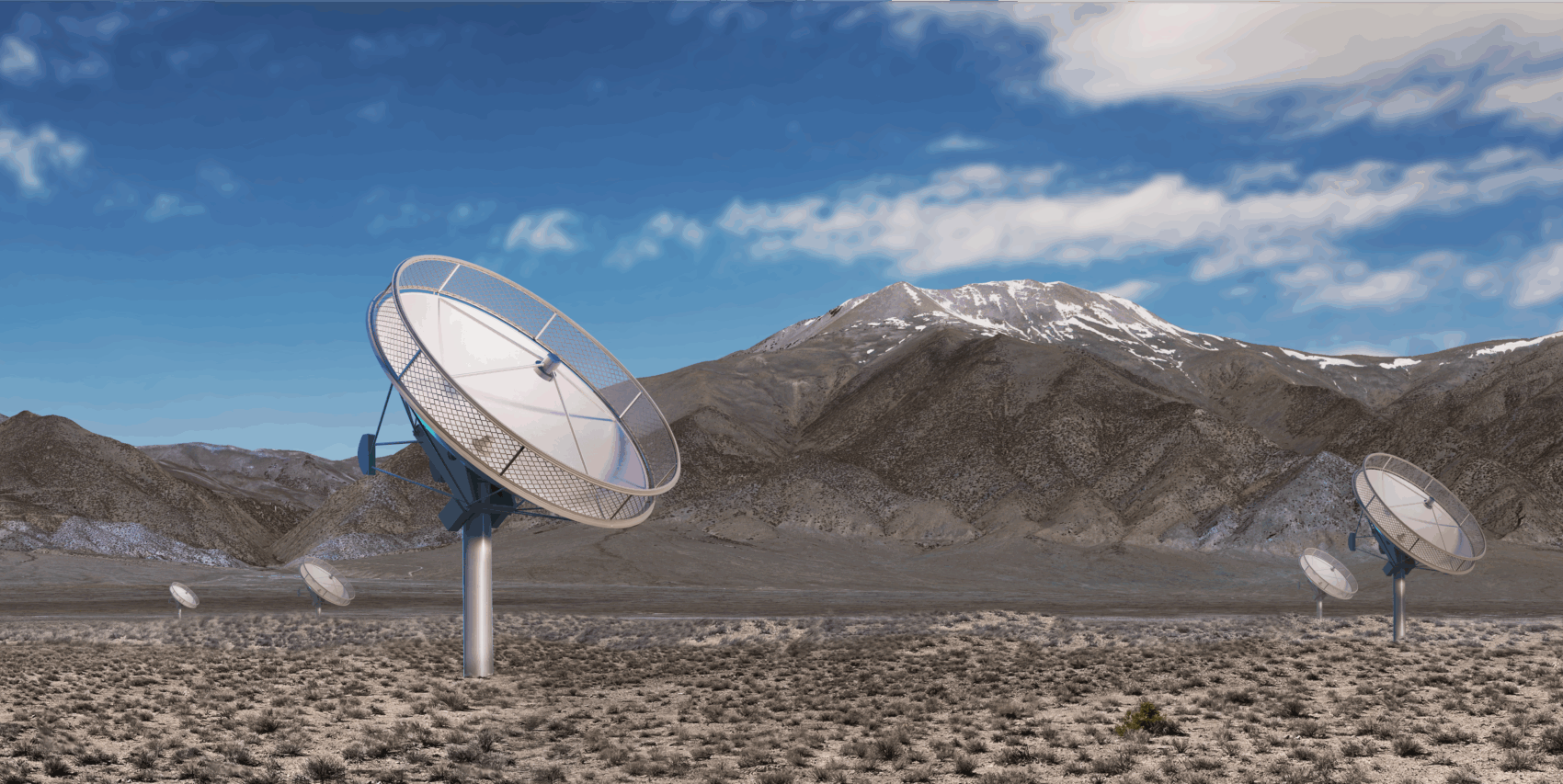 An artist’s impression of the DSA. Source: Schmidt Sciences
The Deep Synoptic Array (DSA), directed by Gregg Hallinan at Caltech, will deploy 1,656 1.5-meter (4.9-foot) radio dishes across a vast 20×16 km (12.4×9.9 miles) site in Nevada. It is expected to be online by 2029. DSA is designed to scan radio wavelengths at unprecedented speeds—potentially doubling the known catalog of 10 million radio sources in its first day. This will allow it to reveal hidden black holes and galaxy centers obscured by dust.
Lastly, the Large Fiber Array Spectroscopic Telescope (LFAST) at the University of Arizona is designed for flexible follow-up spectroscopy of targets from surveys. It will use a modular optical system with 20 scalable units (equivalent to a 3.5-meter mirror) housed in compact “mini domes” to slash costs. The telescope will be able to expand as needed.
Tapping into a ‘storm of possibilities’
According to a New York Times report, officials at Schmidt have acknowledged that it is a challenging time for space science initiatives, amid the Trump administration’s deep budget cuts at NASA and the National Science Foundation. However, they noted that the Schmidt Observatory System was devised to complement government science efforts.
“Between the congestion of space and the tightening of government budgets, a storm of possibilities is formed,” Klupar said at the conference. The private sector has already revolutionized access to space. If successful, this bold new private venture could redefine how humanity peers into the cosmos.
The Schmidt family could also position itself as a key player in the space industry. Last year, Eric Schmidt became one of the first proponents for AI data centers in space. The former Google CEO announced he had acquired space startup Relativity Space with the intention of sending data centers into orbit, amid rising energy demands driven by the AI boom.