
Support CleanTechnica’s work through a Substack subscription or on Stripe.
The idea of sending data centers flying around the Earth seemed kooky just a couple of years ago, and yet here we are. The temptation of limitless solar power, ambient cooling, and freedom from the aches and pains of terrestrial development has prompted a mad scramble for a piece of the space data center action. The latest to join the fray is Singapore-based Orbit AI, which has hooked up with the Canadian solar firm PowerBank Corporation in a project aimed at knocking competitors like Elon Musk’s Starlink venture out of the box.
Limitless Solar Power In Space: Take That, StarLink
Orbit AI is also not shy about taking swipes at Starlink. For starters, the company has named its forthcoming satellite network “DeStarlink,” with “De” standing for Decentralized.
Orbit AI also name-checked both Starlink and Musk when it announced the launch of its first satellite Genesis -1, on December 10, trumpeting the occasion on Musk’s own X social media platform with an “@” for both Starlink and Musk (Note: I’m not linking to X due to proliferation of non-consensual images on the site. Look it up if you must):
“Amidst fierce competition from tech giants (e.g., Starlink @Starlink @elonmusk, Google AI Project Suncatcher) in space AI computing, this launch signifies Orbit AI’s position as the first to achieve real-world AI deployment, formally inaugurating its ‘Orbit AI Cloud Platform.’”
“Genesis-1 is equipped with NVIDIA AI Compute Cores, running a 2.6B parameter AI model for real-time analysis of infrared remote sensing data in space,” Orbit AI continued.
“By processing data on orbit, Genesis-1 drastically reduces critical information retrieval time (e.g., disaster alerts, maritime monitoring) from hours to mere seconds, while cutting transmission bandwidth costs by over 90%,” they added for good measure.
The Solar Power Connection
If PowerBank doesn’t ring any bells, join the club. The Canadian-based solar and energy storage developer is a new face on the pages of CleanTechnica, though it has been in business for about 10 years or so with a mission to accelerate the energy transition in Canada and the US, too.
“We are an established and trusted developer, engineer, builder, and asset operator in the economy-wide pursuit of Net-Zero carbon emissions with a focus on behind-the-meter (BTM) solar power gardens, grid-connected community solar plants, and utility-scale solar farms,” the company says of itself.
They’ll need to update their website to include space solar. PowerBank announced the start of a collaboration with the Orbit AI’s “Orbital Cloud” project back on November 19 of 2025.
“The mission leverages cutting-edge satellite technology, high-performance AI compute hardware, blockchain verification systems, and clean-energy solutions to demonstrate a next-generation digital infrastructure in orbit,” PowerBank explained.
“Orbit AI is developing DeStarlink, the first decentralized low-Earth-orbit network for global connectivity, and DeStarAI, a suite of orbital AI data centers powered by solar arrays and naturally cooled in space,” PowerBank elaborated. “Together, these systems form the Orbital Cloud, a unified infrastructure layer designed to enable sovereign, censorship-resistant connectivity and in-orbit compute services.”
In the same press statement, PowerBank also drew attention to its new focus on data center energy management, including cooling solutions, in “high-growth AI markets.”
“The combined markets for orbital satellites, in-orbit data centers, blockchain verification, and solar-powered digital infrastructure are projected to exceed $700 billion over the next decade,” PowerBank CEO Dr. Richard Lu emphasized.
For the record, PowerBank listed other collaborators on the Orbital Cloud project:
Ethereum Foundation – blockchain framework and wallet architecture.
NVIDIA Corporation – high-performance GPUs powering AI compute payloads.
Galaxy Space – satellite manufacturing components for future satellites.
Galactic Energy – launch systems and rocket technologies for future satellites.
SparkX Satellite – builder of the DeStarlink Genesis-1 satellite.
AscendX Aerospace – advanced rocket materials integrated into future satellite assemblies.
Onward & Upward
In the November announcement, PowerBank also took note of its intention to nail down an initial investment of $50,000 in Orbit AI. That’s pretty small potatoes, but it provided PowerBank with options leading up to a further investment of $10 million prior to the December 10 launch.
On December 26, PowerBank provided an update indicating that all systems are go. “The satellite has been recorded operating and producing solar power as it moves around the earth,” the company reported.
Earlier today, PowerBank provided another update on the Orbit AI (aka Smartlink AI) satellite. “The Genesis-1 satellite launched on December 10, 2025 is confirmed by Smartlink AI to now be both operational and operating an artificial intelligence model directly in orbit,” PowerBank noted.
“By processing data onboard the satellite rather than relying exclusively on ground-based data centers, this milestone provides an initial proof point for Orbit AI’s approach to on-orbit computing. Importantly, Genesis-1 represents the first operational element of Orbit AI’s planned satellite network, serving as an early validation step ahead of future launches and broader expansion,” PowerBank added.
For complete details about Orbit AI — including an online satellite tracker — check out their website here.
Of note, the company is promoting its new satellite network as an adventure in statelessness. They emphasize the ability to evade censorship, but that can easily be a two-edged sword.
“Developers can deploy AI models, privacy applications, financial algorithms, and even blockchain nodes on the satellite network . This ensures that code and data operate in a physically isolated, neutral environment beyond the jurisdiction of major nations, guaranteeing extreme digital sovereignty and service resilience,” PowerBank noted in its press release of November 19, adding that “Orbit AI protocol is committed to creating an ultimate censorship-resistant deployment environment.”
What do you think about the censorship angle? If you have any thoughts about that, drop a note in the comment thread. In a related development, US and other security experts have raised the alarm over Russia’s purported efforts to attack satellite systems, which could render the whole thing moot.
In the meantime, keep an eye out for Orbit AI’s Phase II plan, involving an initial constellation of 5-8 nodes this year, highlighted by the launch of its second satellite, Genesis Ultra, during Q1.
In Phase III, Orbit AI anticipates moving on to full deployment and global coverage in 2027. If all goes according to plan, sometime within the 2028-2030 window, the company also expects the system to take on the nature of a “self-learning orbital swarm,” so stay tuned for more on that.
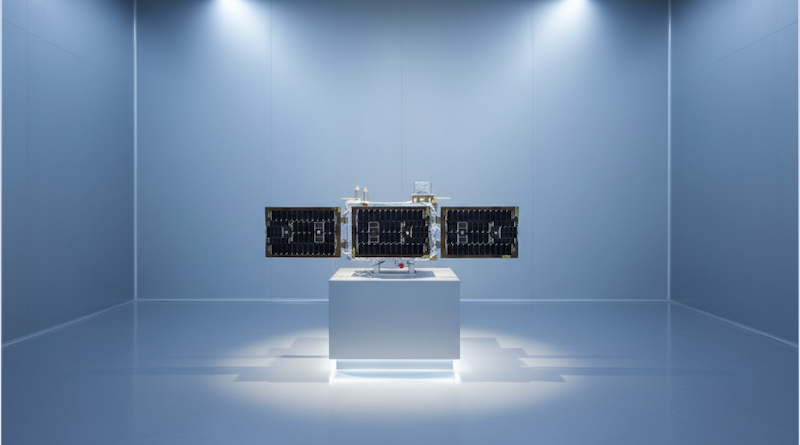
Photo: Solar power is front and center in the race to launch satellite data centers into space, where AI stakeholders aim to take advantage of 24/7 sunlight and ambient cooling (courtesy of PowerBank
Sign up for CleanTechnica’s Weekly Substack for Zach and Scott’s in-depth analyses and high level summaries, sign up for our daily newsletter, and follow us on Google News!
Advertisement
Have a tip for CleanTechnica? Want to advertise? Want to suggest a guest for our CleanTech Talk podcast? Contact us here.
Sign up for our daily newsletter for 15 new cleantech stories a day. Or sign up for our weekly one on top stories of the week if daily is too frequent.
CleanTechnica uses affiliate links. See our policy here.