
“Without a doubt, every person has had a gutsful … no one is feeling safe out in their communities.”
Clarke was compelled to take action after being rushed at by aggressive roaming dogs at least a dozen times, causing her to stop walking around her neighbourhood several years ago.
She is calling for changes to New Zealand’s “extremely outdated” dog laws to tackle the growing problem in Northland and other parts of the country, including Auckland.
She wants the Government and local governments to change relevant policies, rules, and bylaws to make communities safe again.
Clarke’s ideas include introducing mandatory desexing and minimum height requirements on fences, along with “a strike system, so if your dog is caught roaming two or three times, it’s gone”.
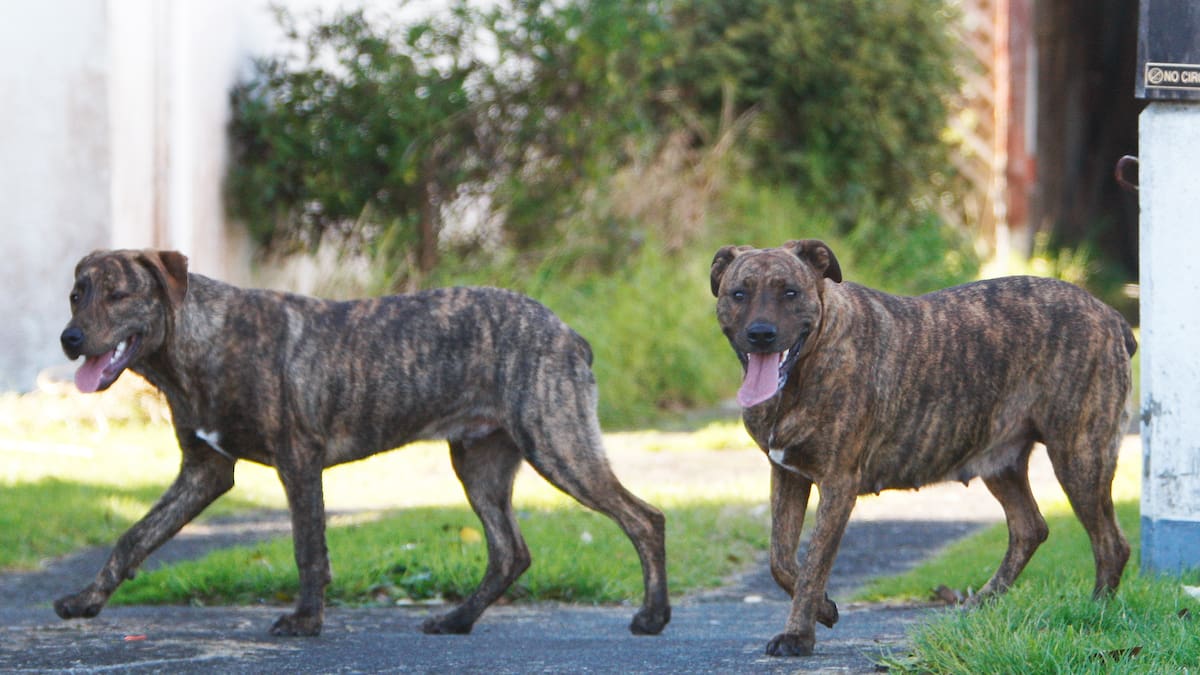
Roaming dogs have increasingly become a problem in Northland and other parts of the country.
Since her petition closed, she has emailed – or is in the process of emailing – Whangārei MP Shane Reti, Northland MP Grant McCallum, Northcote MP Dan Bidois, and Arena Williams, the MP for Manurewa in South Auckland.
Bidois has offered to present the petition to Parliament on Clarke’s behalf. It would then be considered by the Petitions Select Committee.
Clarke was also in touch with Whangārei Hospital emergency doctor Gary Payinda, who told the Northern Advocate he’d seen “far too many victims of dog attacks out in the community”.
Payinda, who was selected as Labour’s candidate for Whangārei in November, said emergency doctors in Northland “routinely see the damage that marauding dogs do the public, often to children, sometimes joggers, sometimes random passerby”.
“All of us would agree you should have a right to walk around in your community without being attacked or mauled by one or more dogs. It’s all too common.”
Payinda said roaming dogs were a “frequent occurrence” in Whangārei.
“I could walk into half a dozen neighbourhoods in Whangārei and not have difficulty finding loose unregistered dogs.
“I agree with her [Clarke] in feeling that regular folks do feel threatened by this.
“Something does need to be done to address this problem.”
Local Government Minister Simon Watts said he was aware of Clarke’s petition and shared the concerns raised by many Northlanders regarding the challenges of roaming dogs.
Watts said the Department of Internal Affairs [DIA] was continuing work on “non-regulatory approaches to support better dog control”.
This includes improving the quality and consistency of dog-related data, he said.
Under Section 10A of the Dog Control Act 1996, councils must report to the DIA each financial year on their dog control policy and practices.
“The department is working with stakeholders to improve and standardise the reporting template, as well as undertaking analysis of the information provided.
“Having a uniform template across councils will make the analysis of information more robust and easier to identify potential problem areas and/or courses of action.”
The department is also working with the local government sector to “refresh the dog control enforcement guidelines”, Watts said.
“This will support consistent dog control enforcement across New Zealand.
“The updated guidelines are expected to be issued towards the beginning of quarter three, 2026.”
Jenny Ling is a senior journalist at the Northern Advocate. She has a special interest in covering human interest stories, along with finance, roading, and social issues.