
As well as the latest proposal, four other housing or retirement developments for more than 500 new homes and villas are also in the pipeline for that corner of Havelock North.
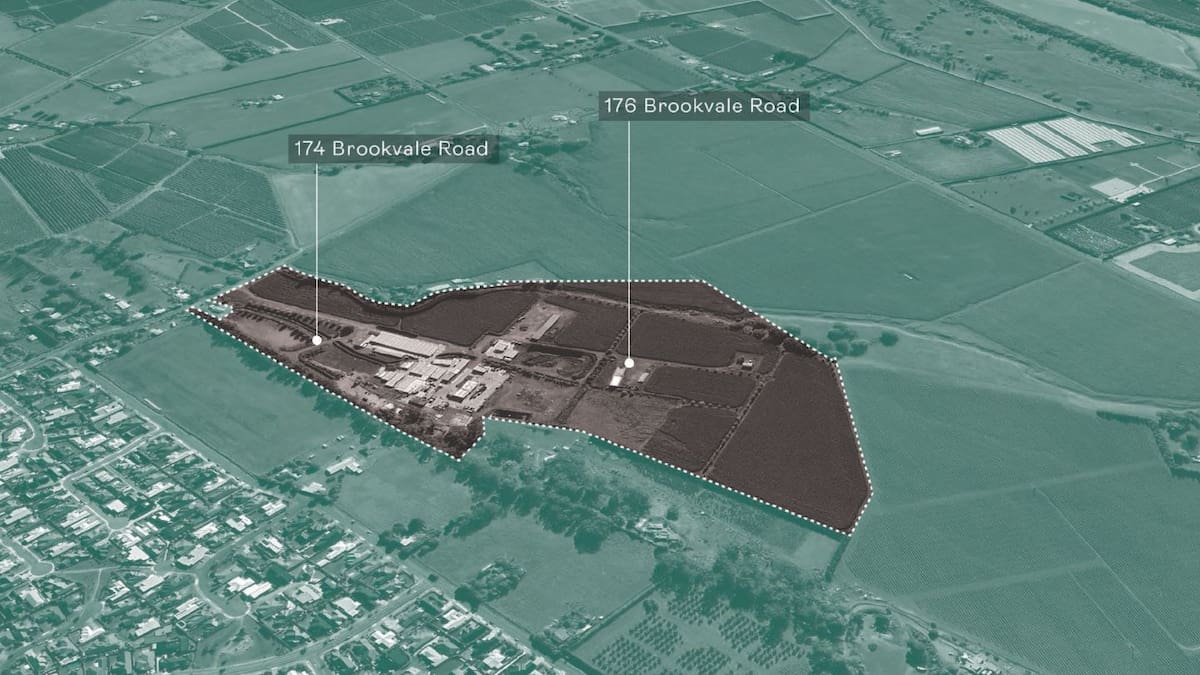
Plans to transform the Te Mata Mushrooms site on Brookvale Rd into housing were successfully referred to the fast-track consent process just before Christmas, under the Government’s Fast-Track Approvals Act.
The entrance to the site off Brookvale Rd. Photo / EPA
Minister for Infrastructure Chris Bishop was satisfied the project should go through the fast-track process given its potential to increase housing and “deliver significant economic benefits”, such as jobs worth $49 million in wages over a seven-year period.
Vermont Street Partners No.4 Ltd is behind the project and is led by Hawke’s Bay-based directors Edward Sundstrum and Ben Bostock.
Vermont Street Partners does not own the land but is working with the landowners.
The proposal, if granted consent, will see between 189 and 215 new homes built across 22ha of land at 174 and 176 Brookvale Rd.
Existing buildings will be knocked down under the plans.
A masterplan of what the layout of the housing could look like if it gets consent. Photo / EPA
Some of those existing buildings are currently being tenanted and used by a mix of businesses.
A range of housing is proposed for the site, from terraced housing (with 200sq m lots) to spacious detached homes (with 800sq m lots).
The project also proposes enhancing two streams and making them a feature of the development, with “one meandering through the centre and the other forming the northern boundary”, the proposal stated.
Vermont Street Partners No.4 Ltd director and developer Sundstrum said the Havelock North area was a great location.
“It has a good airport, in terms of Napier airport, the schooling is top notch, in terms of that particular location you are at Ocean Beach in 15 minutes and Waimarama in 35, you have got some of the world’s best wineries on your doorstep, and you’ve got the Tukituki River and everything that that offers, and its walking distance to Havelock North [town centre].”
He said it was also out of a flood zone.
As for a potential oversupply of subdivisions in the Havelock North area, he said not all developments were the same, and this project would offer a range of housing options.
“I’ll tell you what I think there is an oversupply of, which is small cookie-cutter sections that have little value of utility,” he said.
“Ultimately, it’s my business and my business has its name on it, and something I am passionate about is good design outcomes.”
The area highlighted is also planned to be developed into housing by separate developers. Photo / Google Earth
Sundstrum said a lot of people thought the term “develop” was a dirty word, but he believed there were a lot of benefits in the project.
“At the moment, you’ve got a site which is being used for, let’s say, a patchwork quilt of uses.
“There is no obligation or impetus or probably money to fix things like existing streams [and] waterways.
“By doing what we are doing, that makes capital available to restore, enhance and restore waterways … that means we can clean up waterways and replant them.”
The project includes new walking and cycling tracks and roads, and about 4ha of native plantings.
He said the existing buildings had also become an eyesore.
The property is zoned plains production, and the land is mainly Land Use Capability (LUC) class 3.
For comparison, the most productive land in the region is LUC class 1 and the least productive land is LUC class 8.
Given it was not class 1 or 2 land, Sundstrum claimed it would not remove important fertile soils for growing purposes.
In a written submission, during the Hastings-Napier Future Development Strategy process last year, advocacy group Save Our Plains stated the mushroom farm site had “poorly drained soil that has limited productive value”.
Hawke’s Bay Today has contacted Save Our Plains about the project.
Vermont Street Partners No.4 Ltd co-director Ben Bostock, who comes from a well-known fruit-growing family in Hawke’s Bay, confirmed he is not part of Save Our Plains.
Te Mata Mushrooms operated for 55 years until it was announced in August 2022 the facility would close.
A major reason cited for the closure was housing developments getting closer to the site, which led to complaints about odours and fines. A decision was made to build a new mushroom plant elsewhere in Central Hawke’s Bay.