
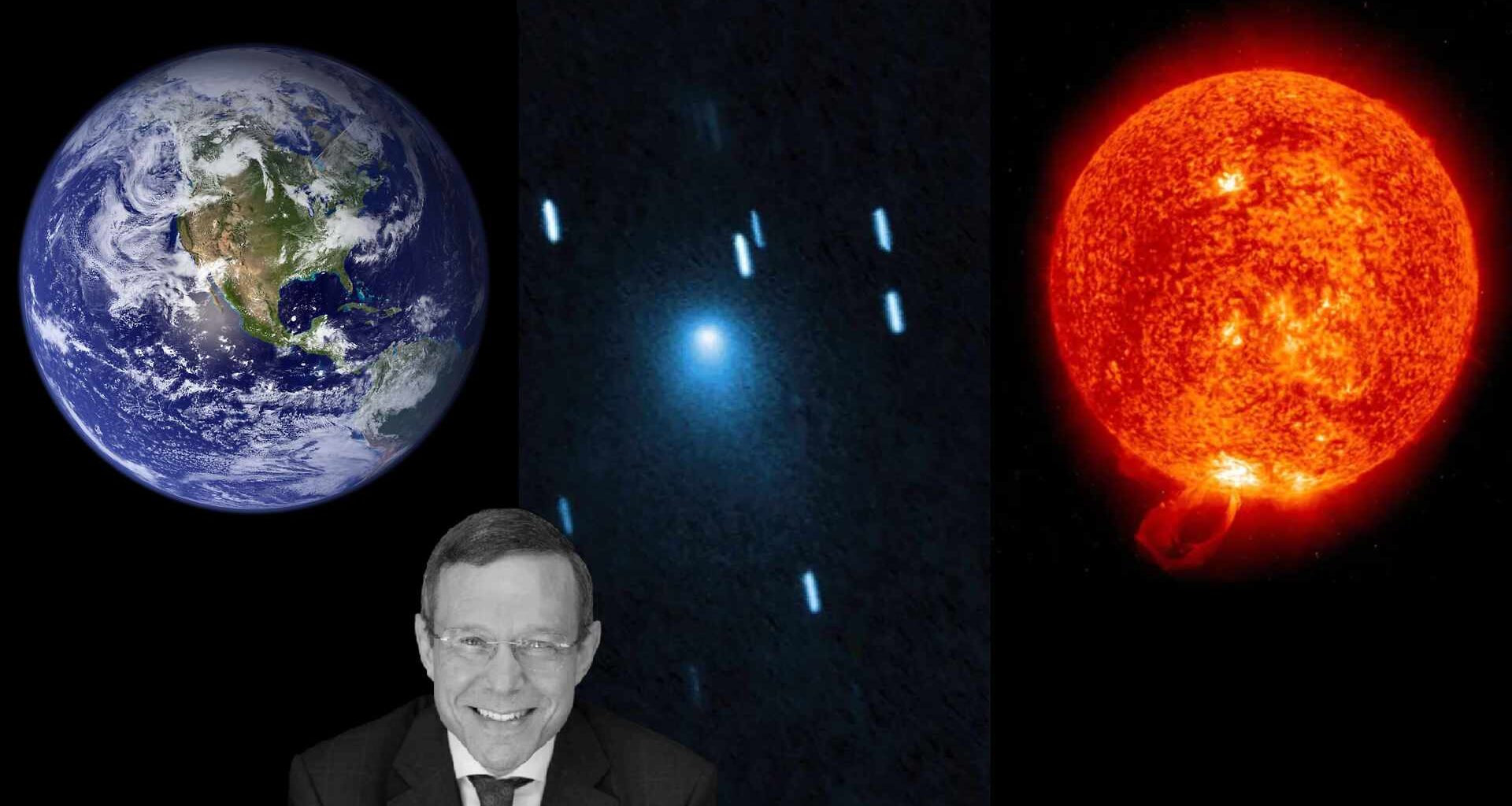
3I/ATLAS, the third ever recorded interstellar interloper after 1I/Oumuamua (2017) and 2I/Borisov (2019), ever since its discovery on July 01, 2025 by the ATLAS observatory has baffled experts and lay alike. The exocomet performed its perihelion on October 27th last year, which was dubbed by eminent Harvard astrophysicist Avi Loeb as a plausible ‘black swan’ event and the end of the world as we know it, as speculations ran adrift about the nature of the object—an alien spy probe? Perhaps?
While Loeb has flagged at least 16 anomalies so far, spectrographic data and other observations is yet to provide substantial info that would identify any technological signature. On the 19th of December, at a distance of 1.8 AU or 270 million kilometers, the exocomet whizzed past Earth as it maneuvered to exit the solar system, which it entered some 8000 years ago via the Oort cloud in our local intergalactic boundary. Tons of data is awaited and nothing can be said confidently as of yet about the nature of the exocomet, while the official word from NASA is that it is but a textbook comet.
Meanwhile, on its way out of the solar system, on March 16, 2026, 3I/ATLAS will encounter one of the farthest of Jupiter’s moons, Eupheme. Prof. Loeb wants the astronomical community to keep a close watch of the event, as it could reveal, once and for all, technological signatures, if any.
Ahead of the event, per Loeb’s latest blog, 3I/ATLAS will form a rare alignment with the Earth-Sun axis on January 22, 2026 at 13:00 UTC or 20:30 IST or 8:30 PM. Prof Loeb notes
At that rare time, Earth will pass nearly between the Sun and 3I/ATLAS. The phase angle α between the Sun-3I/ATLAS axis and the Sun-Earth axis will reach a value of 0.69 degrees. Unlike typical cometary opposition geometries, which often last for hours, 3I/ATLAS will maintain α < 2 degrees for approximately one week, between 19 and 26 of January, 2026.
He adds,
The phase angle of 3I/ATLAS will remain small in subsequent years as it recedes from the Sun, but its magnitude will be fainter—requiring larger telescope apertures.
This will ensue ‘the opposition surge’ due to the physical effect of two phenomena, namely, a) Shadow-hiding, and b) Coherent backscatter.
Prof. Loeb reminds us that only 67P/Churyumov–Gerasimenko has a well-measured opposition surge in the recorded history. This surge in amplitude, per the Harvard scientist, will reveal several mysteries, from the exocomet’s composition to grain structure, temporal coverage, and other data.
Further he remarks,
hoping that many observers with access to suitable telescopes will take advantage of the extraordinary fortune that we are about to have through the rare alignment of 3I/ATLAS with the Sun-Earth direction. Related data can help decipher the nature of the anti-tail jet of 3I/ATLAS and resolve other anomalies—such as its unprecedented polarization properties
A Rare Alignment of 3I/ATLAS With the Sun-Earth Axis on 22 January, 2026https://t.co/UQ0urYbkqq— Galileo Project (@GalileoProject1) January 13, 2026