
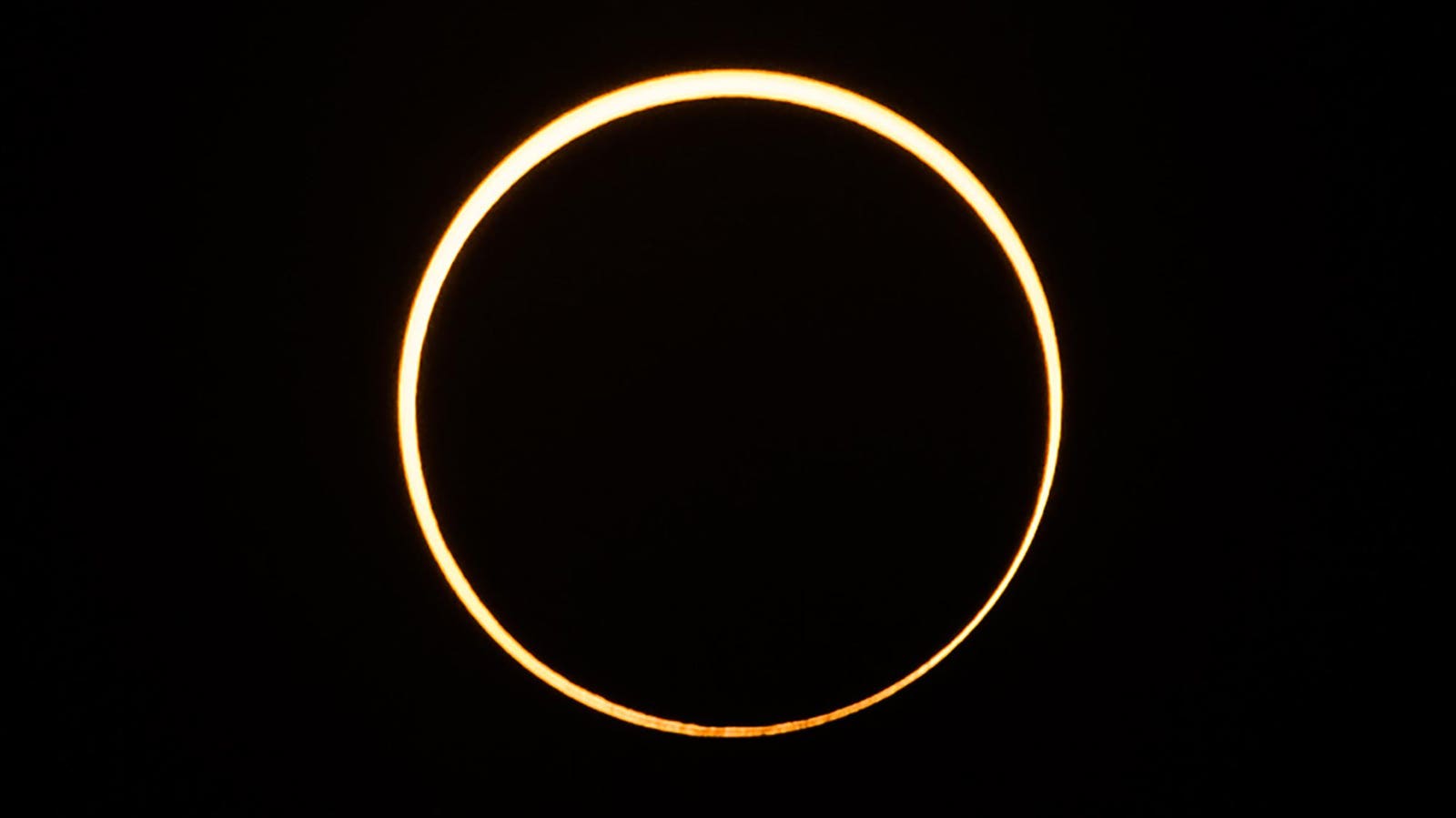
The moon moves in front of the sun in a rare “ring of fire” solar eclipse as seen from Singapore on December 26, 2019. (Photo by Louis KWOK / AFP) (Photo by LOUIS KWOK/AFP via Getty Images)
AFP via Getty Images
One month from today, on Tuesday, Feb. 17, 2026, the moon will pass directly in front of the sun — but not quite cover it — creating a brilliant annular solar eclipse, also known as a “ring of fire.” For about 2 minutes and 20 seconds, observers in a remote part of Antarctica will witness this rare phenomenon, with the moon obscuring 96% of the sun. Almost no humans will witness it.
What Is An Annular Solar Eclipse?
An annular solar eclipse occurs when the moon passes directly in front of the sun, but is too far from Earth to completely cover it. Instead of total darkness, as during a total solar eclipse, observers see a bright ring of sunlight, or annulus, around the moon.
Forbes9 Places To Experience The Next Total Solar Eclipse A Year From TodayBy Jamie CarterWhat’s So Special About The 2026 ‘Ring Of Fire’ Eclipse?
The path of annularity stretches 2,661 miles (4,282 kilometers) across Earth and, at its peak over Antarctica, the “ring of fire” will last 2 minutes 20 seconds. It’s rare because very few people will see it. The annular phase occurs over a remote part of Antarctica, only observable from a handful of research stations such as European-run Concordia (with 2 minutes 1 seconds annularity) and Russian-run Mirny (1 minute 52 seconds).
The sun will be low on the horizon — just 5-10 degrees up — making it a challenging but rewarding observation for scientists and adventurous eclipse chasers.
The path of annularity on Feb. 17, 2026, in this map created by eclipse cartographer Michael Zeiler at EclipseAtlas.com.
Michael Zeiler/EclipseAtlas.comWho Will See The ‘Ring Of Fire’ In 2026?
Although only those in Concordia and Mirny in Antarctica will witness the “ring of fire,” a partial solar eclipse will be visible across Antarctica, southeastern Africa, the southern tip of South America, and remote islands such as Heard Island, Reunion and Mauritius. In places like Durban in South Africa, Antananarivo in Madagascar and Maputo in Mozambique, a partial eclipse ranging from 12% to 20% will be visible. Every observer — including those in Antarctica — will need to wear solar eclipse glasses at all times.
Upcoming Annular Solar Eclipses
After Feb. 17, 2026, the following three “ring of fire” annular solar eclipses are:
Feb. 6, 2027: Chile, Argentina, Uruguay, Brazil, Cote d’Ivoire, Ghana, Togo, Benin and Nigeria.Jan. 26, 2028: Galápagos Islands, mainland Ecuador, Peru, Brazil, Suriname, French Guiana, Morocco and Spain.June 1, 2030: Algeria, Tunisia, Libya, Greece, Turkey, Russia, Kazakhstan, China and Japan.Forbes600 Days To The ‘Eclipse Of The Century’ — How To Plan A TripBy Jamie CarterWhen Is The Next Total Solar Eclipse?
The next total solar eclipse will occur on Aug. 12, 2026, when totality will be visible from eastern Greenland, western Iceland and northern Spain. It’s the first in mainland Europe since 1999. Although totality eclipse skips the U.S., northeastern states will see a small partial solar eclipse at lunchtime — New York 10%, Boston 16% and Bar Harbor, Maine 24%.
ForbesTo See The Next Total Solar Eclipse, Book Now — Here’s WhyBy Jamie CarterWhen Is The Next Total Solar Eclipse In The U.S.?
U.S. viewers will next see a total eclipse on Aug. 23, 2044, though only parts of Montana and the Dakotas will witness the brief event. The following summer, something way more impressive will occur when, on Aug. 12, 2045, a coast-to-coast eclipse sweeps across America, offering up to 6 minutes of totality in some places. It’s set to be the most significant in U.S. history.
Wishing you clear skies and wide eyes.