
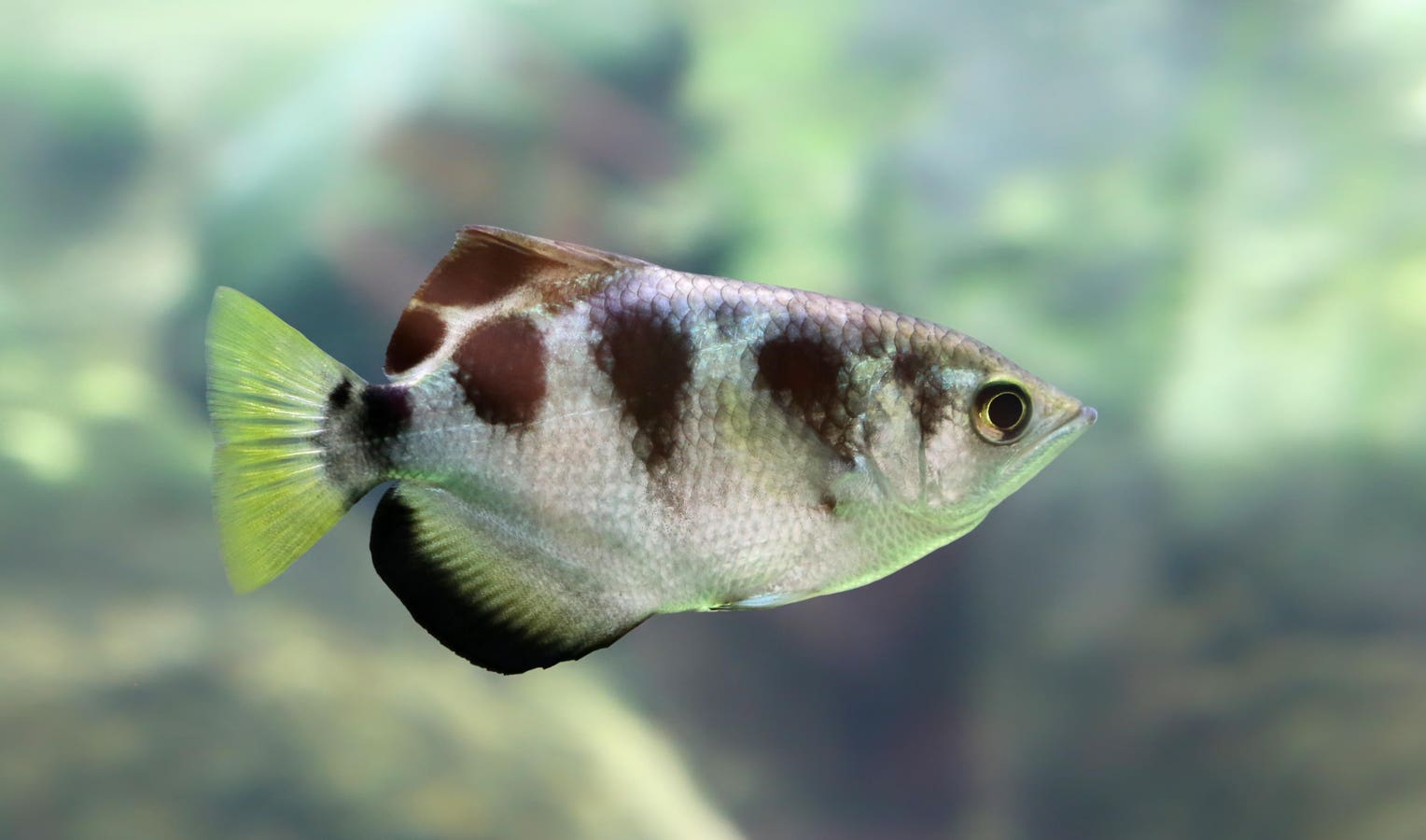
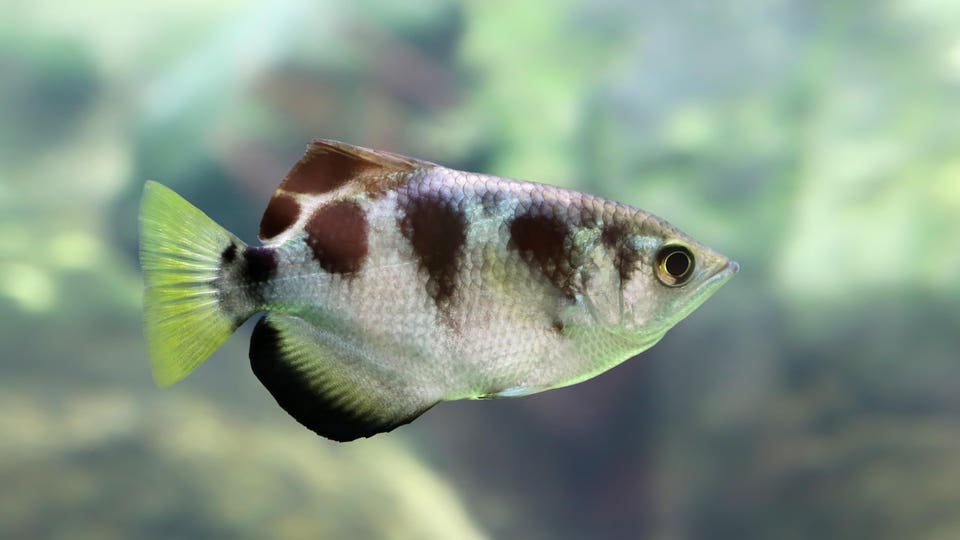
A clever tropical fish has flipped how biologists are thinking about memory, brains and visual recognition in the animal kingdom. Here’s how.
getty
For decades, humans have assumed that recognizing faces, especially our own faces, is a task that requires a large, complex brain. It’s also why animals like primates and birds are central in conversations about intelligence. Fish, on the other hand, are usually dismissed as instinct-driven and forgettable. However, there’s one small tropical fish that has shattered that assumption.
With their sharp eyesight, surprising memory and talent for spitting water, archerfish (family Toxotidae) have forced scientists to rethink what intelligence looks like. Here’s how this little fish has shown us that cognitive power can live inside a brain no bigger than a grape.
This Fish’s Surprising Vision And Memory
The archerfish is a tropical freshwater fish that’s typically found in mangrove edges and slow-moving rivers across Southeast Asia and northern Australia. They’re already famous among biologists for their unique ability to aim and spit water at insects perched above the water’s surface to knock them into the drink.
An archerfish spitting water at an insect above the water.
getty
Their remarkable aim, often hitting targets up to a meter (3.2 feet) above the water, requires excellent eyesight and precise motor control. But in a twist that would surprise even seasoned fish fans, researchers have now shown that archerfish can do something even weirder: recognize human faces, and remember them.
In a 2016 study published in Scientific Reports, an international team of scientists from the University of Oxford and the University of Queensland set out to test how well archerfish could distinguish between complex visual patterns — in this case, human faces.
Most of us assume that facial recognition is a skill that requires a large and specialized part of the brain (the neocortex) that only primates and some birds possess. Surprisingly, archerfish lack a neocortex entirely, yet they still succeeded in the study’s trials.
Specifically, the research team displayed images of human faces on a computer screen, which was positioned above the fish tanks. Each archerfish was trained to spit its water jet at one particular face, and, in exchange, it would receive a food reward.
After training, the fish were shown the same specific face, paired with up to 44 novel human faces. The results were fascinating:
In tests where the face was shown against 44 unfamiliar alternatives, the archerfish correctly identified the trained face roughly 81% of the time.In a second set of trials — which used more standardized images, where color and head shape cues were removed — their accuracy increased to about 86%.
These outcomes show that the fish were not just reacting to easy visual cues; they were really recognizing the faces. This study was the first of its kind in demonstrating that even fish with simpler brains can learn to discriminate complex visual stimuli like human faces.
How This Fish Remembers Faces
Training a fish to spit at photos might seem like a cute trick to some. But in scientific terms, this isn’t an easy feat. Beyond this, it also challenges many long-held assumptions about intelligence and brain architecture in fish.
Humans and many mammals use a dedicated part of the brain to perform facial recognition: the neocortex. This part of the brain is what enables us to instantly recognize a friend’s face in a crowd. However, despite lacking that brain region entirely, archerfish were still able to learn how to perform that same visual discrimination task.
Besides its impressiveness, what makes this finding so valuable is its implications: that complex cognitive abilities can develop in brains that are structurally very different from our own. This opens the door to a much broader understanding of cognition across the animal kingdom. Evidently, high-level tasks like individual recognition don’t necessarily require large brains or “human-like” neural hardware.
Archerfish don’t see the world as we do. Their visual systems are adapted to life in a three-dimensional aquatic world. Here, depth perception, rapid targeting and motion tracking are critical skills for spotting prey above the water’s surface. For this reason, being able to recognize these subtle features (such as the differences between human faces) may actually be easier for them than it would be for other animals that live primarily on flat surfaces.
The 2016 study doesn’t definitively prove whether or not archerfish can process faces in the same way that we do — using facial “templates,” or by breaking down features in a more piecemeal manner. Regardless, the archerfish is clearly still able to learn visual patterns, remember them and retrieve them later on. This is a combination of skills that was once thought to be exclusive to much larger brains.
Why This Fish Matters For Understanding Intelligence
Biologists used to believe that abilities like recognizing individual faces were limited to animals with highly developed brains. However, this is a view that was largely anchored in human neurobiology, which placed animals like fish at the bottom of the intelligence hierarchy. The archerfish experiment negates this assumption.
Of course, this doesn’t mean that fish can see faces in the same way that we do, or that they are “as smart as humans.” Instead, it suggests that cognitive skills can emerge in surprising forms, even if that form has neural machinery very different from our own.
Additionally, because archerfish have no evolutionary reason to recognize human faces in nature, this finding also suggests that the ability likely stems from learning capacity, rather than innate specialization. That supports the notion that learning and memory may be fundamental features of brains of all sizes, instead of just large ones.
Because of these unprecedented findings, biologists have since started to ask fresh questions about the species, such as:
Can archerfish recognize individual humans without being rewarded for doing so?Can they generalize face recognition to real three-dimensional human presence?Do other fish, especially those with complex social lives, share similar or even more advanced recognition abilities?
Early hints from field studies of wild fish recognizing divers give us reason to believe that laboratory results may soon be matched by real-world evidence that fish genuinely differentiate individual humans.
Archerfish were already fascinating for their sharpshooting skills. Now, they’ve proven they can also teach scientists a lesson in humility. By forcing us to acknowledge that small brains can perform complex visual tasks once thought exclusive to “higher” animals, these fish push us to rethink what intelligence really looks like in the natural world. And if a fish that spits water can recognize you — well, maybe intelligence is far more fluid and diverse than we ever imagined.
Do animals like fish feel distant or familiar to you? Measure your bond with nature with this science-backed test: Connectedness to Nature Scale
From sharpshooting fish to social mammals, which animal mirrors your instincts? Discover yours with this quick test: Guardian Animal Test