
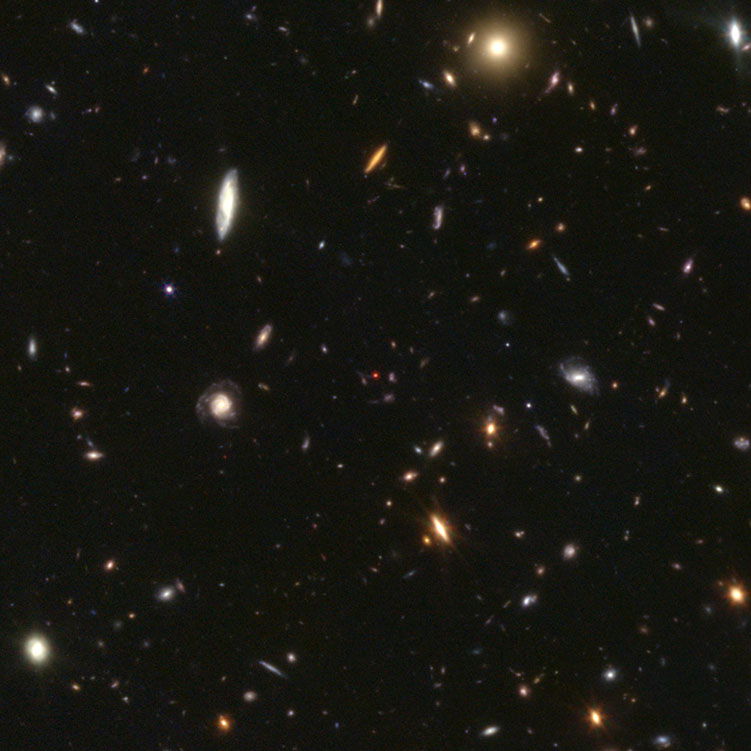
One of the earliest mysteries uncovered by NASA’s James Webb Space Telescope (JWST) involved what astronomers call “little red dots,” and now University of Copenhagen researchers say they finally know the truth about these cosmic enigmas.
The mystery of the little red dots has intrigued astronomers since the James Webb Space Telescope began collecting data about the cosmos in the summer of 2022. Observing light that has traveled immense distances, researchers detected strange, compact red objects appearing just a few million years after the universe formed—only to disappear roughly a billion years later. Their nature quickly became the subject of debate.
Now, it turns out that these enigmatic little red dots are young black holes encased in cocoons of ionized gas. The discovery was reported in a recent paper published in Nature, which addresses one of the major questions posed by JWST imagery.
James Webb Space Telescope Sees Little Red Dots
One hypothesis about these peculiar astronomical objects proposed that the little red dots were massive galaxies, but such complex structures should not have formed so early in cosmic history. It took researchers at the Niels Bohr Institute’s Cosmic Dawn Centre two years of analysis to determine that the objects were, instead, black holes.
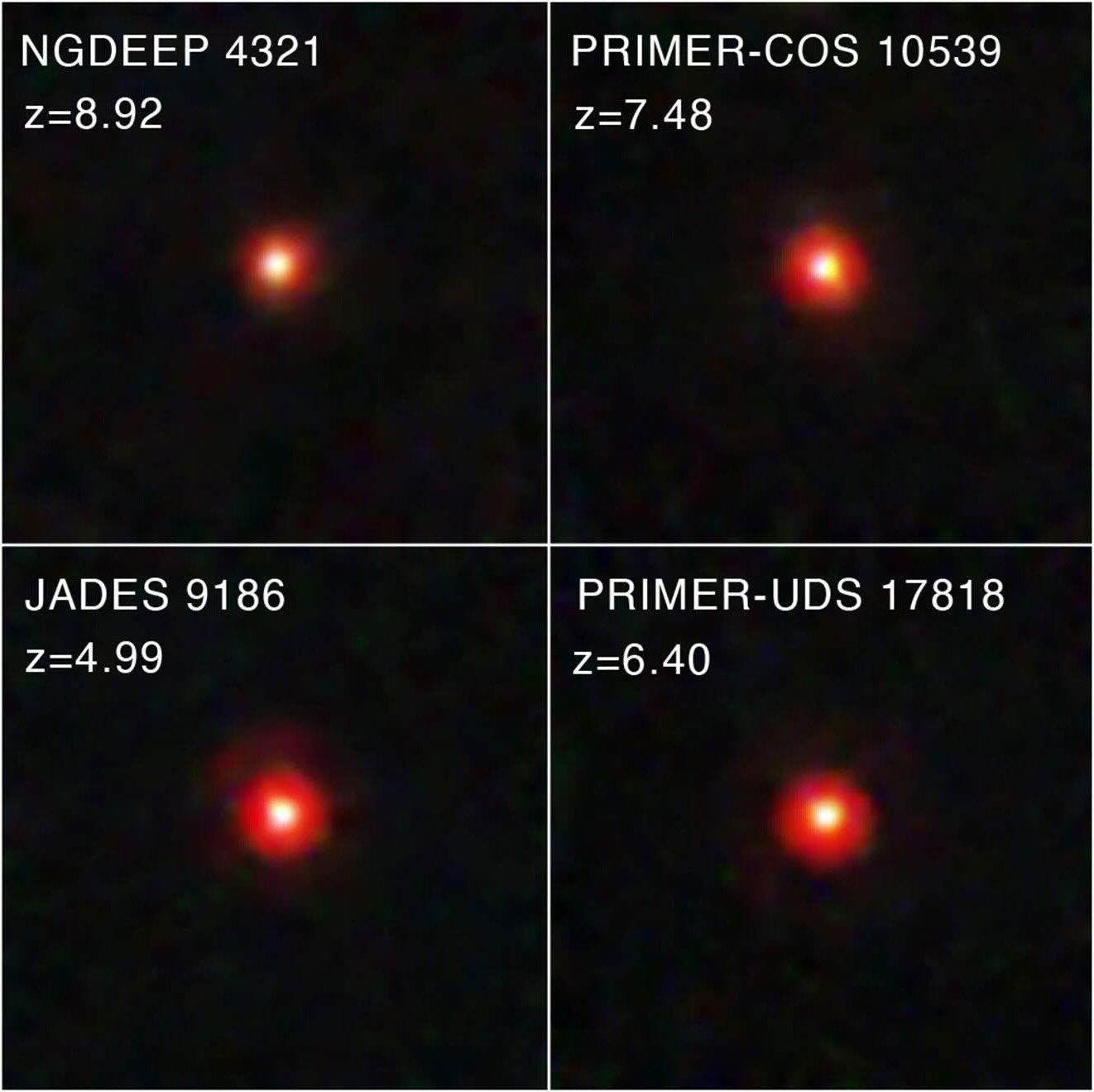 Above: Examples of “Little Red Dots,” which were identified as possibly being galaxies containing active galactic nuclei (AGNs) with a supermassive black hole in past research (Image: NASA, ESA, CSA, STScI, Dale Kocevski (Colby College)).
“The little red dots are young black holes, a hundred times less massive than previously believed, enshrouded in a cocoon of gas, which they are consuming in order to grow larger,” said co-author Professor Darach Watson. “This process generates enormous heat, which shines through the cocoon. This radiation through the cocoon is what gives little red dots their unique red colour.”
‘“They are far less massive than people previously believed, so we do not need to invoke completely new types of events to explain them,” Watson added.
Understanding the Little Red Dots
Since their discovery in late 2021, astronomers have catalogued hundreds of little red dots throughout the universe. These objects are not supermassive black holes of the kind that anchor mature galaxies—a scenario that posed challenges for earlier interpretations. To match the data, such central black holes would have needed to be unrealistically massive compared to their host galaxies.
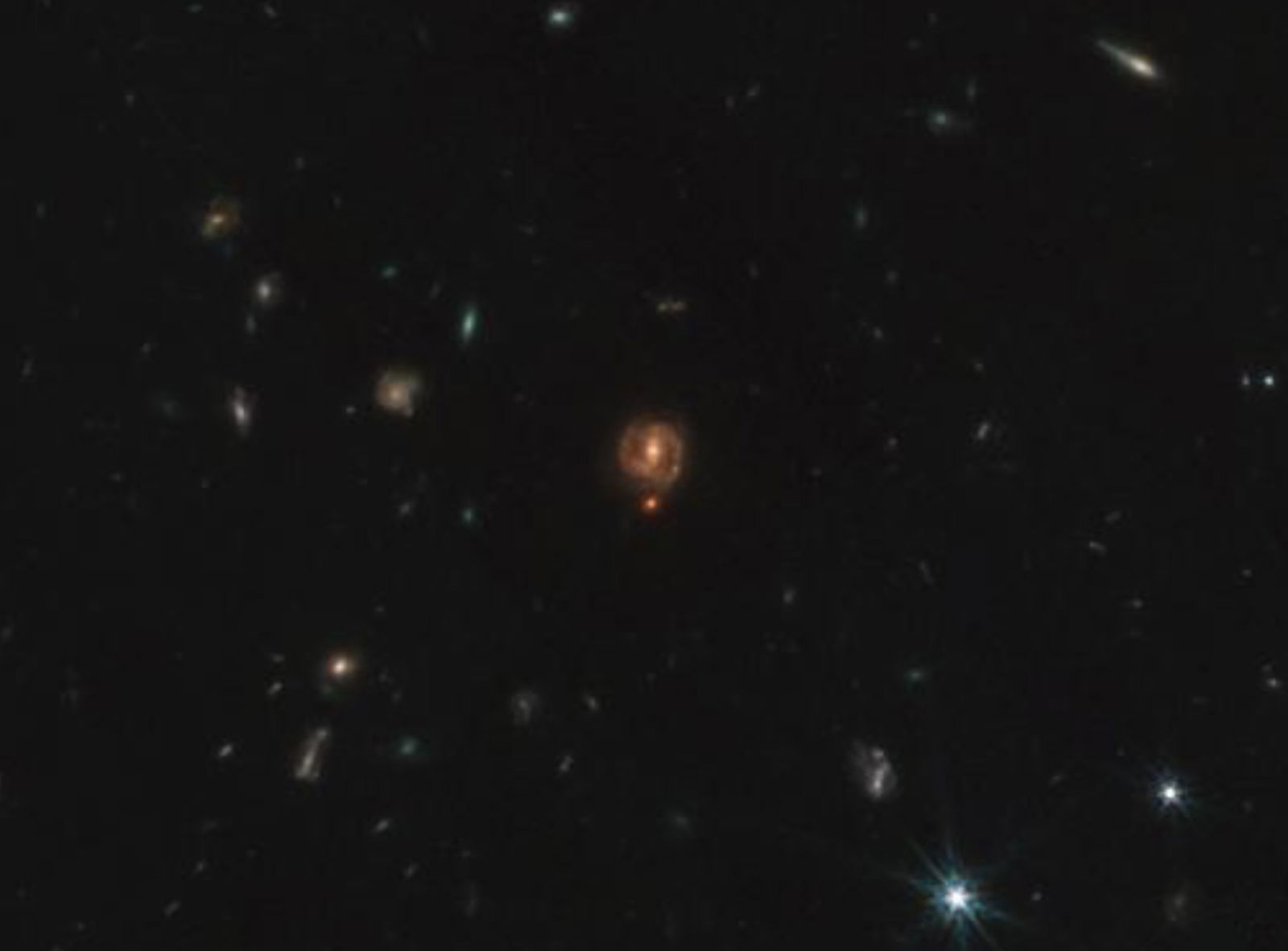 Recent JWST imagery featuring what astronomers call the “little red dots” now associated with black holes (Image Credit: Darach Watson / JWST).
Instead, the research team found that the objects are orders of magnitude smaller, with masses of around 10 million solar masses and diameters of roughly 10 million kilometers. They are embedded within dense clouds of ionized gas, which both fuel their growth and shape their observed appearance.
Black holes are indiscriminate consumers, swallowing nearby material to fuel their expansion. As gas falls inward, it can generate some of the most powerful energy outputs known to science. Near the event horizon, infalling matter reaches extreme temperatures, producing intense radiation that can eject much of the material before it is fully consumed.
“When gas falls towards a black hole, it spirals down into a kind of disk or funnel towards [the] surface of the black hole,” Watson explained. “It ends up going so fast and is squeezed so densely that it generates temperatures of millions of degrees and lights up brightly. But only a very small amount of the gas is swallowed by the black hole. Most of it is blown back out from the poles as the black hole rotates. That’s why we call black holes ‘messy eaters’.”
Black Hole Research Continues
While the riddle of the little red dots may be solved, black holes themselves still hold considerable mystery for scientists. The four-million-solar-mass black hole at the center of the Milky Way and others like it, which similarly anchor their host galaxies, continue to fascinate astronomers.

“We have captured the young black holes in the middle of their growth spurt at a stage that we have not observed before,” Watson said. “The dense cocoon of gas around them provides the fuel they need to grow very quickly.”
Yet the discovery raises new questions. Black holes of this size should not have existed so early in the universe’s history, prompting astronomers to continue investigating how these cosmic growth spurts occurred.
The paper, “Little Red Dots as Young Supermassive Black Holes in Dense Ionized Cocoons (N&V),” appeared in Nature on January 14, 2025.
Ryan Whalen covers science and technology for The Debrief. He holds an MA in History and a Master of Library and Information Science with a certificate in Data Science. He can be contacted at ryan@thedebrief.org, and follow him on Twitter @mdntwvlf.