
Imagine going to the National Gallery in London and not seeing anything by Turner, Constable or Gainsborough. Or the Rijksmuseum in Amsterdam and being told there were no Rembrandts, Vermeers or Van Goghs on display because they didn’t fit the current curatorial narrative.
The names below are those of New
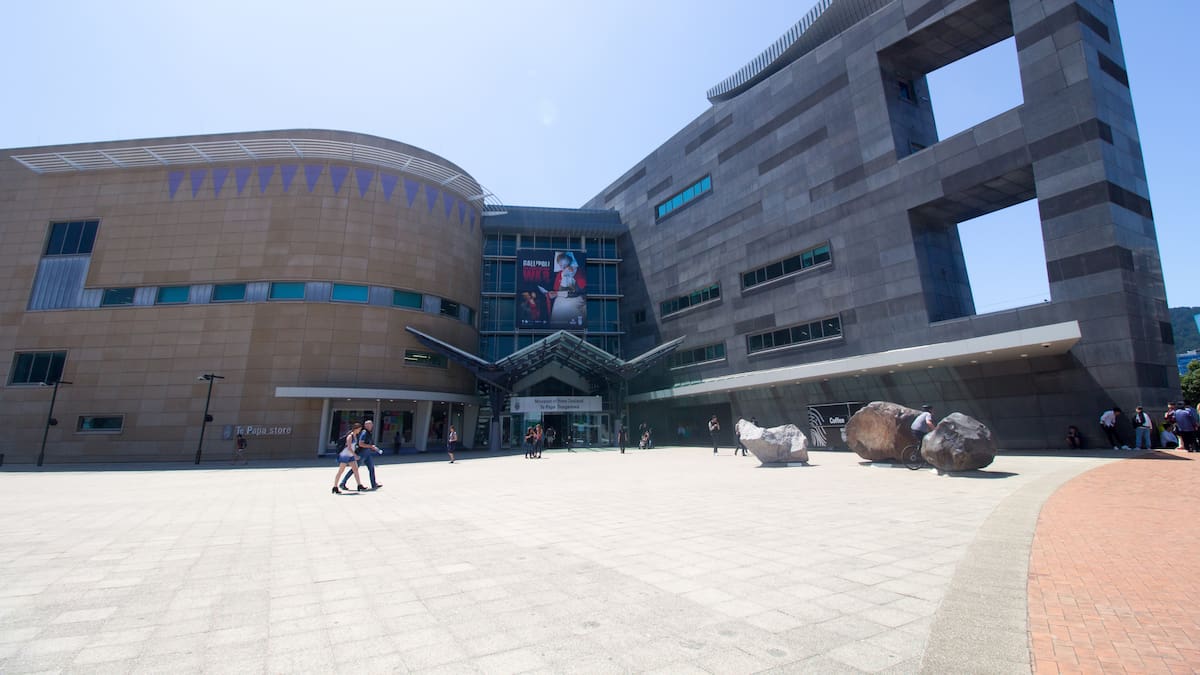
Zealand artists whose paintings are listed on the Museum of New Zealand Te Papa Tongarewa’s website but which are not on display in its dedicated Toi Art gallery space on the fourth and fifth levels of the central Wellington building.
Image / Getty Images. Illustration / Listener
Artists – and gallerists, cultural critics, academics, teachers, overseas visitors, parents – are dismayed at how little art is on show in Te Papa. It could be said it has pulled off an art heist in reverse, in which a gallery has stolen art from people.
How many New Zealand artworks are in this building somewhere? Hard to say. The website is ambiguous or vague. Its New Zealand painting section lists 4975 objects, but figures supplied by the museum identify 2697 paintings by New Zealanders. However, extensive holdings of photographs, prints, sculpture, watercolours and drawings would contribute significantly to the total number of artworks currently not on display.
Most of the art collection held by Te Papa is stored on site, with some at the institution’s storage facility in central Wellington. Members of the public, including students, are able to visit the art stores and view work in storage on request and do so regularly.
No major museum can hope to put more than a fraction of a percent of its collection on display at one time. A visitor to Toi Art today can see 173 artworks, including, according to the website, “new commissions and acquisitions, and beloved works from the national art collection”. Not so many of the latter. Three or four, depending on your definition of “beloved”.
What critics lament is the omission of works that are canonical, iconic, watershed, favourites, historic – whichever unfashionable word you want to use to describe the pictures people want to see.
Te Papa could accurately say people have been making these complaints since the day it opened. Critics could accurately say this suggests the complaints are well founded and Te Papa has done nothing about them.
“I’m going to Wellington tomorrow and I probably won’t go to Te Papa,” says University of Auckland associate professor of art history, Linda Tyler, a former curator. “Nothing has made me want to go upstairs and search out what’s on.”
Artist Chris Corson-Scott, whose work, plus that of his father Ian Scott, is in the collection, says, “I just don’t think they show enough work in general. I find it disappointing to visit Te Papa and find one work, or a couple of works, in the large upstairs galleries that just a decade ago had 30 or 40 works on display.”
Sculptor Brett Graham, who also like his father Fred is represented in the collection: “The place lacks leadership. They have no vision. It’s our national gallery in name only.” A work of Brett Graham’s bought by the institution several years ago has never been displayed.
Artist Paul Hartigan is succinct in his assessment. “Frankly and generally lazy cultural cliché dunce-level autopilot.”
Art dealer John Gow says, “As a regular visitor to the museum, you become slightly frustrated and jaundiced by the lack of change. The bureaucracy and politics involved in changing out shows is next-level ridiculous and the time it takes seems mad. Such a big collection and so hard to see.”
Art collector Kevin Isherwood: “If I want an instructive, enjoyable, intelligent experience of an art gallery, I don’t go to Te Papa. I go to the Auckland Art Gallery.”
Just how Te Papa’s art collection is displayed is as much a point of debate as how much. Photo / Getty Images
Telling our stories
Te Papa enjoys high praise for doing its job as a bicultural institution and for preservation of the taonga in its care. This story set out to answer just one question: why is more of our visual arts heritage not on display?
Perhaps it doesn’t matter. Perhaps the notion of a canon of great work that helps us understand ourselves by showing us how artists have responded to life on these islands is out of date.
It matters to Isherwood. “It’s critical that we have a sense of our nationhood and I’m sure the national art collection would help understanding of the people we are today.”
“I think it’s very relevant,” says Tyler. “National galleries overseas not only tell the story of that nation’s art, they also give you specialist programming around national collections, which we are missing a bit.”
Maybe it’s an age thing? Peggy Robinson has just opened independent gallery, Peg, in Wellington’s Cuba St, at the age of 29. But her view of the masterpiece mindset aligns with that of older critics. “I don’t think the role of a collection display is to tell a single, comprehensive history — there are many stories to be told — but public access to regularly seeing these national treasures is something I think has been deeply missed.”
Isn’t there a law about this? Kind of. The Museum of New Zealand Te Papa Tongarewa Act 1992 makes noble noises, but when it comes to actually obliging anyone to do anything, you could drive Colin McCahon’s Northland Panels through it. As the country’s national museum – notably created from the merger of the then-National Museum and National Art Gallery – it requires Te Papa, for instance, to “exhibit, or make available for exhibition by other public art galleries, museums and allied organisations, such material from its collections as the Board from time to time determines”.
Te Papa’s financing is complex, and the art collection is just one part of that. A spokesperson for the institution outlines the broad picture. “Te Papa received $43.5 million in operational funding from the Crown for the 2025-26 financial year. This has been basically stable over recent years, with an additional $3m acquisition fund, which can be used only to purchase items for the collections. Because of the nature of how collections are added to, a large proportion of the acquisition fund is spent on art – about half of the fund in the financial year to date.”
Operational funding covers all disciplines and the museum has to set its own priorities with that – caring for more than two million collection items, maintaining its buildings, doing research and looking after visitors.
Each year, it must earn at least $30m on top of crown funding. The main sources of revenue are its conferencing business (which it runs at Te Papa and at Tākina Wellington Convention and Exhibition Centre across the road), earnings from retail stores, cafes, car parking and, since September 2024, a $35 entry charge for international visitors over 16 (children and New Zealand citizens and residents enter free).
Kaihautū (Māori co-leader) Arapata Hakiwai, who started full-time at Te Papa in 1990 before it opened its doors, says it is not funded for depreciation. “So we’ve got a $500m building and it’s starting to fall down and break down, and we have to fund that. It’s another commitment we have to do within our current, challenging baseline funding.”
And it matters because?
Two important groups possibly being badly served are young people and international visitors. Again, does it matter?
Up to a point, says Massey University senior research adviser Alice Tappenden. “The importance of exposing our tamariki to art from Aotearoa really can’t be overstated and, in so many respects, Te Papa is an ideal place for these encounters to occur.
“It’s accessible both in the sense that it’s free for New Zealanders and in the way it caters to the needs of families, schools and children. It’s also an ideal way in to discussing our history as a country, considering who we are as individuals and as society, as well as where we want to go in the future.”
But she did not address the question of a canon directly. Corson-Scott is more definitive. “It’s terrible for artists and our students to not have some collective idea of the canon. I don’t get how you fight to change the canon if there is no agreement on what it is.”
As for visitors, it’s no surprise Te Papa is, according to Tripadvisor reviews, “New Zealand’s No 1 tourist attraction”, thanks partly to its prime position on the capital’s waterfront and Weta Workshop wow-factor exhibitions like Gallipoli: The Scale of Our War, or the visiting immersive extravaganzas described as Disneyfication by some observers. (The description is labelled an insult to Walt Disney by others.)
Te Papa’s level 5 gallery was closed for sprinkler repairs in May 2024. Visitors looking for much in the way of art in the national gallery were out of luck until July last year when Toi Art re-opened.
Since then, the Toi space has had 145,000 visitors. Figures for the month after it re-opened show an impressively high 88% of them were satisfied or extremely satisfied, according to visitor polls.
Pent-up demand would have driven many there and the same data show significant numbers went because they were “just making their way through the museum”.
In other words, this is an audience that is seeing art only because it’s at Te Papa, not an audience that is going to Te Papa to see the art. There are no records kept on how long people spend with the art.
A skewed view
But if the meagre selection of work currently on display is typical, visitors are getting a skewed idea of Aotearoa New Zealand’s visual arts tradition. “You want to see those things stylishly presented so that you feel proud to be a New Zealander and proud to take people,” says Wellington gallerist Hamish McKay. “I’ll point visitors towards Zealandia before Te Papa for an interesting experience that tells them about us.”
Notes Corson-Scott: “If you visit one of those major American museums, their masterpieces and iconic works are always on display. Works drive tourism and are destinations themselves. The museums have made them famous, by constantly showing them. For good or bad, a visitor will be able to see what ‘American art’ was and is.”
Film-maker and playwright Stuart McKenzie is also an art lover. He and his wife, Dame Miranda Harcourt, sold an artwork to Te Papa in 2003: Clinic of Phantasms, by the late NZ artist Giovanni Intra. McKenzie believes more could be done with the resources on hand. “There could be creative solutions, even in the gallery as it stands. There are large empty spaces.”
But then there’s the other solution gaining adherents: an alternative venue. Not popular with those who feel they’ve already paid big-time for a national art gallery, it may be the least-worst option.
“There’s a lot of empty buildings in Wellington, and there’s probably people with significant amounts of money who would be prepared to contribute,” says McKenzie.
Would Te Papa even countenance a move? “If the country wished to invest in a new flagship art institution then absolutely, we would support that,” says Te Papa chief executive Courtney Johnston. “I hope that would be as brave a conversation as the creation of Te Papa was.”
Balancing demands: Te Papa’s Arapata Hakiwai and Courtney Johnston. Photo / Victoria Birkinshaw
And that was a very brave conversation. Hakiwai is more aware than most of what the thinking of the time was and how much has filtered through. He puts it in the context of the game-changing 1984 Te Maori exhibition, which toured the United States and “said in a loud and active way that our museums were far from adequate in our country”. Under the leadership of founding chief executives, the late Dame Cheryll Sotheran and Cliff Whiting, Te Papa was conceived as “deliberate disruption, influenced with all sorts of delicious postmodern ideas”, says Johnston.
Three decades later, in the wake of so much dissatisfaction, perhaps those ideas need to be refreshed. “Maybe historical or heritage art becomes the surprising thing to reintroduce into the conversation,” she says.
Hakiwai: “When people come in here, they want to see themselves connect and have a place of belonging. We want to raise the bar and celebrate our art, our creativity. That’s an ongoing challenge for all of us, to have a vibrant programme that can easily meet the needs of our audiences.”
Which seems to be another argument for putting more art of all ages on display.
No one could accuse Te Papa of being change averse. It is currently undergoing its fourth restructuring since 2012. Hopefully this will streamline an eye-wateringly complex management flow chart, which includes an audience and insight directorate whose responsibilities include “visitor facing activities that maximise the value, reach, and impact of our offering”.
It’s no surprise a restructuring is happening. Big surprise that it disestablishes the position of head of art, which Jaenine Parkinson has occupied since last April. The optics of an art gallery without a head of art would seem myopic at best. Parkinson stoically decided to apply for the new, three-tier role, head of matauranga Māori and humanities, which will provide leadership over matauranga Māori, art and the New Zealand and Pacific histories collections.
Less wow, more quiet
Many of Te Papa’s critics canvassed by the Listener would like to see it less in love with “the wow factor” in the form of whizz-bang immersive touring exhibitions currently in vogue. While these might help, as Johnston has said, to bring in people who would not normally feel comfortable in an art gallery, they don’t leave a lot of room – literally – for people who are comfortable in a gallery.
The wow factor could be comforting to those who find the sight of an Ian Scott lattice intimidating, but art also works on a hmmm factor, in which quiet and still contemplation of a painting brings its own, unmediated rewards.
Perhaps the income generated by the likes of the current Breathe/Mauri Ora extravaganza helps Te Papa’s financial situation?
Appointed as Te Papa board chair last April, Chris Swasbrook is hardly definitive when asked about this. He replied to questions via email. “International touring shows are not huge cash earners for Te Papa, but they absolutely repay their investment by bringing extraordinary experiences to our shores.”
Rather than contributing to the Te Papa wellness index, critics would argue money spent on touring shows would be better spent on arranging to show the unseen gems in our national collection.
It needn’t cost a lot. There are ways of increasing exhibition space that don’t require more walls. One is lending work for display on other walls. Te Papa can point with pride to its retrospectives of Rita Angus and Robin White and their national tours.
What about digital access, promoted by the museum as a way to access its collection? Leaving aside that about a quarter of works in the painting section of the website are tagged “No image/Not yet digitised”, the inferiority of a digital to a real-life experience of an artwork is well-documented.
University of Auckland neuroscience researcher Tamar Torrance counts the ways. “Looking at digital reproductions is just looking rather than experiencing. In person, they have contextual significance. You see the frame, you see the weight, you see the size, the texture. They’re situated relative to one another. And they’re also situated within a gallery context that obviously has historical weight.”
Too many choices
Could anything else be inhibiting the display of the heritage collection? Apparently, it’s just really hard to choose.
The message from staff is that putting anything on a wall is fraught because every choice is a commitment to some sort of viewpoint. But not doing it is a commitment to the viewpoint that there is no hierarchy and the icon model is out of date, with the result that magnificent art – whether from 200 or 20 years ago – is effectively suppressed.
“In Aotearoa, it’s obvious the canon of the past, especially before the 1950s, failed in diversity and often politics too,” says Corson-Scott. “In that respect, I get the desire to de-emphasise it. I think it would be more useful to show the canon – with all its problems – so that the new work which questions it can open a discussion and invites the public into the debate.”
Art historian Tyler says the museum is inconsistent in these respects. “Te Papa has published books of its treasures and its top works, and they always do it in a chronological fashion. They’re always telling the story of New Zealand’s art history. It doesn’t matter if they want to deny the existence of the canon. We all know there is one, and they’ve been collecting it, and spending public money to do it.”
Very contemporary work has been a Te Papa priority, often with great success. “We have had a deliberate focus on supporting contemporary artists to make new work,” says CEO Johnston. One such artist is Ruth Buchanan, director of Auckland’s Artspace Aotearoa gallery, who was very happy with how her recently commissioned work Priorities, whakapapa / Or, Door, window, world was handled at Te Papa.
Seeing a connection between that experience and a possible way for the museum to put more of its treasures where they can be seen if there is a focus on “continuity”, she described her experience in an email. “As an uri [relative] of Te Aro Pā, where Te Papa sits, it was very meaningful for me and my whānau to be able to develop a work especially for this site, working closely with curator of contemporary art Hanahiva Rose. In this process, we focused on continuity, exploring the many whakapapa that might be available to an individual artist, but equally to audiences who encounter the work.
“Continuity could also provide a compelling and generous framework for Te Papa to consider collection exhibitions in the future as well. Working with collections in this way could unlock and scramble timeframes, allowing for rich complexity as well as increased access to key works from the collection. 65,000 Years: A Short History of Australian Art, the recent significant exhibition at Potter Museum of Art in Melbourne, is worth analysing closely in this regard.”
Minister for Arts, Culture and Heritage Paul Goldsmith says he shares the desire of many New Zealanders to see more of Te Papa’s New Zealand art collection on display. Photo / Getty Images
What’s in store
Exactly what future the curators of Te Papa have in mind for the taonga in their care is vague. Asked what exhibitions were being prepared by its staff curators, the Listener was told some work will be changed late this year, an exhibition of photography by women is opening next month, and a large show of whakairo is in the planning.
And that’s it. Those were the only exhibitions that were confirmed and able to be spoken of publicly at the time of writing.
Yet, when you put it to those in charge, there seems to be a lot of support for putting more of the collection on show. Maybe just a couple of walls, like the empty ones around Phar Lap in his glass case, could be used.
“We need to have the icons on display permanently – I’ve heard that,” said Jaenine Parkinson when questioned. “I’m fresh in the job, and I’d like to see us be able to deliver. And my team are working on it as well.”
Unfortunately, she won’t see how far her team gets. A couple of weeks after speaking to the Listener, she learnt that “I was unsuccessful in securing a role in the new leadership structure.”
Swasbrook says he is all for more art out there. “I am aware of a desire for more of the traditional icons of New Zealand art to be on display, and as board chair I’m keen to make sure we meet that desire, while also giving New Zealanders a chance to discover the icons of the future by showing modern and contemporary works.”
It’s one of Paul Goldsmith’s expectations as Minister for Arts, Culture and Heritage.
“I certainly share the desire of many New Zealanders to see more of its great New Zealand art collection on display, both at Te Papa and on loan around the country,” he said via email. “In my letter of expectations this year, I outlined my expectation that Te Papa focuses on being a source of pride for all New Zealanders, that it ensures space is used to display art to appeal to a range of audiences, and that it continues to improve access to the national collections.”
Asked if it might be possible to present a sampling of work that highlights major pieces from pre-European times to the present day, Johnston explained current art-world thinking. Apparently, chronology is a sticking point.
“The trend for chronology has given way internationally, mostly for that kind of more thematic exploration. I guess the trick for all of us, locally and internationally is taking our audiences along on that with us.”
But people outside the institution are not nailing themselves to the cross of chronology as a curatorial principle. They are concerned about seeing more of the art they love. They’re not particularly fussed about what order they see it in.
So, the idea of more canon on more walls is not rejected outright. But then, no one’s committing to it, either. The space, the art, the demand and even official support are there. All that seems to be lacking is the will to make it happen.
One group that has not complained much about Te Papa’s exhibition policy is perhaps the most important – the public. But that’s hardly surprising. Given the paucity of work on show for so many years, they don’t know what they’re missing.
SaveShare this article
Reminder, this is a Premium article and requires a subscription to read.
Copy LinkEmailFacebookTwitter/XLinkedInReddit
Tags:
- Amsterdam
- anything
- Arts
- Arts and design
- ArtsAndDesign
- ArtsDesign
- artworks
- because
- being
- constable
- curatorial
- current
- Design
- didnt
- display
- Entertainment
- gainsborough
- gallery
- goghs
- going
- greatest
- has
- imagine
- let
- london
- museum
- narrative
- National
- New Zealand
- NewZealand
- NZ
- nzs
- of
- our
- papa
- rembrandts
- Rijksmuseum
- see
- seeing
- so
- some
- te
- them
- there
- they
- told
- Turner
- us
- vermeers
- were
- why
- wont