
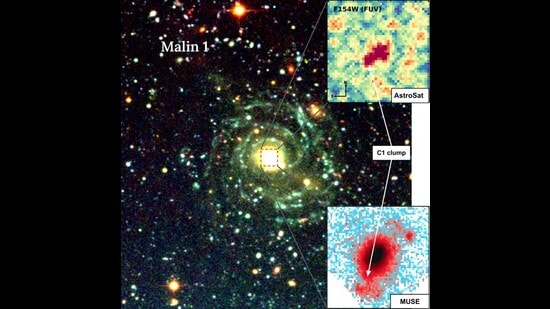
Astronomers have uncovered hidden evidence that Malin 1, the largest known low-surface-brightness galaxy in the universe, is quietly growing by swallowing smaller dwarf galaxies, a process that had remained invisible until now.
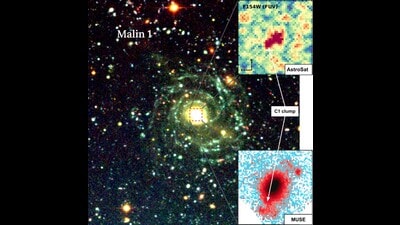 One clump, named C1, stood out as it was unusually bright and massive, something unexpected in an otherwise ‘quenched” region where star formation should have ended long ago. (HT)
The discovery comes from a recent study by scientists at the Inter-University Centre for Astronomy and Astrophysics (IUCAA), using data from India’s AstroSat and the Very Large Telescope (VLT) in Chile. The findings were published in the prestigious Astrophysical Journal Letters in December 2025.
Malin 1 has long puzzled scientists. Though its faint spiral arms stretch across an enormous distance, its central region looks calm and settled, similar to a lenticular galaxy where star formation has largely stopped. Even more curiously, Malin 1 appears isolated, showing no obvious signs of interaction with other galaxies. So how was it still evolving? The answer lay hidden in ultraviolet light.
While observing Malin 1 using the Ultraviolet Imaging Telescope (UVIT) onboard AstroSat, researchers detected several bright, young star-forming clumps near the galaxy’s centre. One clump, named C1, stood out as it was unusually bright and massive, something unexpected in an otherwise ‘quenched” region where star formation should have ended long ago.
This mystery prompted deeper investigation. Using the MUSE spectrograph on the VLT, the team studied how stars and gas in the region were moving. They found that the C1 clump was racing through space at nearly 150 km per second faster than its surroundings and showed signs of strong turbulence behaviour that did not match the calm environment of Malin 1’s core. Even more telling, the clump appeared only in specific velocity maps, strongly indicating that it did not originate within Malin 1 itself.
By analysing the chemical makeup and ages of the stars, researchers performed what they describe as “galaxy archaeology” Beneath the C1 clump lies an ancient population of stars more than six billion years old, typical of Malin 1’s core.
But above this old layer, the team found evidence of a recent burst of star formation, within the last 200 million years, involving extremely metal-poor, alpha-enhanced stars, a signature usually linked to gas from the early universe.
So, C1 is the remnant of a dwarf galaxy that fell into Malin 1 on a polar orbit. As it was torn apart, it delivered fresh, pristine gas that triggered new star formation. The dwarf galaxy was likely shredded into four or more fragments, all sharing similar ages and chemical fingerprints. Similar patterns were found in other UV-bright clumps, confirming that this was not an isolated event.
“These mergers are subtle and non-disruptive, which is why they were missed earlier,” said Manish Kataria, the study’s lead author and a Ph.D. student at IUCAA. “But they are crucial to understanding how giant low-surface-brightness galaxies like Malin 1 continue to grow.”
He further said, “Understanding how giant, low-surface-brightness (GLSB) galaxies like Malin 1 grow is crucial, as their enormous, faint structures challenge existing galaxy formation theories. New ultraviolet imaging from AstroSat/UVIT, combined with Multi-Unit Spectroscopic Explorer (MUSE) IFU spectroscopy, offers a powerful method to uncover the subtle, non-disruptive minor-mergers driving their hidden growth.”
His supervisor, Prof. Kanak Saha, recalled noticing the UV clumps years ago and suspecting they might have an external origin. “With MUSE data and careful analysis, that suspicion has now been confirmed,” he said.
The discovery challenges existing theories of galaxy formation, which struggle to explain how such massive, yet faint, galaxies evolve without dramatic collisions.
Malin 1, it turns out, is not as quiet as it seems. Instead of violent crashes, it is slowly and silently feeding on smaller galaxies, reshaping its core, and growing over cosmic time, one quiet bite at a time.