
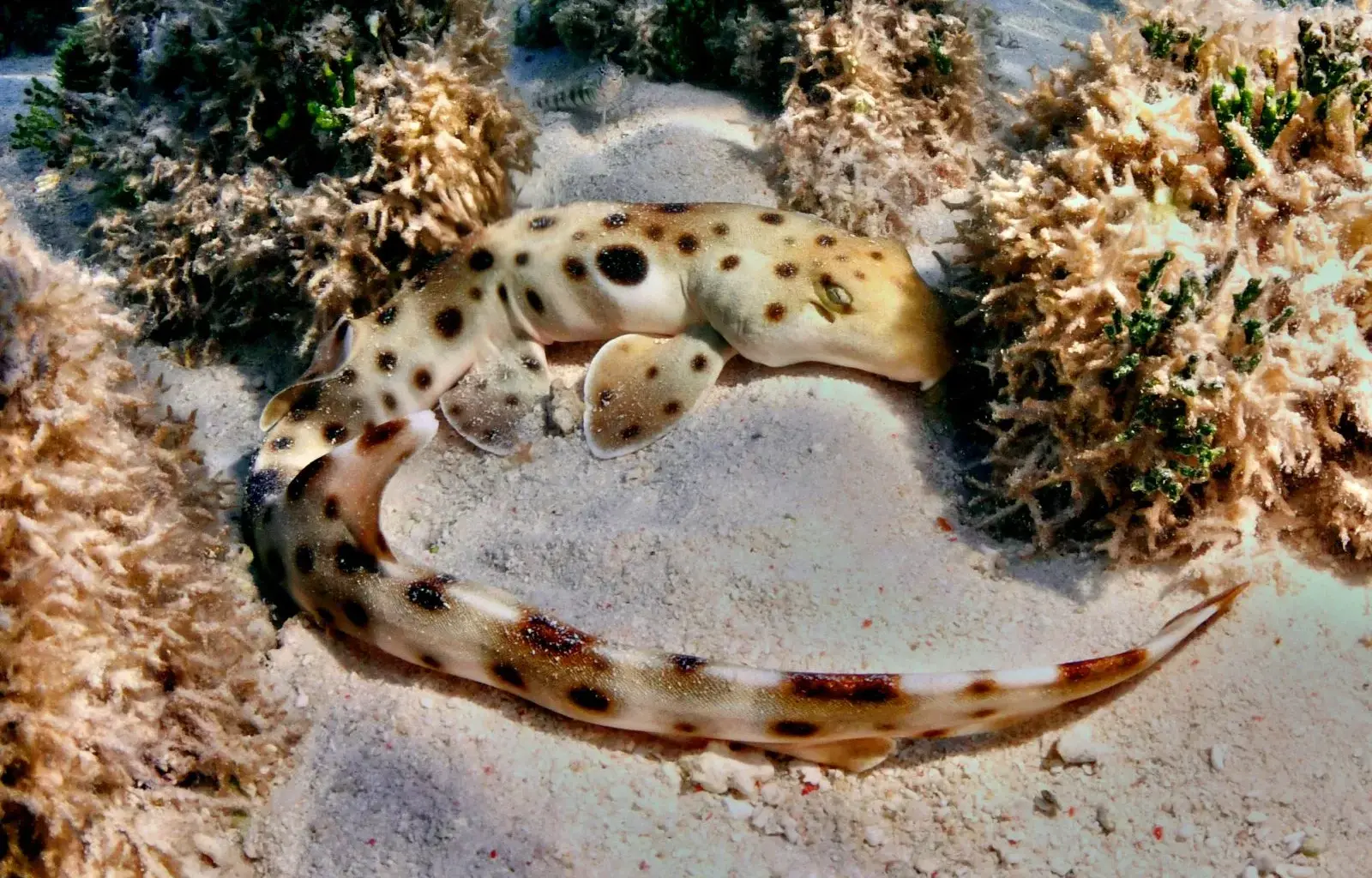
Sharks, rays, skates, and chimaeras are slow to reproduce, and scientists believe the process takes a lot of energy. But no one really knows how much, because it’s difficult to measure without harming the animals.
To learn more, researchers at James Cook University studied five female epaulette sharks, a small reef‑dwelling species, to see how their bodies and energy use change while laying eggs.
The study showed that epaulette sharks, often called “walking sharks” because they can shuffle along the seafloor, are able to reproduce and lay eggs without burning extra energy.
Professor Jodie Rummer said, “We expected that when sharks make this complex egg, their energy use would shoot up. But there was no uptick in energy use; it was completely flat.”
Polar fish prioritize growth over reproduction
Until now, scientists had never directly measured how much energy sharks use when laying eggs. To find out, researchers tracked oxygen use (a stand‑in for metabolic rate) in five female epaulette sharks over three weeks, covering the period before, during, and after egg laying. They also checked hormone levels and blood traits like hemoglobin and hematocrit.
The results were surprising: the sharks’ energy use didn’t change much at all during the 19‑day cycle. Hormone levels stayed steady, except for a brief spike in testosterone early on, and blood measures showed no meaningful shifts. In short, laying eggs didn’t seem to cost these sharks extra energy.
Lead author of the research and recent JCU PhD graduate, Dr Carolyn Wheeler, said, “Everything was remarkably stable, so this research challenges our fundamental assumptions about chondrichthyan fishes (sharks, rays, skates and chimaeras).”
“Under environmental stress, many species will choose between survival and reproduction, but the epaulette shark might be able to continue to produce eggs, even under such stressors.”
The impact of climate change on marine animals
“That’s encouraging, because healthy sharks equal healthy reefs.”
The results suggest that epaulette sharks can lay eggs without putting extra strain on their bodies or burning more energy. Future studies, especially under different seasonal conditions, could reveal more about how reproduction works in sharks and their relatives.
Importantly, this research is the first to directly measure the energy effects of egg‑laying in these fishes, and it challenges the long‑held belief that reproduction is always a heavy energy burden for them.
Journal Reference:
Carolyn R. Wheeler, Cynthia A. Awruch, John W. Mandelman, Jodie L. Rummer. Assessing the metabolic and physiological costs of oviparity in the epaulette shark (Hemiscyllium ocellatum). Biology Open. DOI: 10.1242/bio.062076