
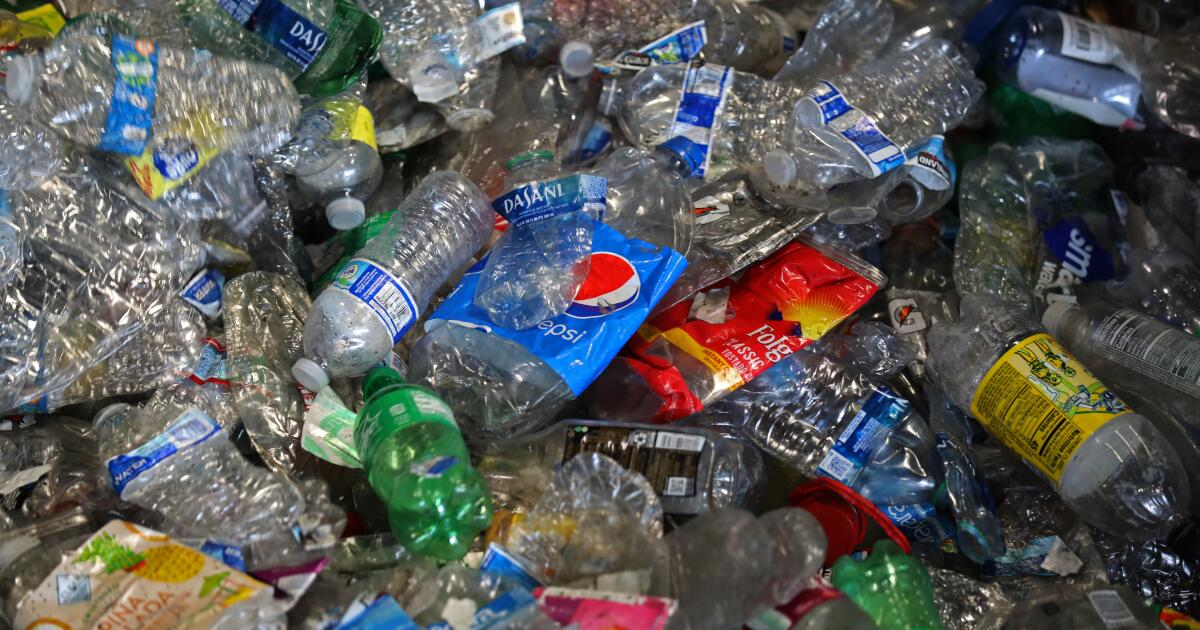
Last week’s report on California’s abysmal plastics recycling rates made it clear that the state, and individual citizens, need to do more to reduce the amount of the waste going into landfills, streams, rivers and the ocean.
In the report, the state’s waste agency said items like yogurt containers, shampoo bottles and restaurant takeout trays are being recycled at rates only in the low single digits. Colored shampoo and detergent bottles, made from polyethylene, or #1 plastic, are getting recycled at a rate of just 5%. Even plastic water bottles that are presumably more recyclable are being turned into new products at just 16%.
My colleague Susanne Rust reported those findings last week and she and another expert explained to me — despite Californians dutiful use of blue recycling bins — why so little plastic actually gets turned into new products.
The primary reason is that it’s cheaper and easier for businesses to use new plastic, material that is mostly made out of oil and natural gas. “The plastics industry is pretty happy to continue flooding the market with new kinds of plastic and plastic packaging,” Rust told me.
But the haulers can’t find many places that want the discarded plastic items. “For materials such as polypropylene, milk cartons, plastic film and polystyrene — nobody wants it,” Rust said. There either aren’t plants available to convert the plastic into new items, or the market for those items is weak.
A local recycling facility closes its doors
Last fall, one of the few California-based plants that recycled plastic, rPlanet Earth of Vernon, closed down. It had recycled the plastic known as polyethylene terephthalate or PET, that is used for bottles and many other products. But according to Recycling Today, the company faced low demand for its products while competing against a surge of low-cost imported material and cheap, oversupplied virgin plastic.
Debbie Raphael, former head of the Department of Environment for the city of San Francisco, said the bleak recycling figures confirm that “the real answer is to avoid plastic to begin with” and to turn to recycling only as a “ last resort.”
Going forward, Raphael said our policies need to focus on:
• Incentivizing or requiring reduction through systems like reuse/refill for packaging and the use of non-plastic materials for anything. Taxing the bad, investing in the good — it’s not a new concept.
• Banning the use/sale of plastics unless the industry invests in and makes use of sorting (i.e. collection) and recycling technology. “This direct investment is critical,” Raphael said, “otherwise industry just bales the mixed plastic waste and ships it to other countries and then claims it’s recycled.”
Raphael noted that some California cities, like Berkeley, are requiring reusable food utensils when people are dining in. In San Francisco, large events and festivals now must offer reusable cups.
Research has clearly shown how the proliferation of plastics has fouled waterways and oceans, making sea creatures sick and threatening human health.
How Europe mandated recycling at McDonald’s
Corporations have not shown tremendous enthusiasm for the best alternatives — like reusable beverage containers or serving dishes. Raphael sent me a picture of the reusable containers that McDonald’s uses to deliver some of its food in Germany.
“McDonald’s did not do this out of some sense of moral or environmental responsibility, they were mandated to do it,” she told me. “And they are fighting tooth and nail to avoid having to do this in the U.S.” When the reuse policies were rolled out in Europe, McDonald’s representatives said they believed recycling could be more effective and ultimately less polluting.
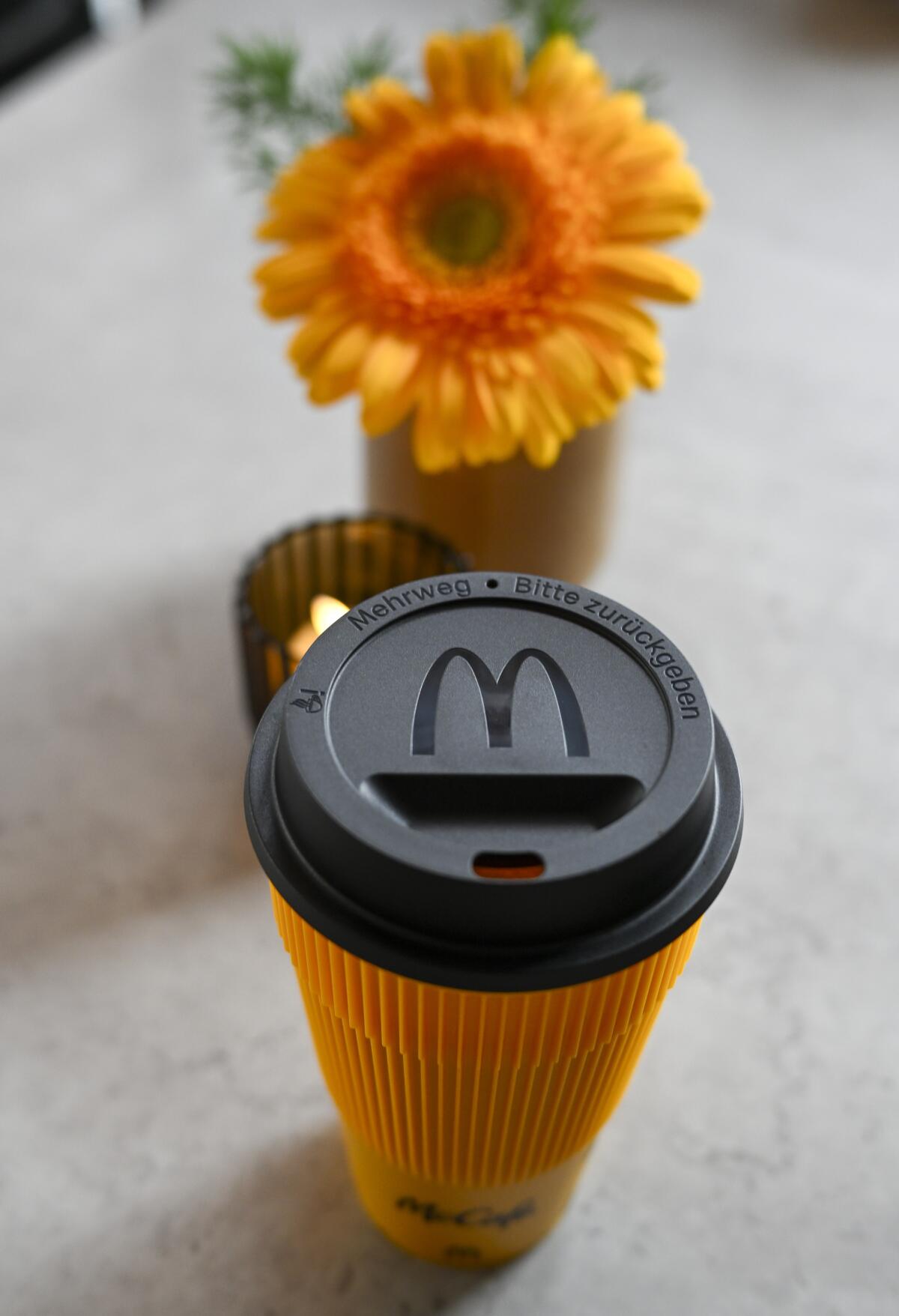
A reusable McDonald’s cup in Berlin in 2024.
(Jens Kalaene / dpa / Picture Alliance via Getty Images)
But consumers can do their part to drive down use of plastics. I found that my dry cleaner (after a couple of reminders) will return clean shirts and laundry to me, without the plastic wrapping. I try to bring my own cup to my local coffee joint, rather than use one of their plastic-lined throwaways, seemingly always fitted with a plastic lid. At the supermarket, some items I want — like honey and fruit juice — can be found in glass containers.
Even at my local burger joint, part of a regional chain, the counter folks oblige when I ask them if I can just reuse the plastic cup I got on my last visit. (I keep it in my car.) When I first asked about my one-man recycling mission, they looked a little confused. But they caught on quickly. Just like all of us can.
Today’s top stories 
A handgun is displayed for sale at Arcadia Firearm and Safety in 2023.
(Raul Roa / Los Angeles Times)
The Supreme Court appears likely to strike down a California law on guns in stores and restaurantsIconic LAX pylons are being removed. Here’s whyThe lighted pylons are being removed temporarily as part of a traffic improvement project.LAX’s Airfield and Terminal Modernization Program will reconfigure 4.4 miles of road and move cars previously queued along Sepulveda Boulevard onto dedicated, elevated roadways separate from local traffic. The roadways are expected to be open before the 2028 Summer Olympics, with full completion expected by 2030.Anti-Trump protesters held a ‘Free America’ walkout in downtown L.A. and across SoCalThe walkout across Southern California on Tuesday opposed Trump’s ICE raids, military presence in cities and attacks on transgender rights.It took place during work and school hours to demonstrate how labor and participation are often taken for granted.Rallies across downtown L.A., Pasadena, Long Beach and Santa Monica included student walkouts, with dozens from East L.A. high schools ditching class.A lawsuit against LAUSD alleges ‘overt discrimination’ against white studentsA group sued LAUSD claiming the district discriminates against white students by allocating more resources to schools where at least 70% of students are nonwhite.The lawsuit alleges that students in the targeted schools receive benefits that include smaller class sizes and that they also receive preferential treatment for entry into sought-after magnet programs.Critics of the lawsuit say the programs were established to address decades of discrimination in underresourced schools.What else is going onCommentary and opinionsThis morning’s must readOther must readsFor your downtime 
Ali Wong at the Wiltern for the Netflix is a Joke Festival
(Terence Patrick / Netflix)
Going outStaying inA question for you: What’s your biggest recycling gripe?
Email us at essentialcalifornia@latimes.com, and your response might appear in the newsletter this week.
And finally … your photo of the day 
The Los Angeles Unified School District All City Honor Marching Band performs during the Dr. Martin Luther King Jr. Day Parade in Los Angeles.
(Kayla Bartkowski / Los Angeles Times)
Today’s great photo is from Times photographer Kayla Bartkowski at the annual Martin Luther King Jr. Day parade in South Los Angeles.
Have a great day, from the Essential California team
Jim Rainey, staff reporter
Hugo Martín, assistant editor, fast break desk
Kevinisha Walker, multiplatform editor
Andrew Campa, weekend writer
Karim Doumar, head of newsletters
How can we make this newsletter more useful? Send comments to essentialcalifornia@latimes.com. Check our top stories, topics and the latest articles on latimes.com.